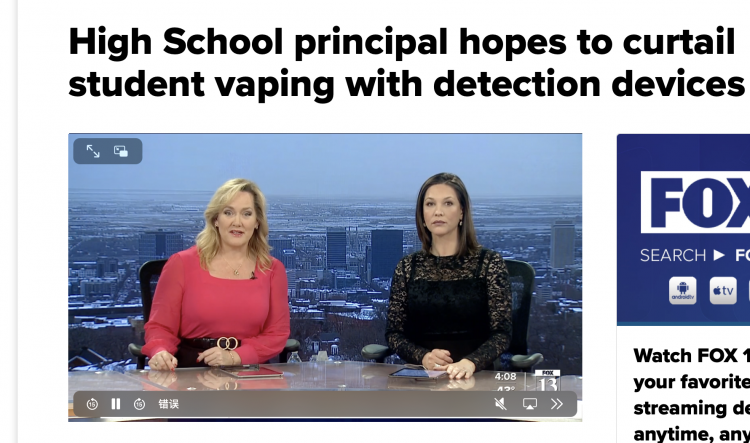
A 2019 Student Health and Risk Prevention (SHARP) survey conducted in Murray, Utah revealed that one in four students in the Granite School District have tried vaping.
The survey team further stated that 12.8% of these students are currently using e-cigarettes.
This is Michael Douglas' first year serving as principal of Katonah-Woodbury High School in the United States.
Douglas showed the journalist some of the electronic cigarette devices and pods that the school has confiscated so far this year.
Douglas stated, "This is only a quarter of the products we have confiscated.
Douglas stated that last academic year they wrote 31 citations for vaping, which essentially amounted to a slap on the wrist and a minor fine. They have seen the number of citations double year after year. He noted that at the midpoint of the current academic year, they have issued twice as many citations for vaping as they did at the same time last year. So far in the 2022-2023 academic year, they have issued 14 citations for vaping.
Douglas said, "We are finding various devices, not just nicotine e-cigarettes, but also tetrahydrocannabinol (THC) e-cigarettes, which is a huge problem.
This prompted Douglas to write letters in November to VUSE and JUUL companies, both of which produce and sell electronic cigarette products.
Douglas hopes to purchase electronic cigarette detection devices for the six bathrooms in the school. He stated that most students purchase electronic cigarettes there.
According to Douglas, they work like smoke detectors in bathrooms, and are very expensive but highly effective in mitigating the use of e-cigarettes.
Douglas said, "I hope these companies are earning trillions of dollars and helping us solve the problems they create.
Douglas received an email reply from representatives of VUSE last week, stating that the company will get in touch with him at the start of the new year.
At present, JUUL has not responded yet.
Disclaimer
This article is provided solely for professional research, industry discussion, and informational purposes. Any references to brands, companies, products, technologies, or policies are made for factual reporting and analytical purposes only, and do not constitute endorsement, recommendation, promotion, or advertising by 2Firsts.
Nicotine-containing products, including but not limited to cigarettes, e-cigarettes, heated tobacco products, and nicotine pouches, carry significant health risks. Readers are responsible for complying with all applicable laws and regulations in their respective jurisdictions, including age restrictions and access limitations.
The information contained in this article should not be regarded as investment, legal, medical, regulatory, or commercial advice. While 2Firsts strives to ensure the accuracy and reliability of its content, it does not assume liability for any direct or indirect loss arising from errors, omissions, inaccuracies, or reliance on the information contained herein.
This article is not intended for individuals below the legal age for accessing tobacco or nicotine-related information in their jurisdiction.
Copyright Notice
This article is either original content produced by 2Firsts or content reproduced, translated, summarized, or adapted from third-party sources with attribution where applicable. The intellectual property rights of the original content remain with 2Firsts or the respective original rights holders.
No individual or organization may copy, reproduce, distribute, republish, modify, translate, or otherwise use this content without prior authorization. Any unauthorized use may result in legal action.
For copyright-related inquiries, corrections, or removal requests, please contact: info@2firsts.com.
AI-Assisted Translation and Editing Notice
Portions of this article may have been translated, edited, or reviewed with the assistance of artificial intelligence tools to improve efficiency and readability. Due to the limitations of AI-assisted translation and editing, discrepancies, omissions, or inaccuracies may exist when compared with the original source.
Where applicable, readers are advised to refer to the original source for the most complete and accurate information. If you identify any errors or believe that any content infringes upon your rights, please contact us at info@2firsts.com, and we will review and address the matter promptly.