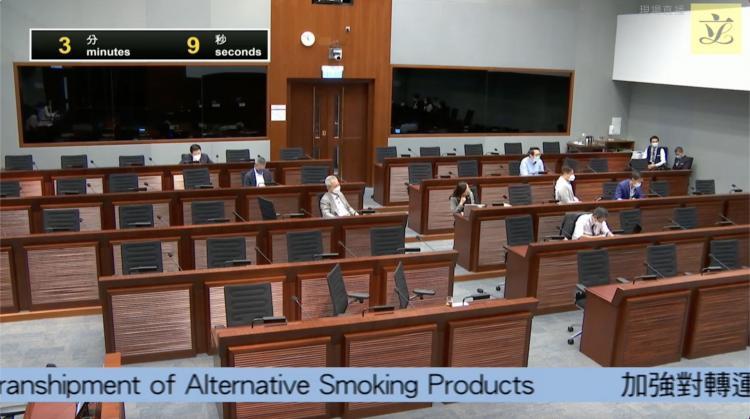
On November 28th, the Hong Kong Legislative Council's Committee on Economic Development held a public meeting to discuss the revised agenda for "Strengthening the Regulation of Alternative Smoking Products." The meeting focused on the impact of the COVID-19 pandemic on Hong Kong's status as an international logistics hub, and how lifting the ban on electronic cigarette air and sea transportation in 2023 could help mitigate the losses incurred since the ban was implemented on April 30th.
The Hong Kong government plans to open up the import and export of electronic cigarettes by sea and air.
The government has revealed plans for a new sea-air intermodal transport route. This will involve the establishment of a logistics park, known as the "Hong Kong International Airport Logistics Park", in Dongguan by the Hong Kong Airport Authority (HKAA). Another key component of this initiative is the "air-sea intermodal freight terminal" located at the Hong Kong airport. By completing inspection procedures in advance, mainland export products can be transported seamlessly by sea, and then smoothly integrated into the international air network of Hong Kong. This will eliminate the need for repetitive inspection procedures and facilitate expeditious transfer of goods to destinations around the world.
Since the beginning of 2022, the airport and seaport authorities have been implementing the seamless transport facilitation plan for goods, resulting in smooth operations. The government believes that this new approach can be applied to electronic cigarette products, as well as effectively prevent products from flowing into the local Hong Kong market during transportation.
This image shows a demonstration of sea-air transportation in Dongguan Logistics Port. The image is sourced from a screenshot of a live broadcast video on the official website of the Hong Kong Legislative Council.
During a legislative discussion, Ms. Chan Cheng-Sze, the Business Director of Hong Kong Airport Authority, confirmed that the experimental operation of sea-air intermodal transport between Dongguan Logistics Park and Hong Kong International Airport will be completed by December. She further stated that the intermodal monitoring measures would include the following:
Security checks such as X-ray scans are conducted at Dongguan Logistics Park, and goods are securely wrapped and stored for shipping to Hong Kong International Airport via sea. Information about the goods and airport codes are uploaded to the aviation management system in advance. Central cameras track the entire process in real time and alerts are set in case of any deviation from the set route. A centralized camera monitoring system is also set up at the Western Port in Hong Kong. Customs inspects the goods' seals and airport insurance companies conduct security checks before packing and air transportation to various destinations. Chen Zhengsi stated that this approach effectively monitors the e-cigarette shipping market and prevents these products from flowing into Hong Kong communities. Ms. Lin Yawen, the Deputy Secretary-General of the Hong Kong Transport and Logistics Bureau, emphasized that the implementation of sea and air transport as soon as possible is to alleviate the impact of the government's transit ban on the economy.
Lawmakers express strong doubts and urge the government to open up the transportation of goods via land and air routes.
Based on data presented by certain legislators during a Legislative Council meeting, prior to the ban, Hong Kong's annual direct air freight amounted to around 3 million tons, with approximately 330,000 tons being electronic cigarettes, accounting for one-tenth of total air freight. In the first quarter of 2022, alternative smoking products generated trade revenue of HKD 820 million, with 90% being transported through land-air intermodal transportation.
Several lawmakers, including Yi Zhiming, Chen Hengbin, and Lin Jianfeng, have expressed confusion and disappointment over the government's prioritization of the Dongguan air-sea intermodal transportation without first establishing legislation for land-air transfers. They have also questioned the actual effectiveness of the Dongguan logistics station in addressing the current transit difficulties in Hong Kong.
Legislator Yi Chi-ming speaks. Photo source: screenshot from live stream on the official website of the Hong Kong Legislative Council.
Legislator Yee Chih-ming cited survey data that showed since the ban on electronic cigarettes took effect on April 30th, the cargo volume at Hong Kong International Airport has decreased on average by 18% per month. Other legislators added that due to the necessity of balancing weight in air freight, the ban on e-cigarette shipments has affected other products as well. E-cigarettes, which are small in size but heavy in weight, can be combined with light but bulky products, effectively utilizing cargo space and reducing costs while improving shipping efficiency. The e-cigarette ban, along with the soaring transportation costs of light goods due to the inability to balance weights, has caused a sharp decrease in total cargo volume, resulting in an estimated loss of HKD 1 trillion.
Legislator Chen Hang-bun delivers a speech. Source: screenshot from the Hong Kong Legislative Council's live broadcast.
Legislator Chen Hengbin believes that the low volume of sea and air transportation cannot truly solve the problem of electronic cigarette transportation and the resulting serious losses in Hong Kong. He stated that sea and air transportation make up less than 5% of the transportation of electronic cigarettes, while land and air transportation account for over 90%. Creating legislation that only opens a small window rather than a large channel has no meaning. Instead, it is better to wait for more time to develop the most important plan for land and air transportation.
Legislator Lam Kin-fung speaks; Photo source: Screenshots from Hong Kong Legislative Council's live webcast.
Legislator Lin Jianfeng has raised concerns about the government's mechanism for assessing the risk of tobacco transportation. He stated that the government's tobacco legislation is essentially a ban on the use of alternative tobacco, not a ban on transportation. Prior to the ban, land and air transportation passed through Shenzhen. Can the legislative committee explain the specific risks associated with transportation? He believes that the government's considerations in drafting the legislation were not entirely comprehensive and that measures to mitigate losses were only taken after facing significant damages, which does not reflect forward-thinking legislation. Furthermore, there is no specific timeline for resolving related issues.
Ms. Lin Yawen, Deputy Secretary of Transport and Logistics Bureau, was seen presenting legislative documents in a live video broadcast from the Hong Kong Legislative Council website.
Ms. Lin Yawen responded by stating that compared to land-air transportation, air-air transportation is better regulated, despite the fact that land-air transportation accounts for 90% of Hong Kong's international transit. Discussions relating to how to carry out land-air transportation are ongoing, while sea-air transportation is seen as urgent in order to restore Hong Kong as a transit hub. Legislation is still being discussed, with land transportation being a priority, but a timeline is currently unavailable.
Legislator urges to save Hong Kong's status as an aviation hub.
As a key pillar of the Hong Kong economy, the trade and logistics industry accounts for around one-fifth of its total gross domestic product (GDP) and provides nearly 600,000 jobs. Despite the slowdown in global economic growth and the impact of the pandemic over the past two years, Hong Kong's air cargo volume has remained steady. However, since the ban on electronic cigarette shipments was implemented on April 30th, cross-border transportation by sea, land and air has come to a halt, causing substantial losses in the air freight industry due to weight distribution issues. This has also led to a slump in other related industries.
In early November, Hong Kong's Financial Secretary Paul Chan stated that the budget deficit for this year is expected to exceed HKD 100 billion (USD 12.7 billion), which is double the previous estimate. The government should address this issue by diversifying their income streams.
According to legislative documents, in 2021, the value of Hong Kong International Airport's foreign trade in cargo amounted to approximately HK$4.34 trillion. Electronic cigarettes alone accounted for almost one-tenth of the total weight of air cargo. The lifting of the ban on the transportation of electronic cigarettes is expected to help the government achieve a diversified fiscal revenue source and ease deficit pressure.
Legislators are urging the relevant departments to establish a law for land-air transportation as soon as possible, not just focusing on sea-air transportation (with Dongguan as the main starting point) but also on land-air transportation (with Shenzhen as the main starting point). They are calling for the implementation of substantial measures that can help Hong Kong regain its status as an international aviation hub and save its economy and air transport industry.
2FIRSTS will continue to track and report on the discussions and outcomes of this conference. Further updates will be available on the "2FIRSTSAPP". Scan the QR code below to download the app.
2FIRSTS will continue to bring you relevant news coverage.
To read more articles about Hong Kong's lifting of the e-cigarette transportation ban, please click on the topic link below.
Special Statement: [1] This article is limited to the discussion of the export business model of the electronic cigarette industry and does not involve any political issues; [2] Regarding the operation mechanism of the Legislative Council of Hong Kong, the legislative mechanism of the Special Administrative Region government and other issues, please refer to the "Basic Law of the Hong Kong Special Administrative Region of the People's Republic of China"; [3] The materials used in this article are from the Legislative Council of Hong Kong's official website, and when quoting, some content may have been omitted, so please refer to the original video.
Disclaimer
This article is provided solely for professional research, industry discussion, and informational purposes. Any references to brands, companies, products, technologies, or policies are made for factual reporting and analytical purposes only, and do not constitute endorsement, recommendation, promotion, or advertising by 2Firsts.
Nicotine-containing products, including but not limited to cigarettes, e-cigarettes, heated tobacco products, and nicotine pouches, carry significant health risks. Readers are responsible for complying with all applicable laws and regulations in their respective jurisdictions, including age restrictions and access limitations.
The information contained in this article should not be regarded as investment, legal, medical, regulatory, or commercial advice. While 2Firsts strives to ensure the accuracy and reliability of its content, it does not assume liability for any direct or indirect loss arising from errors, omissions, inaccuracies, or reliance on the information contained herein.
This article is not intended for individuals below the legal age for accessing tobacco or nicotine-related information in their jurisdiction.
Copyright Notice
This article is either original content produced by 2Firsts or content reproduced, translated, summarized, or adapted from third-party sources with attribution where applicable. The intellectual property rights of the original content remain with 2Firsts or the respective original rights holders.
No individual or organization may copy, reproduce, distribute, republish, modify, translate, or otherwise use this content without prior authorization. Any unauthorized use may result in legal action.
For copyright-related inquiries, corrections, or removal requests, please contact: info@2firsts.com.
AI-Assisted Translation and Editing Notice
Portions of this article may have been translated, edited, or reviewed with the assistance of artificial intelligence tools to improve efficiency and readability. Due to the limitations of AI-assisted translation and editing, discrepancies, omissions, or inaccuracies may exist when compared with the original source.
Where applicable, readers are advised to refer to the original source for the most complete and accurate information. If you identify any errors or believe that any content infringes upon your rights, please contact us at info@2firsts.com, and we will review and address the matter promptly.