Incheon City Takes Action to Prevent E-Cigarette Music Festival

Regulations by 2FIRSTS.ai
Sep.11.2024
Incheon City Takes Action to Prevent E-Cigarette Music Festival
Incheon City to block KECIA's e-cigarette music festival in October due to smoking concerns and has taken action.

According to a report from South Korean newspaper "Gyeonggi Daily" on September 10th, the Korean E-Cigarette Industry Association (KECIA) planned to hold an e-cigarette music festival in Songshan Park in Yongjong International City, Jung-gu, Incheon in October. However, Incheon City has decided to prevent the event from taking place and has already taken action.


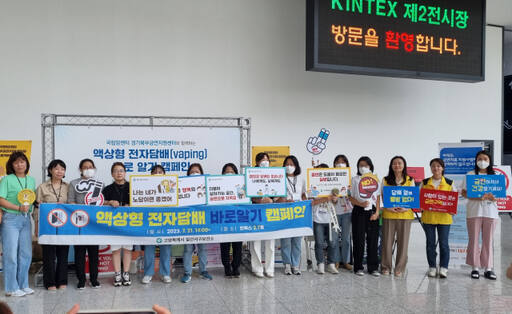
The Municipal Committee stated that KECIA originally planned to hold an e-cigarette music festival called "The 2024 vape-k hip hop Festival" from October 18th to 20th in Songshan Park in the central district. The festival had been held in KINTEX, Goyang City, Gyeonggi-do in 2018, 2019, 2022, and 2023, but due to opposition from health agencies and local communities, KINTEX in Goyang decided to no longer provide the venue. This year, the festival will be held in Suwon City in October. At the time, the organizers announced various liquid e-cigarette exhibitions and e-cigarette stunt performances.


In July of this year, Incheon city received notice from the Ministry of Health and Welfare for the first time, and after two months of self-inspection, ultimately decided to prevent the event from taking place. The city stated that the e-cigarette music festival could potentially lead to issues such as people smoking in smoke-free areas. Therefore, on the 11th, they will launch a promotional campaign with the city's education bureau, central district government, Incheon Smoke-Free Support Center, and other organizations in various locations to oppose the hosting of the e-cigarette music festival in Incheon city.


Officials from the city expressed, "Although the preparations for the event have not yet visibly begun, we plan to prevent the music festival from taking place in advance through promotional activities and other forms of opposition." In addition, a reporter from the "Keigi Daily" tried multiple times to contact KECIA to understand their position, but was unable to reach them.


We welcome news tips, article submissions, interview requests, or comments on this piece.

Please contact us at info@2firsts.com, or reach out to Alan Zhao, CEO of 2Firsts, on LinkedIn


Notice

1.  This article is intended solely for professional research purposes related to industry, technology, and policy. Any references to brands or products are made purely for objective description and do not constitute any form of endorsement, recommendation, or promotion by 2Firsts.

2.  The use of nicotine-containing products — including, but not limited to, cigarettes, e-cigarettes, nicotine pouchand heated tobacco products — carries significant health risks. Users are responsible for complying with all applicable laws and regulations in their respective jurisdictions.

3.  This article is not intended to serve as the basis for any investment decisions or financial advice. 2Firsts assumes no direct or indirect liability for any inaccuracies or errors in the content.

4.  Access to this article is strictly prohibited for individuals below the legal age in their jurisdiction.


Copyright


This article is either an original work created by 2Firsts or a reproduction from third-party sources with proper attribution. All copyrights and usage rights belong to 2Firsts or the original content provider. Unauthorized reproduction, distribution, or any other form of unauthorized use by any individual or organization is strictly prohibited. Violators will be held legally accountable.

For copyright-related inquiries, please contact: info@2firsts.com


AI Assistance Disclaimer


This article may have been enhanced using AI tools to improve translation and editorial efficiency. However, due to technical limitations, inaccuracies may occur. Readers are encouraged to refer to the cited sources for the most accurate information.

We welcome any corrections or feedback. Please contact us at: info@2firsts.com

Indiana’s Foreign-Made Vape Ban Takes Effect, Forcing Brands and Retailers to Adjust Supply Chains
A new Indiana law restricting the sale of foreign-made vape products has taken effect, requiring retailers to adjust inventory and sourcing practices. According to The Sun, WDRB and other reports, some local vape shops are reviewing product origins and supplier information to comply with the new requirements. The measure represents a broader shift in U.S. vape regulation, with oversight expanding beyond product authorization and sales rules toward manufacturing origin and supply-chain management.
Jul.24
South Korean Lawmaker Jeong Jin-wook Pushes Synthetic Nicotine Vape Probe, Highlighting Supply Chain and Tax Concerns
South Korean lawmaker Jeong Jin-wook has again called for stronger government action against liquid synthetic nicotine vape manufacturers and sellers, alleging that some businesses may have avoided regulation through product labeling changes and corporate restructuring. According to Newsworks, JNILBO and other Korean reports, Jeong has held his third press conference on the issue, calling for a government-wide investigation. The dispute involves whether synthetic nicotine products should fall under tobacco regulations, tax implications and supply-chain transparency. South Korean government agencies have previously said some estimates of potential tax losses cannot be verified due to limited sales data.
Jul.27
Germany Seizes 56 Pallets of Illegal Vapes, Probe Estimates €1.8 Million Tax Loss
German authorities have seized dozens of pallets of illegal disposable vapes in a criminal investigation, with the products estimated to have caused at least €1.8 million in tax losses. The case has also raised concerns over cross-border supply chains linked to unauthorized nicotine products entering the European market.
Jul.14
Vape Industry Group Loses Alabama Court Fight as State Tightens Rules on Imported Products
The Alabama Supreme Court affirmed a lower court’s refusal to issue a preliminary injunction blocking the state’s 2025 electronic nicotine delivery systems law, allowing rules requiring covered products to be U.S.-made or FDA-authorized to remain in effect.
Jul.10
From Nicotine Pouches to Soft Candy Forms: China Tobacco Hubei explores adjustable-release oral nicotine products
China-based China Tobacco Hubei Industrial Co., Ltd. has filed a patent application covering an oral nicotine product and its preparation method. The patent proposes a soft candy-shaped oral nicotine product containing nicotine ingredients, gelling agents, sweeteners and alkaline pH regulators. Through formulation adjustments and homogeneous or dual-layer structures, the technology aims to achieve different nicotine release profiles. The filing reflects exploration of new oral nicotine product formats and controlled nicotine delivery approaches.
Aug.06
South Korea’s New Vape Rules Raise Bar for E-Liquid Makers and China-Linked Supply Chains, Expert Says
South Korea’s new vape regulations are reshaping the e-liquid market, raising compliance requirements for manufacturers, retailers and overseas suppliers. In an interview with 2Firsts, Korean nicotine products specialist Sam Kim discusses licensing barriers, inventory impacts, China-linked supply chains, and emerging regulatory challenges around nicotine analogues, nicotine-free products and DIY mixing. The Korean case may offer broader insights as governments worldwide adapt to rapidly evolving nicotine products.
Jul.16