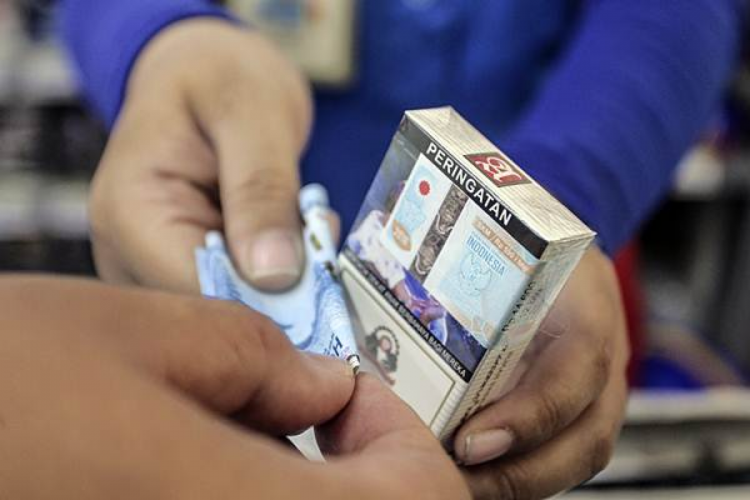
Starting from January 1, 2023, the Indonesian government has officially increased the consumption tax on tobacco cigarettes and electronic cigarettes.
The price of traditional tobacco cigarettes has increased by 10%, while the price of e-cigarettes has increased by 15%, leading to a surge in community retail prices for cigarettes.
According to the Finance Minister Sri Mulyani, there are several objectives behind raising the cigarette consumption tax.
One of the goals is to protect children from smoking and to control the consumption of tobacco products.
Here is a list of retail cigarette prices as of January 1st, 2023.
Mechanism Lavender cigarettes (SKM)
Each unit of group I costs a minimum of 2,055 Indonesian rupiah (approximately 0.9 Chinese yuan).
Group II is priced at a minimum of 1,255 Indonesian rupiah (approximately 0.55 yuan in Chinese currency).
2. SPM Cigarettes
The I group is willing to pay a minimum of 2,165 Indonesian rupiahs (approximately 0.95 Chinese yuan) per unit.
Each member of Group II costs at least 1,295 Indonesian rupiah (approximately 0.57 yuan).
This sentence does not make sense as it appears to be a product name or code without any context. Please provide more information or context so that it can be translated into standard journalistic English.
For the first group, the lowest amount is between 1,250-1,800 Indonesian rupiahs per piece (approximately 0.55-0.79 RMB).
Group II costs at least 720 Indonesian rupiahs (approximately 0.32 RMB).
The lowest value for Group III is IDR 605 (approximately RMB 0.27).
Hand-rolled filtered clove cigarettes (SKTF) or hand-rolled filtered white cigarettes (SPTF).
The minimum selling price is 2,055 Indonesian rupiahs per unit (equivalent to approximately 0.9 yuan in Chinese currency).
5. Kam Lan Mixture (KLM) Cigarettes with Frankincense and Rhubarb.
The lowest price in the first group is 860 Indonesian rupiah (approximately 0.38 yuan in Chinese currency).
Group II has a minimum of 200 Indonesian rupiah (approximately 0.09 yuan) per unit.
TIS stands for Tobacco Ingredients and Substances, which refers to the various components and additives used in the production of cigarettes.
The minimum selling price is IDR 55-180.
The types of cigarettes known as "leaf-shaped" or Klobot (KLB)
The minimum selling price is 290 Indonesian Rupiah.
8. Cathode Ray Tube (CRT)
The minimum selling price ranges from 495 to 5,500 Indonesian rupiah (approximately 0.22-2.43 yuan in Chinese currency).
Disclaimer
This article is provided solely for professional research, industry discussion, and informational purposes. Any references to brands, companies, products, technologies, or policies are made for factual reporting and analytical purposes only, and do not constitute endorsement, recommendation, promotion, or advertising by 2Firsts.
Nicotine-containing products, including but not limited to cigarettes, e-cigarettes, heated tobacco products, and nicotine pouches, carry significant health risks. Readers are responsible for complying with all applicable laws and regulations in their respective jurisdictions, including age restrictions and access limitations.
The information contained in this article should not be regarded as investment, legal, medical, regulatory, or commercial advice. While 2Firsts strives to ensure the accuracy and reliability of its content, it does not assume liability for any direct or indirect loss arising from errors, omissions, inaccuracies, or reliance on the information contained herein.
This article is not intended for individuals below the legal age for accessing tobacco or nicotine-related information in their jurisdiction.
Copyright Notice
This article is either original content produced by 2Firsts or content reproduced, translated, summarized, or adapted from third-party sources with attribution where applicable. The intellectual property rights of the original content remain with 2Firsts or the respective original rights holders.
No individual or organization may copy, reproduce, distribute, republish, modify, translate, or otherwise use this content without prior authorization. Any unauthorized use may result in legal action.
For copyright-related inquiries, corrections, or removal requests, please contact: info@2firsts.com.
AI-Assisted Translation and Editing Notice
Portions of this article may have been translated, edited, or reviewed with the assistance of artificial intelligence tools to improve efficiency and readability. Due to the limitations of AI-assisted translation and editing, discrepancies, omissions, or inaccuracies may exist when compared with the original source.
Where applicable, readers are advised to refer to the original source for the most complete and accurate information. If you identify any errors or believe that any content infringes upon your rights, please contact us at info@2firsts.com, and we will review and address the matter promptly.