Innokin Trine: A Revolutionary Rechargeable E-Cigarette with Replaceable Battery

Oct.12.2024
Innokin Trine: A Revolutionary Rechargeable E-Cigarette with Replaceable Battery
A new Innokin Trine e-cigarette with replaceable battery has hit shelves in Europe, meeting upcoming EU regulations.

Recently, 2Firsts noticed a new type of replaceable battery e-cigarette called the Innokin Trine being showcased at a tobacco exhibition in Dortmund. The product, launched by e-cigarette brand Innokin, is now available on e-cigarette retail websites in regions such as the UK and Germany. With its design allowing for replaceable batteries, the product complies with the new regulations set to be implemented by the EU Battery Directive in 2026.
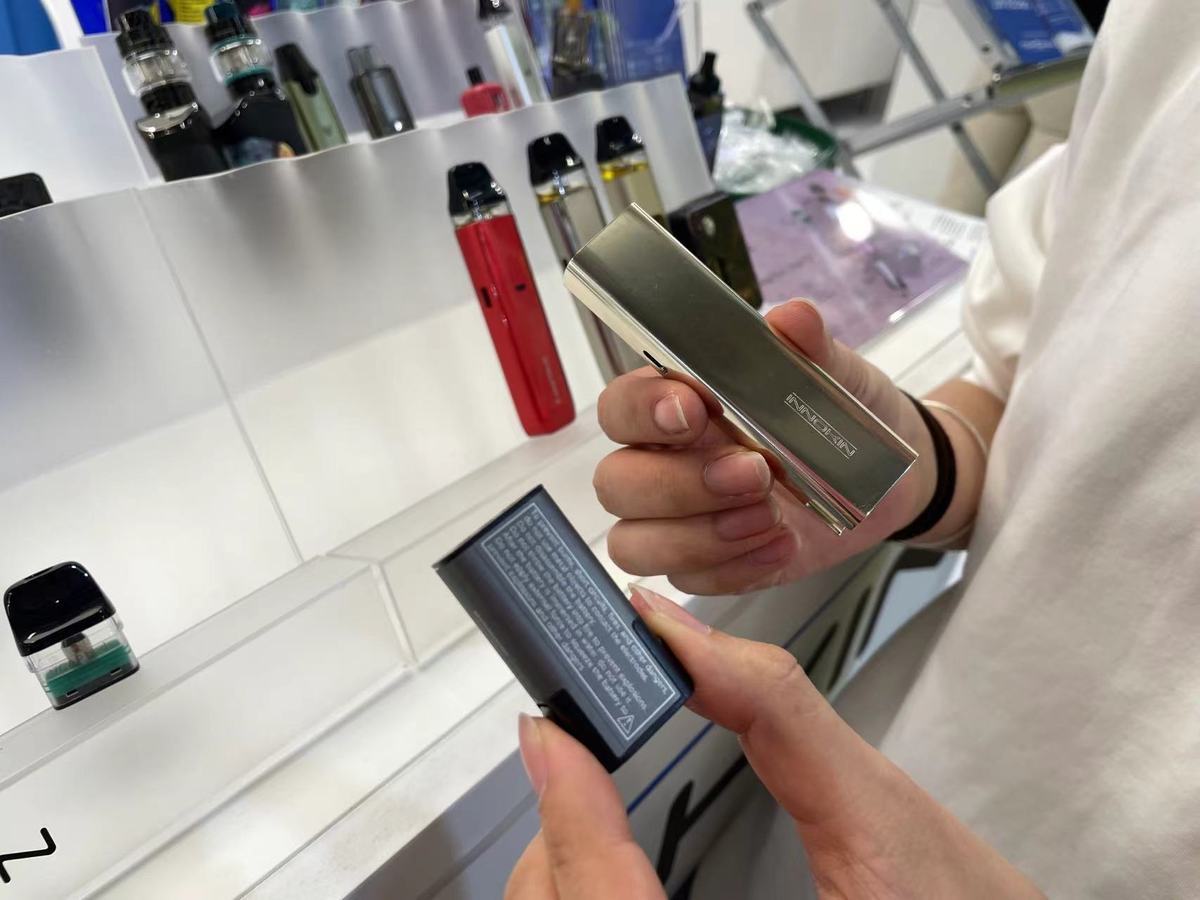
Innokin Trine: A Revolutionary Rechargeable E-Cigarette with Replaceable Battery
Innokin Trine displayed at the tobacco exhibition in Dortmund by Innokin|Image source: 2Firsts


At the recent Dortmund tobacco exhibition, several exhibitors showcased e-cigarette products with replaceable batteries, including disposable, pod-based, and open-system devices, in response to the EU's Battery Directive. According to the directive, by 2026, batteries in portable devices (such as disposable e-cigarettes) must be easily removable and replaceable by the user.
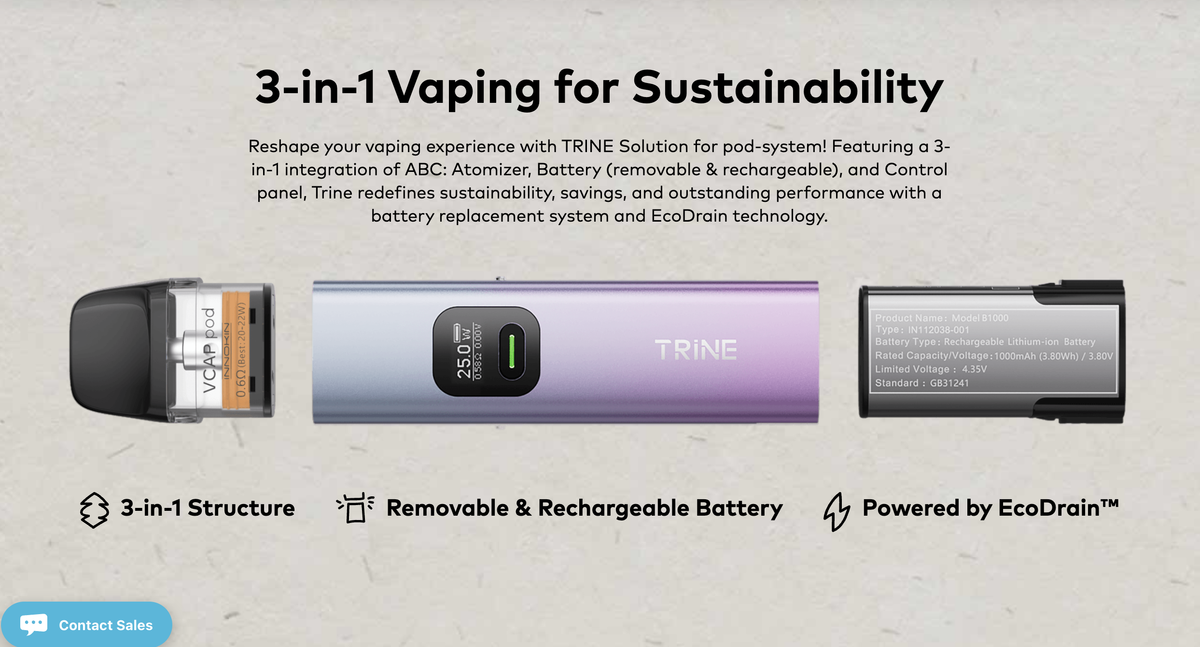
Innokin Trine: A Revolutionary Rechargeable E-Cigarette with Replaceable Battery
Image Source | Innokin Official Website


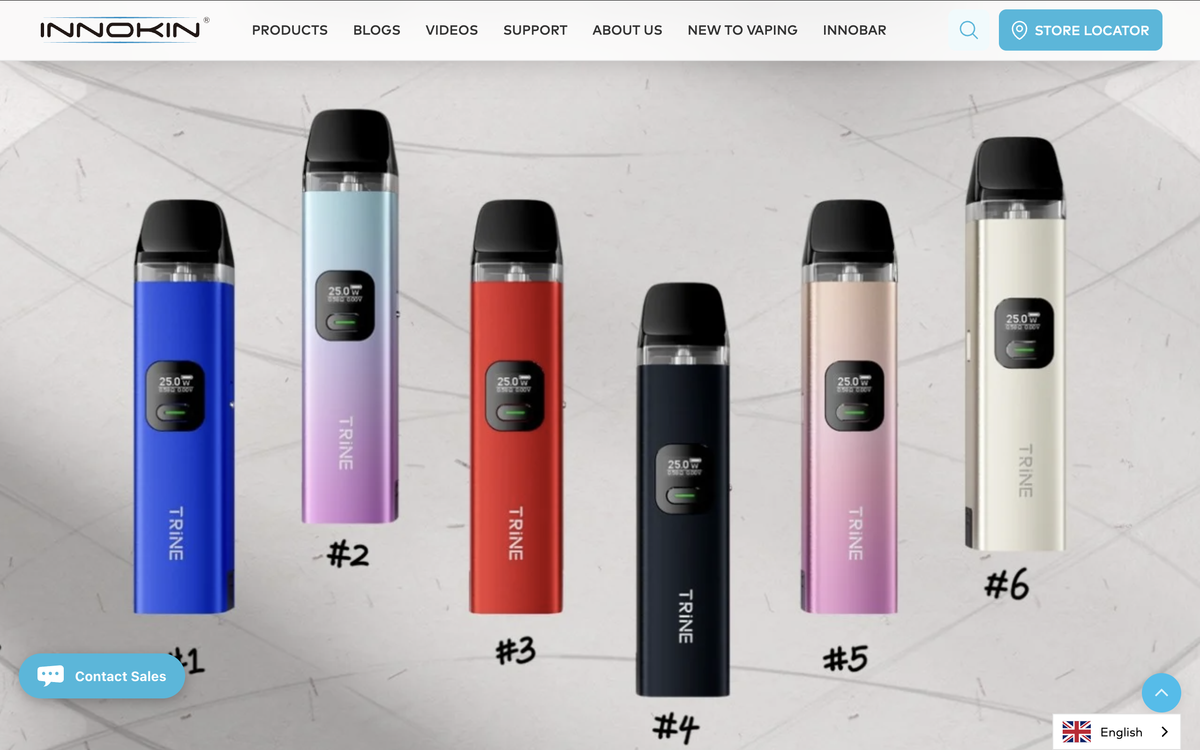
The newly released Innokin Trine, an open system product from Innokin, complies with the upcoming new regulations in the European Union market.
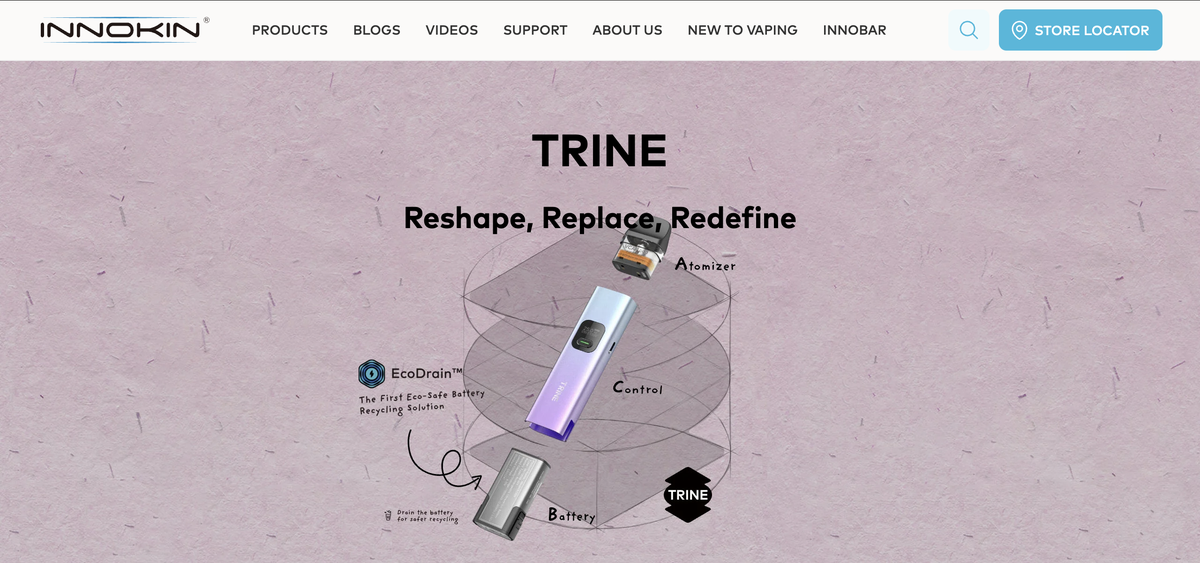
Innokin Trine: A Revolutionary Rechargeable E-Cigarette with Replaceable Battery
Image source | Innokin official website


In addition, the main feature of Trine is its "three-in-one" structure: atomizer, detachable and rechargeable battery, control panel. At the same time, the detachable and rechargeable battery enhances the convenience and durability of the device.
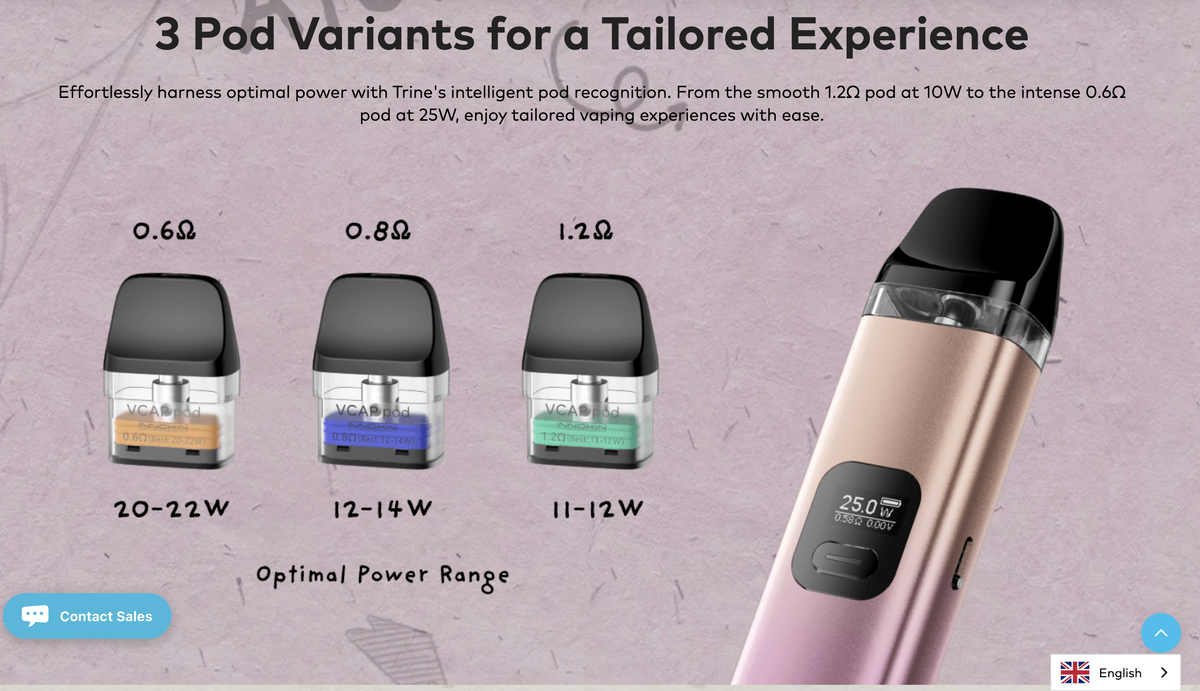
Innokin Trine: A Revolutionary Rechargeable E-Cigarette with Replaceable Battery
Image source | Innokin brand official website


Specifically, the main product features of the Innokin Trine include:


E-liquid capacity: 2ml Nicotine concentration: Supports a variety of nicotine levels in e-liquid Battery capacity: 1000mAh removable battery Charging method: Supports Type-C fast charging.


Trine Power Hub charger charges


Backup batteries can also be purchased separately.


Power Mode: Provides a power output of 6-25W.


Function: - Suction activation


Support mouth to lung (MTL) or limit direct lung (RDL) inhale mode.


Compatible with a variety of e-liquid flavors.


Charging indicator light


The screen displays operational parameters such as output power and battery level.


Currently, the Innokin Trine has been listed on the official website of the Innokin e-cigarette brand and major distributor websites in Europe, with a selling price of approximately 19.95 euros.


In addition to the Innokin brand, other brands such as GOLISI and NEXIONE have also introduced similar products with replaceable batteries. 2Firsts will continue to monitor the latest products and market trends in replaceable battery e-cigarette products, providing the public with accurate and authoritative industry information.


We welcome news tips, article submissions, interview requests, or comments on this piece.

Please contact us at info@2firsts.com, or reach out to Alan Zhao, CEO of 2Firsts, on LinkedIn


Notice

1.  This article is intended solely for professional research purposes related to industry, technology, and policy. Any references to brands or products are made purely for objective description and do not constitute any form of endorsement, recommendation, or promotion by 2Firsts.

2.  The use of nicotine-containing products — including, but not limited to, cigarettes, e-cigarettes, nicotine pouchand heated tobacco products — carries significant health risks. Users are responsible for complying with all applicable laws and regulations in their respective jurisdictions.

3.  This article is not intended to serve as the basis for any investment decisions or financial advice. 2Firsts assumes no direct or indirect liability for any inaccuracies or errors in the content.

4.  Access to this article is strictly prohibited for individuals below the legal age in their jurisdiction.


Copyright


This article is either an original work created by 2Firsts or a reproduction from third-party sources with proper attribution. All copyrights and usage rights belong to 2Firsts or the original content provider. Unauthorized reproduction, distribution, or any other form of unauthorized use by any individual or organization is strictly prohibited. Violators will be held legally accountable.

For copyright-related inquiries, please contact: info@2firsts.com


AI Assistance Disclaimer


This article may have been enhanced using AI tools to improve translation and editorial efficiency. However, due to technical limitations, inaccuracies may occur. Readers are encouraged to refer to the cited sources for the most accurate information.

We welcome any corrections or feedback. Please contact us at: info@2firsts.com

GSTHR Estimates 200 Million People Use Non-Combustible Nicotine Products as 28 Countries Show Rising Use Alongside Falling Smoking Rates
The Global State of Tobacco Harm Reduction, a project operated by Knowledge·Action·Change, estimates that about 200 million people worldwide use non-combustible nicotine products including vapes, heated tobacco, nicotine pouches and snus. Its 2026 report says use of these products rose alongside declining smoking rates in 28 countries it analyzed. The data do not establish that all 200 million users have quit smoking, nor do they prove a direct causal relationship. GSTHR also says regulatory restrictions on the products continue to expand in many markets.
Sep.10
Reynolds Puts Nearly 183,000 U.S. Contracted Outlets Under Age-Verification Rules, Covering 94% of Volume — Can It Shift an Unauthorized Vape Market?
Reynolds American says nearly 183,000 U.S. retail outlets are under contract, with its Retail Marketing Plan Contract covering about 94% of company volume and requiring point-of-sale age verification. The company combines those contracts with We Card, TruAge, NACS-linked infrastructure and POS integration, while enhanced Vuse Pro retail rules add ID scanning, purchase limits and stronger underage-sales accountability. The initial Vuse Pro rollout targets about 50,000 stores. The system is taking shape as unauthorized vapor products remain dominant in parts of the U.S. market: a 2026 study estimated they accounted for 69.4% of tracked brick-and-mortar e-cigarette dollar sales in December 2025.
Special Report
Oct.15
UK Directors Banned After 352,688 Vapes Imported From China Were Misdeclared as Medical Nebulizers in £15 Million Tax Case
The UK Insolvency Service said YSK Enterprises imported large quantities of vapes from China in 2023, with a shipment addressed to the company declared as medical nebulizers before Border Force found 352,688 vaping products. HMRC calculated nearly £15 million ($20.3 million) in unpaid VAT and customs duty, alongside about £437,000 in corporation tax. Two directors were disqualified for nine years. The case predates the UK's Vaping Products Duty, which will introduce vape-specific excise and duty-stamp requirements from October 2026.
Regulations
Sep.11
Australia Adds 6-Methylnicotine to Schedule 9 Prohibited Substances, Effective October 1
Australia's Therapeutic Goods Administration published a final decision on September 25 to classify 6-methylnicotine as a Schedule 9 prohibited substance under the Poisons Standard, effective October 1, 2026. TGA said the chemical has been reported in e-cigarette liquids sold in Australia and marketed as nicotine-free or nicotine alternatives, while evidence also indicates its use in preparations such as oral pouches. The government originally proposed a Schedule 7 classification but ultimately adopted the stricter Schedule 9 designation, citing acute toxicity, dependence risk, use in unapproved consumer products and misleading marketing.
News
Sep.29 by 2Firsts Perspectives
JUUL Purchasers Ask Ninth Circuit to Preserve Antitrust Classes in Case Over Altria’s $12.8 Billion Investment
Private antitrust litigation stemming from Altria's 2018 $12.8 billion investment for a 35% economic interest in JUUL is advancing before the U.S. Court of Appeals for the Ninth Circuit. Direct purchasers, indirect purchasers and indirect resellers of JUUL products filed answering briefs this week seeking to preserve class certifications granted by a California federal court in February. Altria and JUUL argue that individual consumers and large distributors differ too much in purchasing terms to remain in a single direct-purchaser class, while a separate dispute concerns whether California antitrust law can apply to indirect purchasers across 27 jurisdictions. A September trial has been put on hold during the appeal.
Sep.23
India Duty-Free Nicotine Pouch Sales Face Regulatory Test as ZYN, FOX Classification Remains Open
The Bombay High Court has ruled that airport duty-free shops are not exempt from India's domestic regulatory laws merely because they operate beyond the customs barrier, leaving in place a sales halt covering ZYN and FOX nicotine pouches at Mumbai's international airport. The court, however, did not determine that the products necessarily qualify as "drugs" under India's Drugs and Cosmetics Act. The retailers have four weeks to submit product information to the appropriate authorities, including CDSCO, which must complete its review within 30 days of receiving the submissions.
Sep.24