South Korea’s President Raises Safety Concerns Over Nicotine Alternatives at Cabinet Meeting

Dec.16.2025
South Korea’s President Raises Safety Concerns Over Nicotine Alternatives at Cabinet Meeting
South Korea’s Cabinet has approved an amendment to the Tobacco Business Act that legally classifies liquid e-cigarettes as tobacco products. Under the revision, any product containing tobacco or nicotine will fall under tobacco regulation, explicitly including synthetic nicotine vapes. The move addresses long-standing regulatory and taxation gaps.

Key Points


  • South Korea approved an amendment to the Tobacco Business Act at a Cabinet meeting;
  • Liquid e-cigarettes and synthetic nicotine products are now included in tobacco regulation;
  • Products released four months after enforcement will be subject to tobacco control and taxation;
  • Nicotine-free substitute products remain outside full regulatory coverage;
  • The government plans to strengthen safety assessments and inter-agency oversight mechanisms.


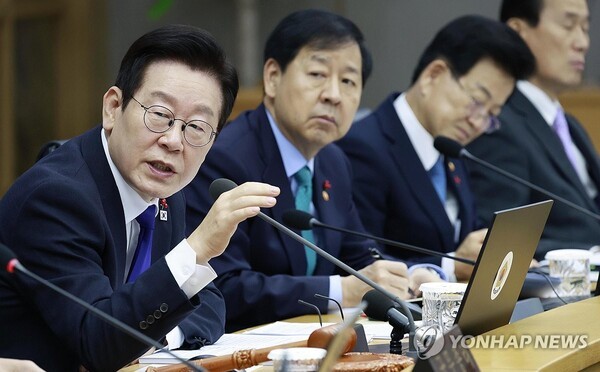
2Firsts, December 16, 2025 – According to Cheonji Ilbo, regulatory and taxation gaps surrounding nicotine substitute substances used in liquid e-cigarettes were formally raised during a South Korean Cabinet meeting on December 16.


The Cabinet, chaired by President Lee Jae-myung, reviewed and approved a promulgation bill amending the Tobacco Business Act. The amendment expands the definition of tobacco from products derived from tobacco leaves to all products containing tobacco or nicotine, thereby explicitly including synthetic nicotine liquid e-cigarettes.


Deputy Prime Minister and Finance Minister Koo Yun-cheol stated that products released four months after the law takes effect will be regulated and taxed as tobacco. However, he noted limitations in managing nicotine-free “pseudo-nicotine” products manufactured before enforcement.


Koo explained that while liquid e-cigarettes had been jointly managed by multiple ministries, nicotine-free products lacked a clear regulatory authority. The government plans to link the Chemical Products Safety Act with the Ministry of Food and Drug Safety’s human-use product oversight system to address regulatory gaps.


President Lee questioned whether substances performing nicotine-like functions should be allowed on the market without safety verification. The meeting also included reports of suspected lung injury cases linked to liquid e-cigarettes.


Previously, such products were not taxed due to their exclusion from tobacco classification. Koo said the legal amendment provides a clear basis for taxation.


Photo credit: Yonhap News Agency.


We welcome news tips, article submissions, interview requests, or comments on this piece.

Please contact us at info@2firsts.com, or reach out to Alan Zhao, CEO of 2Firsts, on LinkedIn


Notice

1.  This article is intended solely for professional research purposes related to industry, technology, and policy. Any references to brands or products are made purely for objective description and do not constitute any form of endorsement, recommendation, or promotion by 2Firsts.

2.  The use of nicotine-containing products — including, but not limited to, cigarettes, e-cigarettes, nicotine pouchand heated tobacco products — carries significant health risks. Users are responsible for complying with all applicable laws and regulations in their respective jurisdictions.

3.  This article is not intended to serve as the basis for any investment decisions or financial advice. 2Firsts assumes no direct or indirect liability for any inaccuracies or errors in the content.

4.  Access to this article is strictly prohibited for individuals below the legal age in their jurisdiction.


Copyright


This article is either an original work created by 2Firsts or a reproduction from third-party sources with proper attribution. All copyrights and usage rights belong to 2Firsts or the original content provider. Unauthorized reproduction, distribution, or any other form of unauthorized use by any individual or organization is strictly prohibited. Violators will be held legally accountable.

For copyright-related inquiries, please contact: info@2firsts.com


AI Assistance Disclaimer


This article may have been enhanced using AI tools to improve translation and editorial efficiency. However, due to technical limitations, inaccuracies may occur. Readers are encouraged to refer to the cited sources for the most accurate information.

We welcome any corrections or feedback. Please contact us at: info@2firsts.com

From Nicotine Pouches to Soft Candy Forms: China Tobacco Hubei explores adjustable-release oral nicotine products
China-based China Tobacco Hubei Industrial Co., Ltd. has filed a patent application covering an oral nicotine product and its preparation method. The patent proposes a soft candy-shaped oral nicotine product containing nicotine ingredients, gelling agents, sweeteners and alkaline pH regulators. Through formulation adjustments and homogeneous or dual-layer structures, the technology aims to achieve different nicotine release profiles. The filing reflects exploration of new oral nicotine product formats and controlled nicotine delivery approaches.
Aug.06
Global Tobacco Control Faces Regional Adaptation Test as Nicotine Markets Evolve, Asian Specialist Says
As e-cigarettes, heated tobacco products and nicotine pouches expand across global markets, a central question is gaining urgency: can tobacco control rely on a universal policy model? In an interview with 2Firsts, Asian public health and addiction medicine specialist Dr. Rashidi Mohamed bin Pakri Mohamed says Western experience remains relevant, but policies must be adapted to local culture, healthcare systems, enforcement capacity, illicit markets and clinical evidence.
Jul.08
BP, Marathon and Valero Warn U.S. Gas-Station Stores: Illegal Vape Sales Could Bring Heavy Fines and Card-Processing Limits
Fiserv and service station operators including BP, Marathon Petroleum and Valero have warned U.S. partners and gas-station convenience-store owners that selling illegal vapes could lead to heavy fines, breach brand agreements and even put stores’ card-processing access at risk, according to Reuters.
Regulations
Jul.07 by 2Firsts Perspectives
Product | Vapsolo Launches Sixer 180K, Introducing a 6-in-1 Architecture for Disposable Vapes
Vapsolo has launched the Sixer 180K, a flagship disposable vape built around a 6-in-1 architecture featuring six independent e-liquid tanks and six dedicated mesh coils. Alongside a claimed up to 180,000 puffs, the new device reflects a broader shift in disposable vape development from increasing puff counts toward modular hardware design and multi-flavor user experience.
Jul.03
UK Parliament Briefing Puts Vape Hardware Design and Materials in Regulatory Focus
The UK Parliament’s Parliamentary Office of Science and Technology (POST) has published a scientific briefing reviewing current evidence on the health effects of vape device components, including heating elements, power settings, metals, plastics, batteries and e-liquid ingredients, signalling growing regulatory attention to device design and whole-product systems beyond e-liquids, flavours and packaging.
Special Report
Jun.29
Former ATF Official’s Claims on Chinese Vape Companies and 6-Methyl Nicotine Fuel US Regulatory Debate
Former ATF Deputy Director Edgar Domenech has warned that some Chinese vape companies may be using 6-methyl nicotine, a nicotine analogue, raising new questions over how US regulators should classify emerging nicotine compounds.
Jul.13