Company | JTI Cambodia Awarded “Gold Tax Compliance Certificate”

Sep.05.2025
Company | JTI Cambodia Awarded “Gold Tax Compliance Certificate”
Japan Tobacco International (Cambodia) Co., Ltd. has received the “Gold Tax Compliance Certificate,” valid for 2026–2027, marking the company’s third consecutive recognition.

Key points


  • Consecutive award: Received the “Gold Tax Compliance Certificate” on July 31, 2025; this is JTI’s third straight recognition in Cambodia, valid for 2026–2027.
  • Management statement: JTI Cambodia General Manager Benjamin Cerletti said the company will continue to support economic development and cooperate in combating illicit trade to boost government tax revenues and national development.
  • Tax and customs honors: JTI was acknowledged as the 22nd-largest taxpayer in 2020 and the 34th in 2022; in 2024, it was recognized as a “Best Trader” by the General Department of Customs.
  • Community programs: Initiatives include promoting the “Tobacco Collective Mark,” rural reforestation and solar streetlights, clean water and housing support for vulnerable groups, and assistance for the elderly and people with disabilities.
  • Employer certification: JTI is the only company in Cambodia to be certified by the Netherlands-based Top Employers Institute for four consecutive years.


2Firsts, September 5, 2025 — Japan Tobacco International (Cambodia) Co., Ltd. (JTI) announced that it received the “Gold Tax Compliance Certificate” from the General Department of Taxation on July 31, 2025. The certificate covers the 2026–2027 period and represents the company’s third consecutive tax compliance recognition in Cambodia.


Company | JTI Cambodia Awarded “Gold Tax Compliance Certificate”


JTI Cambodia General Manager Benjamin Cerletti said the certification reflects the company’s long-standing commitment to transparency, accountability, and compliance. As a “Partner for Cambodia’s development,” the company will continue to support economic growth, improve the investment climate, and cooperate with relevant authorities to combat illicit trade in tobacco products, thereby increasing government revenues and contributing to national development.


According to the company, JTI Cambodia has consistently ranked among the country’s major taxpayers: it was acknowledged by former Prime Minister Hun Sen as the 22nd-largest taxpayer in 2020 and the 34th in 2022. In 2024, the company was also honored as a “Best Trader” by the General Department of Customs.


Beyond tax and customs compliance, JTI continues to invest in social responsibility initiatives, including promoting the “Tobacco Collective Mark” with the Ministry of Commerce; implementing rural reforestation and solar streetlight projects; providing clean water and housing support for vulnerable communities; and running assistance programs for the elderly and people with disabilities. JTI is also the only company in Cambodia to have been certified by the Netherlands-based Top Employers Institute as a “Top Employer” for four consecutive years.


We welcome news tips, article submissions, interview requests, or comments on this piece.

Please contact us at info@2firsts.com, or reach out to Alan Zhao, CEO of 2Firsts, on LinkedIn


Notice

1.  This article is intended solely for professional research purposes related to industry, technology, and policy. Any references to brands or products are made purely for objective description and do not constitute any form of endorsement, recommendation, or promotion by 2Firsts.

2.  The use of nicotine-containing products — including, but not limited to, cigarettes, e-cigarettes, nicotine pouchand heated tobacco products — carries significant health risks. Users are responsible for complying with all applicable laws and regulations in their respective jurisdictions.

3.  This article is not intended to serve as the basis for any investment decisions or financial advice. 2Firsts assumes no direct or indirect liability for any inaccuracies or errors in the content.

4.  Access to this article is strictly prohibited for individuals below the legal age in their jurisdiction.


Copyright


This article is either an original work created by 2Firsts or a reproduction from third-party sources with proper attribution. All copyrights and usage rights belong to 2Firsts or the original content provider. Unauthorized reproduction, distribution, or any other form of unauthorized use by any individual or organization is strictly prohibited. Violators will be held legally accountable.

For copyright-related inquiries, please contact: info@2firsts.com


AI Assistance Disclaimer


This article may have been enhanced using AI tools to improve translation and editorial efficiency. However, due to technical limitations, inaccuracies may occur. Readers are encouraged to refer to the cited sources for the most accurate information.

We welcome any corrections or feedback. Please contact us at: info@2firsts.com

Global Nicotine-Pouch E-Commerce Group Haypp Shuts Sweden’s Snusnetto Over Age Verification as Identity Checks Become Industry Infrastructure for New Nicotine Products
Sweden's Supreme Administrative Court has declined to hear an appeal over age verification for tobacco and nicotine products collected from parcel lockers, leaving in place a lower-court ruling that geo-located BankID verification is insufficient to securely verify the actual recipient. Haypp Group has stopped tobacco and nicotine sales through Snusnetto and is deploying a new system across its other Swedish e-commerce sites to verify the age of the person who actually opens the locker and receives the shipment. The change comes as age verification across next-generation nicotine products expands from purchase checks into retail, delivery and, for some e-cigarettes, device access itself.
Regulations
Oct.20
Germany's Four-Year Tobacco Tax Plan Heads to Parliament as BAT, JTI and PMI Push for Changes
Germany's parliament is scheduled to hold a first reading of amendments to the Tobacco Tax Act on September 24. The government plans annual tax increases from 2027 through 2030 covering cigarettes, heated tobacco, vaping liquids and other categories. It expects the reform to generate €756 million in additional revenue in 2027, rising to €3.589 billion in additional annual revenue by 2030. Ahead of the parliamentary debate, the German Association of the Tobacco Industry and Novel Products, or BVTE, launched the "Tabaksteuer mit Augenmaß" campaign backed by BAT, JTI, Philip Morris, Reemtsma and wholesale and retail groups.
Sep.23
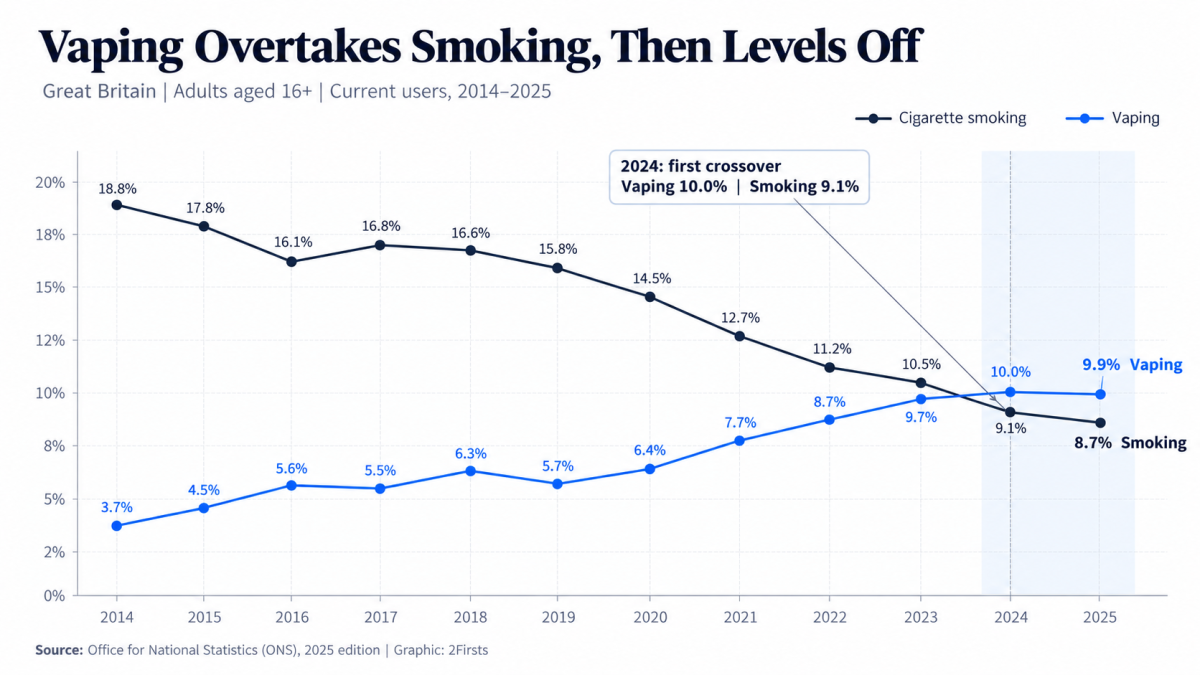
Latest UK ONS Data: Vaping Rate Edges Down to 9.9% in 2025, a Year After Overtaking Cigarette Smoking
Vaping prevalence in Great Britain edged down to 9.9% in 2025 from 10.0% in 2024, with the number of adult users holding at approximately 5.4 million for a second consecutive year, according to the Office for National Statistics (ONS). E-cigarette use had risen from 6.4% in 2020 to 10.0% in 2024, when it exceeded cigarette smoking prevalence for the first time. Cigarette smoking continued to decline to 8.7% in 2025, widening the gap to 1.2 percentage points. Daily vaping declined slightly, while usage among adults aged 25–34 increased despite falling rates in other age groups.
DATA
Oct.14
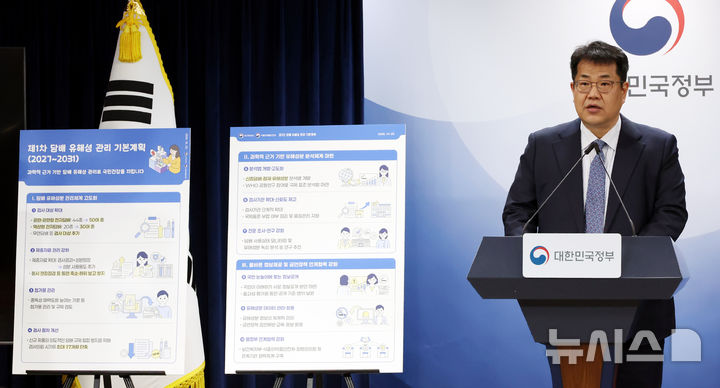
South Korea's Tobacco Plan Excludes 6-Methyl Nicotine as Customs Tightens Import Controls and Analog Liquid Imports Fall 83%
South Korea's government unveiled its first Tobacco Harm Management Basic Plan for 2027–2031 on October 29, 2026, proposing broader testing of vaping and heated tobacco products while excluding nicotine analogs such as 6-methyl nicotine. Synthetic nicotine came under tobacco regulation on April 24, and a June investigation found 6-methyl nicotine in 12 liquid inhalation products marketed as nicotine-free. Customs data released in September showed that imports of nicotine analog solutions fell 83.3%, from 12 metric tons in January–April to 2 metric tons in May–August. By September 20, imports had reached approximately 15 metric tons for the year, with 99.99% originating from China. Customs authorities have tightened pre-clearance testing and supply-chain documentation requirements, while the MFDS expects to complete its assessment of nicotine analog hazards by the end of 2026.
Regulations
Nov.04
India Duty-Free Nicotine Pouch Sales Face Regulatory Test as ZYN, FOX Classification Remains Open
The Bombay High Court has ruled that airport duty-free shops are not exempt from India's domestic regulatory laws merely because they operate beyond the customs barrier, leaving in place a sales halt covering ZYN and FOX nicotine pouches at Mumbai's international airport. The court, however, did not determine that the products necessarily qualify as "drugs" under India's Drugs and Cosmetics Act. The retailers have four weeks to submit product information to the appropriate authorities, including CDSCO, which must complete its review within 30 days of receiving the submissions.
Sep.24
2Firsts Hosts China Market Forum at InterTabac as Global Industry Attention to China’s Tobacco Sector Deepens
On September 16, 2Firsts hosted a China-focused industry forum during InterTabac in Dortmund, bringing together more than 30 participants from North America, Europe, India, South Korea and other markets. The session covered traditional tobacco, next-generation products, exports, technology, regulation and supply chains, while examining how China’s tobacco sector operates, where its transformation may be heading, and why its growing role matters increasingly to companies across the global tobacco and nicotine industry.
Sep.21