Korean Health Survey Reveals Increase in Youth E-cigarette Use

Jul.30.2024
Korean Health Survey Reveals Increase in Youth E-cigarette Use
The Ministry of Disease Control in South Korea reveals alarming rise in e-cigarette use among middle school students.

According to a report by KBS News, the Korea Disease Control and Prevention Agency announced the results of the adolescent health tracking survey conducted between 2019 and 2023 on July 30th. The data showed that the use of e-cigarettes significantly increased among middle school students when they entered high school.


The survey conducted by the Department of Disease Management targeted 5,051 sixth-grade elementary school students nationwide, tracking their health behavior changes over a period of ten years. This included smoking, drinking, dietary habits, physical activity, etc., with the aim of monitoring changes in their health behavior and identifying contributing factors.


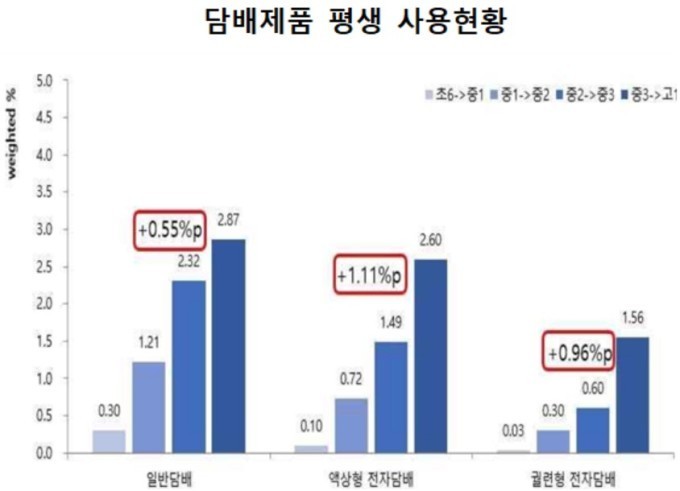
The survey results indicate that the proportion of students who first come into contact with tobacco products increases as students get older. Particularly during the transition from junior high to high school, there is a significant increase in the use of vaporizers and HNB-type e-cigarettes. The use of vapes increased by 1.11%, HNB-type e-cigarettes by 0.96%, and traditional cigarettes by 0.55%.


In terms of the usage of various tobacco products, e-cigarette users have the highest overlap rate. The overlap rate for HNB e-cigarettes is 98.5%, with 63.5% of users simultaneously using three products (traditional cigarettes + vape), and 35.0% simultaneously using two products (traditional cigarettes). The overlap rate for vape is 73.8%, with 26.6% of users simultaneously using three products and 47.2% simultaneously using two products.


The first products used by students when they start smoking are traditional cigarettes, vape, and HNB e-cigarettes in order. Among them, over 60% of students who first use vape currently mainly use traditional cigarettes.


The Department of Health stated that


According to research findings, vaping may potentially serve as a gateway product for teenagers to transition to traditional cigarettes. It is believed that there is a need to strengthen regulation of new tobacco and flavored tobacco products.


We welcome news tips, article submissions, interview requests, or comments on this piece.

Please contact us at info@2firsts.com, or reach out to Alan Zhao, CEO of 2Firsts, on LinkedIn


Notice

1.  This article is intended solely for professional research purposes related to industry, technology, and policy. Any references to brands or products are made purely for objective description and do not constitute any form of endorsement, recommendation, or promotion by 2Firsts.

2.  The use of nicotine-containing products — including, but not limited to, cigarettes, e-cigarettes, nicotine pouchand heated tobacco products — carries significant health risks. Users are responsible for complying with all applicable laws and regulations in their respective jurisdictions.

3.  This article is not intended to serve as the basis for any investment decisions or financial advice. 2Firsts assumes no direct or indirect liability for any inaccuracies or errors in the content.

4.  Access to this article is strictly prohibited for individuals below the legal age in their jurisdiction.


Copyright


This article is either an original work created by 2Firsts or a reproduction from third-party sources with proper attribution. All copyrights and usage rights belong to 2Firsts or the original content provider. Unauthorized reproduction, distribution, or any other form of unauthorized use by any individual or organization is strictly prohibited. Violators will be held legally accountable.

For copyright-related inquiries, please contact: info@2firsts.com


AI Assistance Disclaimer


This article may have been enhanced using AI tools to improve translation and editorial efficiency. However, due to technical limitations, inaccuracies may occur. Readers are encouraged to refer to the cited sources for the most accurate information.

We welcome any corrections or feedback. Please contact us at: info@2firsts.com

North Carolina Adds $1,000 Vape Shop Tax and 21+ Age Verification Requirement
North Carolina’s new state budget introduces additional vape retail regulations, including a $1,000 tax on vape shops and mandatory age verification requiring customers to be at least 21.
Jul.08
BAT Calls for Retailer Input in Future Nicotine Regulations
British American Tobacco (BAT) has called for stronger retailer involvement in shaping future nicotine product regulations in the UK, arguing that frontline market feedback should be considered during policy development. BAT said retailers provide direct insight into consumer behavior, market changes and regulatory implementation challenges. The comments come as the UK nicotine market undergoes regulatory changes, including the disposable vape ban, Vaping Products Duty and efforts to address illicit vape sales.
Jul.29
JTI Makes Third Bet on South Korea as Ploom AURA Enters a Market Dominated by lil and IQOS
Japan Tobacco International is stepping up its heated tobacco push in South Korea with Ploom AURA. Since its official launch in April 2026, the device's limited First Edition and Glacier White version have sold out, while distribution has expanded across Seoul, Incheon, Gyeonggi Province and airport duty-free channels. The rollout marks JTI's third major attempt to build a stronger heated tobacco position in South Korea, following Ploom TECH in 2019 and Ploom X Advanced in 2024. At the group level, JT plans to invest about ¥800 billion, approximately $5 billion, in reduced-risk products from 2026 through 2028, with heated products and Ploom identified as its primary investment priority.
Aug.14
PMI Q2 Call: ZYN Growth, IQOS Pricing and a Diverging Global Tobacco Market
Philip Morris International’s second-quarter earnings call offered new detail on its smoke-free strategy. Management said it would increase U.S. investment behind nicotine pouch brand ZYN, keep IQOS focused on volume before stronger pricing, and use SENTIA, DELIA, LEVIA, VEEV and ZYN to manage tax and regulatory pressure across Japan and Europe. Analysts from Goldman Sachs, Morgan Stanley, UBS and other firms also pressed PMI on profitability, market share, cigarette resilience and the durability of its global transformation over coming quarters.
Jul.24
UAE Sets Dh1-Per-ml Minimum Excise Price for Vape Liquids From Sept. 1 While Keeping 100% Tax Rate
The UAE Ministry of Finance will introduce a minimum excise price for e-liquids used in vaping and electronic smoking devices from September 1, 2026. The minimum excise price will be set at AED 1 per millilitre. The existing 100% excise tax rate will continue to apply to tobacco and electronic smoking products. The measure changes the minimum taxable base rather than the tax rate, with the UAE government saying it aims to establish unified tax standards, improve market compliance and prevent pricing loopholes.
Regulations
Aug.07 by 2Firsts Perspectives
PMI Q2 Revenue Rises 10.4% as IQOS and VEEV Expand, U.S. ZYN Growth Slows
Philip Morris International’s second-quarter net revenues rose 10.4% to a record $11.19 billion, as heated tobacco and e-vapor expanded across international markets. IQOS remained the main smoke-free growth engine, while VEEV shipments jumped 55.1%. In the United States, however, ZYN shipments increased just 1.8% and consumer offtake was broadly flat to slightly higher. Cigarette volumes also rose, showing that PMI’s transformation is advancing, but growth is becoming increasingly uneven across categories and markets.
PMI
Jul.22