Key takeaways
- Record revenue: Full-year 2025 consolidated net revenue reached KRW 6.58 trillion (about USD 4.47 billion), up 11.4% YoY, a record high.
- Operating profit: Full-year operating profit was KRW 1.35 trillion (about USD 920 million), up 13.5% YoY; Q4 operating profit rose 17.1% YoY.
- Overseas cigarette business (Global CC): The strongest performer, with revenue up 29.4% YoY and operating profit surging 53.8%; both volume and average selling price (ASP) hit record highs.
- Next-generation products (NGP): Revenue continued to grow; domestic NGP market penetration expanded to 22.8%, and KT&G’s stick market share reached 46.0%.
- Shareholder returns: Full-year dividend per share (DPS) increased to KRW 6,000 (about USD 4.08), up 11.1% YoY, and treasury shares worth KRW 533.9 billion (about USD 363 million) were canceled.
- 2026 outlook: Revenue is expected to grow 3%–5% and operating profit 6%–8%, while maintaining a shareholder return ratio above 100%.
2Firsts, Feb 5, 2026
According to KT&G’s official website on Feb 5, 2026, South Korean tobacco giant KT&G released its 2025 fourth-quarter and full-year financial results report. The report shows that driven by strong growth in its overseas cigarette business and a recovery in its real estate business, the company achieved double-digit growth in both full-year revenue and operating profit, setting a record-high performance.
Financial Performance Highlights
- Full-year revenue: Full-year 2025 consolidated revenue was KRW 6.58 trillion (about USD 4.47 billion), up 11.4% YoY.
- Full-year profit: Full-year operating profit was KRW 1.35 trillion (about USD 920 million), up 13.5% YoY; full-year net profit was KRW 1.09 trillion (about USD 740 million), down 6.1% YoY. Earnings per share (EPS) were KRW 10,143 (about USD 6.90).
- Fourth-quarter performance: Q4 revenue was KRW 1.71 trillion (about USD 1.16 billion), up 10.1% YoY; operating profit was KRW 248.8 billion (about USD 169 million), up 17.1% YoY; net profit was KRW 274.2 billion (about USD 186 million).
Performance by Business Segment
KT&G’s business mainly consists of three segments: tobacco (domestic and overseas conventional cigarettes, and NGP), health-functional food, and real estate.
1. Tobacco Business
The tobacco business was the core driver of performance growth, with full-year revenue reaching KRW 4.37 trillion (about USD 2.97 billion) and operating profit reaching KRW 1.16 trillion (about USD 790 million).
- Overseas conventional cigarettes (Global CC): The most outstanding performer. Not only did volume rise 11.2% YoY to a record high, but ASP also jumped 16.4%. This drove segment revenue up 29.4% YoY and operating profit up 53.8%. The company’s products now cover 145 markets worldwide.
- Domestic conventional cigarettes (Domestic CC): Due to factors such as earlier-than-usual stocking demand ahead of the Chuseok holiday, Q4 volume fell 11.6% YoY. However, supported by the launch of new products, KT&G’s domestic market share (SoM) further increased to 67.3% (66.7% in 2024).
- Next-generation products (NGP): Despite intense market competition, revenue continued to grow thanks to the launch of new devices and consumables. Full-year consumables volume reached 14.78 billion sticks. In the domestic market, KT&G’s NGP stick market share reached 46.0%, up 0.1 percentage points from the previous year.
2. Health-Functional Food
Affected by rising global consumer prices and weak market demand, full-year segment revenue declined to KRW 1.14 trillion (about USD 780 million).
However, through structural reforms—focusing on high-margin channels and products—the company achieved operating profit growth, with full-year operating profit reaching KRW 102.8 billion (about USD 70 million).
3. Real Estate
Benefiting from strong earnings from small- and mid-sized development projects and the one-off recognition of profit from the Seocho SPC project in Q4, segment revenue surged to KRW 712.6 billion (about USD 485 million). Operating profit turned positive to KRW 81.6 billion (about USD 55 million).
Shareholder Returns and Outlook
Shareholder returns: KT&G announced a 2025 DPS of KRW 6,000 (about USD 4.08), up 11.1% YoY, with a payout ratio of 58%. In addition, since 2024 the company has canceled about 14.3% of its shares (vs. end-2023 share capital), bringing the total shareholder return ratio (TSR) to 103.3%.
2026 guidance:
Targets: Revenue is expected to grow 3%–5% and operating profit 6%–8%.
Return commitment: The company committed to a total shareholder return ratio above 100% in 2026, plans to increase DPS, and to conduct share buybacks or cancellations of more than KRW 300 billion (about USD 204 million). In addition, it plans to provide additional shareholder returns by divesting non-core assets.
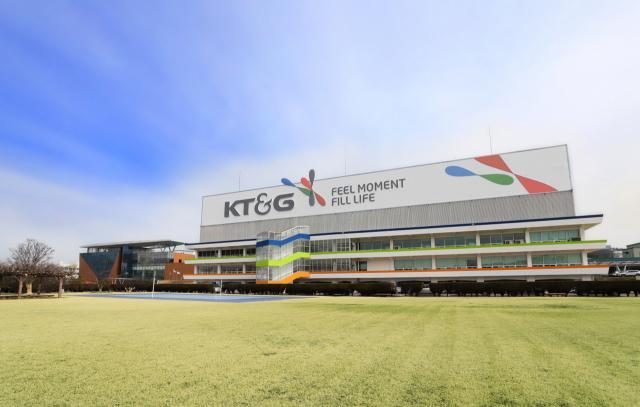
Image source: KT&G’s official website,
We welcome news tips, article submissions, interview requests, or comments on this piece.
Please contact us at info@2firsts.com, or reach out to Alan Zhao, CEO of 2Firsts, on LinkedIn
Notice
1. This article is intended solely for professional research purposes related to industry, technology, and policy. Any references to brands or products are made purely for objective description and do not constitute any form of endorsement, recommendation, or promotion by 2Firsts.
2. The use of nicotine-containing products — including, but not limited to, cigarettes, e-cigarettes, nicotine pouchand heated tobacco products — carries significant health risks. Users are responsible for complying with all applicable laws and regulations in their respective jurisdictions.
3. This article is not intended to serve as the basis for any investment decisions or financial advice. 2Firsts assumes no direct or indirect liability for any inaccuracies or errors in the content.
4. Access to this article is strictly prohibited for individuals below the legal age in their jurisdiction.
Copyright
This article is either an original work created by 2Firsts or a reproduction from third-party sources with proper attribution. All copyrights and usage rights belong to 2Firsts or the original content provider. Unauthorized reproduction, distribution, or any other form of unauthorized use by any individual or organization is strictly prohibited. Violators will be held legally accountable.
For copyright-related inquiries, please contact: info@2firsts.com
AI Assistance Disclaimer
This article may have been enhanced using AI tools to improve translation and editorial efficiency. However, due to technical limitations, inaccuracies may occur. Readers are encouraged to refer to the cited sources for the most accurate information.
We welcome any corrections or feedback. Please contact us at: info@2firsts.com