China’s E-Cigarette Exports USD 1.096 billion in November, UK and South Korea Offset U.S. Decline

Dec.22.2025
China’s E-Cigarette Exports USD 1.096 billion in November, UK and South Korea Offset U.S. Decline
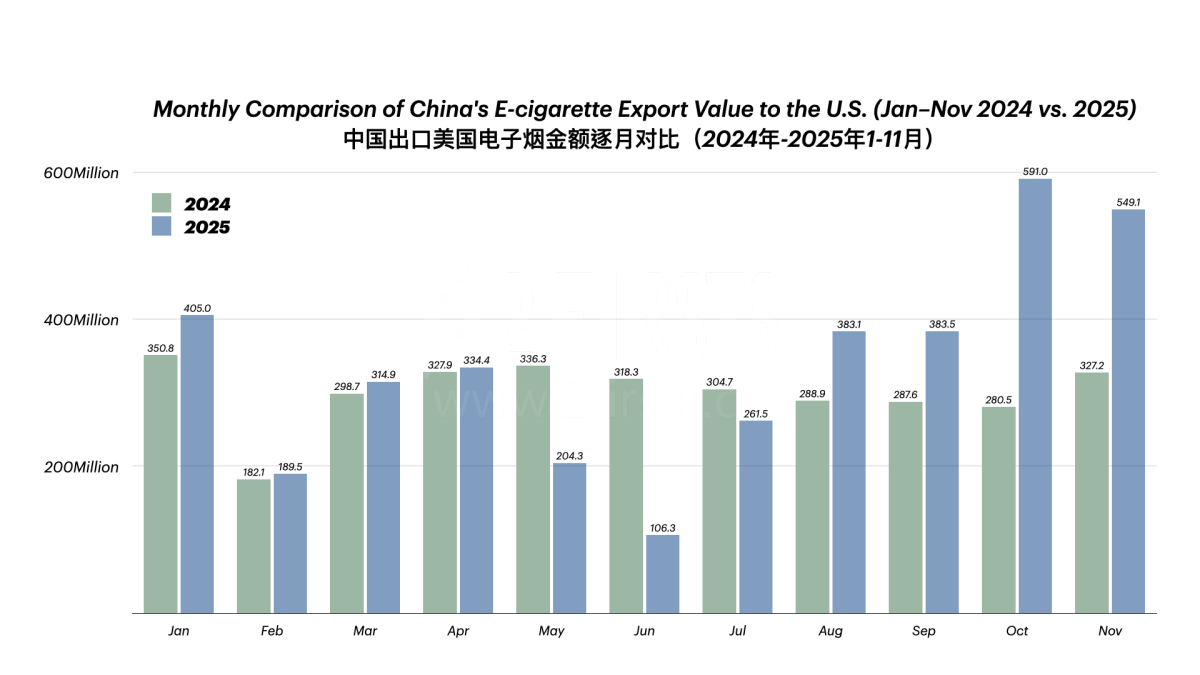
China’s e-cigarette exports edged lower in November 2025, totaling USD 1.096 billion, down 0.2% month-on-month, as a decline in shipments to the United States was partially offset by stronger demand from the United Kingdom, Germany and South Korea, according to data released by the General Administration of Customs of China.

2Firsts, December 22, 2025 —China’s e-cigarette exports remained at a relatively high level in November, following a strong rebound in October. While overall shipments softened marginally, export performance varied significantly across major destination markets.
 

China’s E-Cigarette Exports USD 1.096 billion in November, UK and South Korea Offset U.S. Decline
Cartography:2Firsts


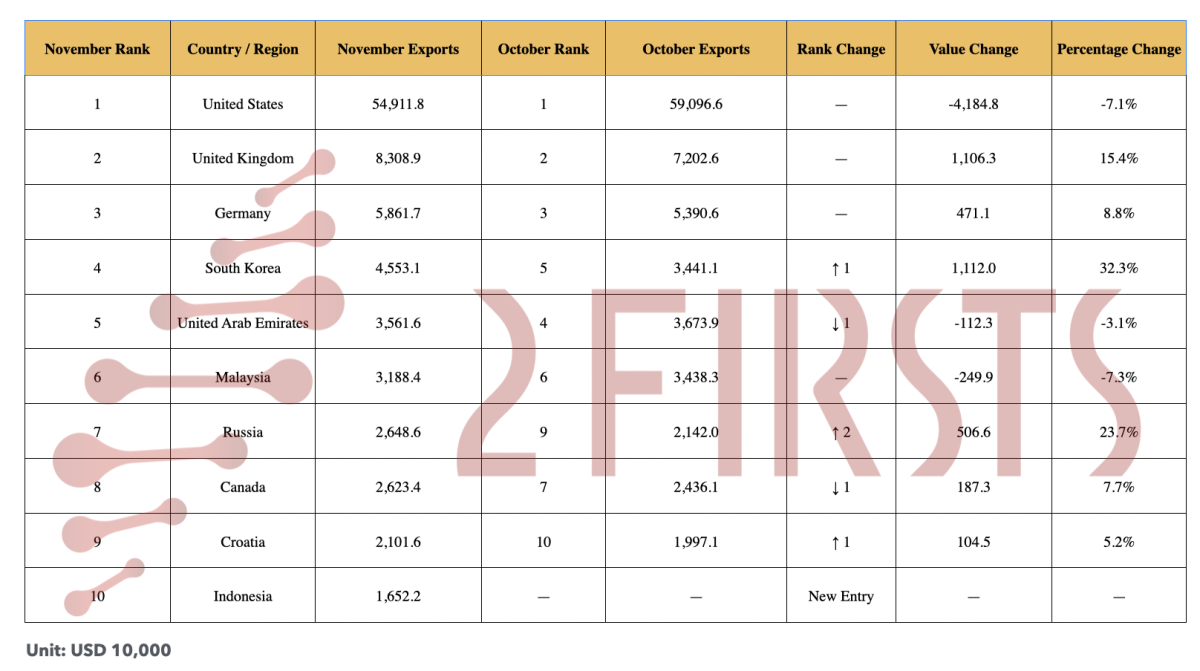
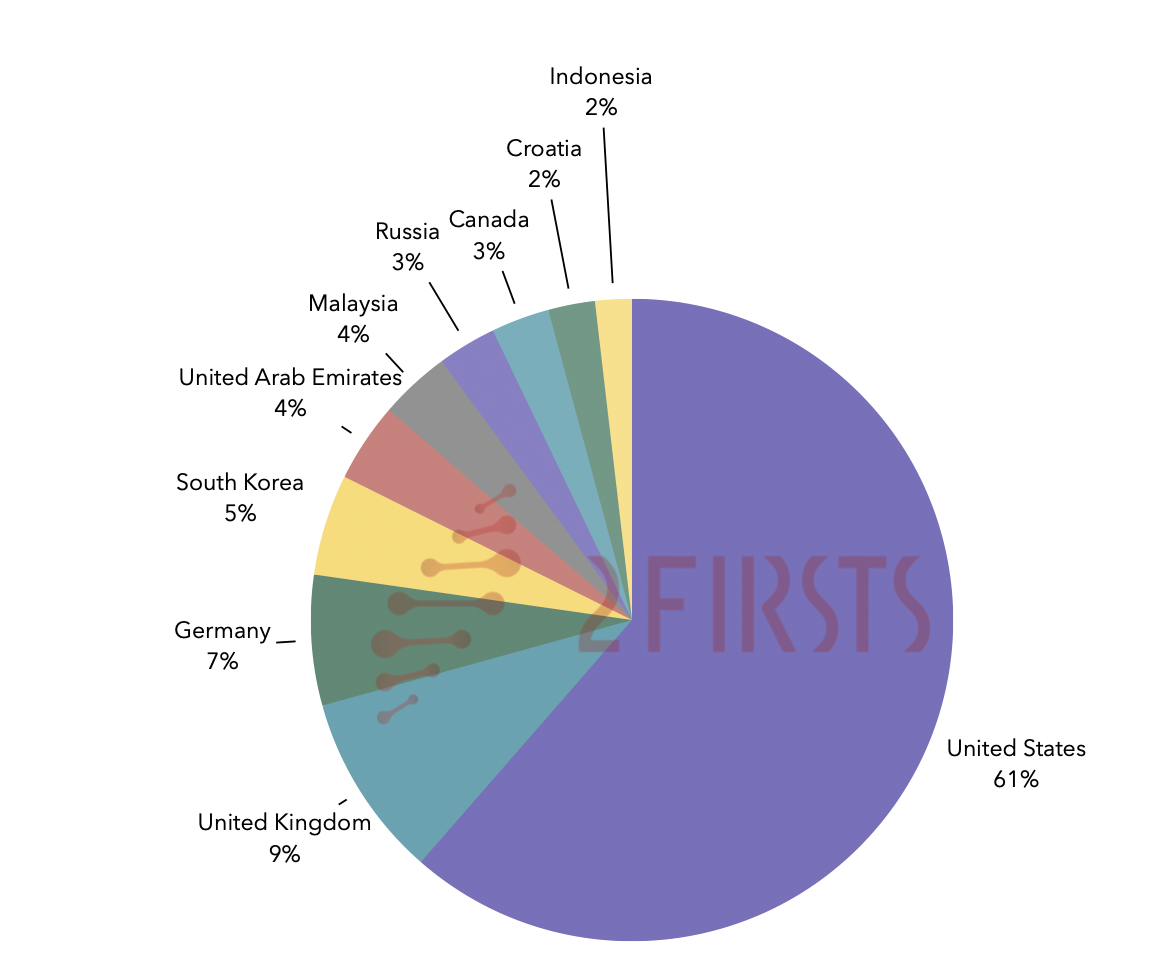
The United States, China’s largest e-cigarette export destination, recorded exports of USD 549.1 million in November, a 7.1% decrease month-on-month from October. Despite the decline, the U.S. continued to account for roughly half of China’s total e-cigarette exports, maintaining its dominant position in the export structure.


The United Kingdom ranked second, with exports rising to USD 83.1 million, marking a 15.4% month-on-month increase. Germany, the third-largest destination, also extended its recovery, with exports climbing 8.8% to USD 58.6 million, indicating sustained improvement in core European markets.


Among Asian and Middle Eastern markets, South Korea posted the strongest growth, with exports surging 32.3% month-on-month to USD 45.5 million, lifting it to fourth place in the monthly ranking. The United Arab Emirates recorded exports of USD 35.6 million, down 3.1% from October, while Malaysia fell 7.3% to USD 31.9 million, though both remained among the top destinations.


In other markets, Russia and Canada reported moderate increases, with exports reaching USD 26.5 million and USD 26.2 million, respectively. Croatia remained in the top ten for a second consecutive month, with exports totaling USD 21.0 million. Indonesia re-entered the top ten, posting exports of USD 16.5 million in November.


Export concentration eased slightly, with the top ten destinations accounting for 81.6% of total exports, down from 83.1% in October, suggesting a modest pickup in shipments to non-core markets.


Overall, November’s data show that China’s e-cigarette exports stabilized after October’s surge. While U.S. demand cooled, growth in the UK, Germany and South Korea helped cushion the impact, highlighting continued regional divergence in global e-cigarette demand.
 

China’s E-Cigarette Exports USD 1.096 billion in November, UK and South Korea Offset U.S. Decline


Related Reading:
 

China’s E-Cigarette Exports USD 1.096 billion in November, UK and South Korea Offset U.S. Decline

Image Source:China Customs 

We welcome news tips, article submissions, interview requests, or comments on this piece.

Please contact us at info@2firsts.com, or reach out to Alan Zhao, CEO of 2Firsts, on LinkedIn


Notice

1.  This article is intended solely for professional research purposes related to industry, technology, and policy. Any references to brands or products are made purely for objective description and do not constitute any form of endorsement, recommendation, or promotion by 2Firsts.

2.  The use of nicotine-containing products — including, but not limited to, cigarettes, e-cigarettes, nicotine pouchand heated tobacco products — carries significant health risks. Users are responsible for complying with all applicable laws and regulations in their respective jurisdictions.

3.  This article is not intended to serve as the basis for any investment decisions or financial advice. 2Firsts assumes no direct or indirect liability for any inaccuracies or errors in the content.

4.  Access to this article is strictly prohibited for individuals below the legal age in their jurisdiction.


Copyright


This article is either an original work created by 2Firsts or a reproduction from third-party sources with proper attribution. All copyrights and usage rights belong to 2Firsts or the original content provider. Unauthorized reproduction, distribution, or any other form of unauthorized use by any individual or organization is strictly prohibited. Violators will be held legally accountable.

For copyright-related inquiries, please contact: info@2firsts.com


AI Assistance Disclaimer


This article may have been enhanced using AI tools to improve translation and editorial efficiency. However, due to technical limitations, inaccuracies may occur. Readers are encouraged to refer to the cited sources for the most accurate information.

We welcome any corrections or feedback. Please contact us at: info@2firsts.com

PMI’s Smoke-Free Business Accounts for 43% of Net Revenues in Q1 as Full-Year EPS Guidance Rises
On April 22, 2026, Philip Morris International released its first-quarter 2026 results. The report showed net revenues of $10.146 billion, up 9.1% year on year; adjusted diluted EPS of $1.96, up 16.0%; and smoke-free products accounting for 43% of total net revenues. Based on first-quarter performance, the company raised its 2026 full-year adjusted diluted EPS forecast to $8.36 to $8.51, or $8.11 to $8.26 excluding currency.
Apr.23 by 2FIRSTS.ai
Exhibition Insights | Geek Bar Booth Shows Two Fasoul Heat-Not-Burn Devices in Prague
At EVO NXT 2026 in Prague, the Geek Bar booth displayed two Fasoul heat-not-burn devices, Q1 Pro and C2. One stressed compact size, screen-led control and dual modes, while the other highlighted faster heating, a larger battery and added functions. Both were presented as compatible with IQOS TEREA and SENTIA sticks. Materials on a website displaying Fasoul-related information also show recent market activity in Japan and Italy.
Apr.20 by 2FIRSTS.ai
Alberta Seeks to Add New Vape Restrictions on Top of Existing Tobacco Framework
A new Alberta bill aimed at reducing vaping rates, especially among young people, is moving into the legislative process. Bill 208, the Vaping Reduction Act, was introduced by United Conservative Party MLA Chelsae Petrovic and appears to build on the province’s existing Tobacco, Smoking and Vaping Reduction Act. Early reporting suggests the bill could focus on disposable vapes and impose further limits on youth access to vaping products.
Apr.15 by 2FIRSTS.ai
French Lawmakers Move to Extend Plain Packaging Rules to Vaping Product
French lawmakers Nicolas Thierry and Pierre Cazenave said on April 15 that they will file a cross-party bill to extend plain packaging requirements to vaping products. Under the proposal, unit packs and outer packaging for vaping products, including those without nicotine, would become neutral and standardized in the same way cigarette packs have been since 2017.
Apr.16 by 2FIRSTS.ai
FDA and NIH Release New Wave 8 Restricted-Use PATH Study Data Files
FDA’s Center for Tobacco Products and NIH’s National Institute on Drug Abuse announced that new Wave 8 restricted-use data files from the PATH Study are now available. The files contain data collected between January 2024 and December 2024, including questionnaire data, location characteristics data, and state identifier data.
Apr.17 by 2FIRSTS.ai
Special Report | Russian Vape Compromise Faces First Hurdles
Russia’s regional vape-ban model is facing early legal and political tests, as Perm Krai moves ahead before federal legislation is fully adopted. The case highlights uncertainty over regional authority, concerns from business groups about market fragmentation, and the risk that pressure against regional bans could revive calls for a stricter nationwide prohibition.
Industry Insight
May.28