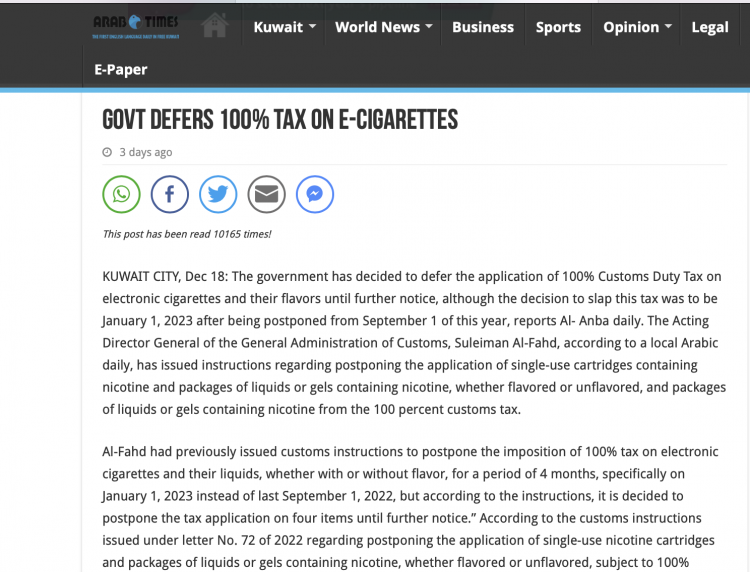
The Kuwaiti government has decided to delay the imposition of a 100% tariff on electronic cigarettes and their flavors. The imposition of this tariff has been postponed from September 1st of this year to January 1st, 2023.
According to a report in a local Arabic daily, Suleiman Fahd, the acting Director General of customs, has issued a directive to defer the use of disposable e-cigarettes containing nicotine, flavored or unflavored, liquid or gel containing nicotine, and the packaging of liquid or gel containing nicotine from a 100% customs duty.
Fahd has previously issued directives from the customs department to impose a 100% tax on electronic cigarettes and their liquids, regardless of flavor. The specific deadline for this has been postponed for 4 months, but according to the directive, the decision to delay the tax application for four items has been made until further notice.
According to a customs directive published in bulletin No. 72 of 2022, the list of prohibited items includes disposable nicotine e-cigarettes flavored for single use, disposable nicotine e-cigarettes without flavor, flavored liquid or gel packaging containing nicotine, and flavorless liquid or gel containers containing nicotine.
These instructions supplement the Other Customs Instruction No. 19 of 2022 issued in February 2022, which pertains to the introduction of the contents of Chapter 24, Article 2404 of the Unified Tariff Scheme applicable to Gulf Cooperation Council countries. This entails imposing a 100% tariff on packaged electronic cigarettes containing one-time nicotine flavor without taste, as well as on liquid or gel packs containing flavored or flavorless nicotine.
Disclaimer
This article is provided solely for professional research, industry discussion, and informational purposes. Any references to brands, companies, products, technologies, or policies are made for factual reporting and analytical purposes only, and do not constitute endorsement, recommendation, promotion, or advertising by 2Firsts.
Nicotine-containing products, including but not limited to cigarettes, e-cigarettes, heated tobacco products, and nicotine pouches, carry significant health risks. Readers are responsible for complying with all applicable laws and regulations in their respective jurisdictions, including age restrictions and access limitations.
The information contained in this article should not be regarded as investment, legal, medical, regulatory, or commercial advice. While 2Firsts strives to ensure the accuracy and reliability of its content, it does not assume liability for any direct or indirect loss arising from errors, omissions, inaccuracies, or reliance on the information contained herein.
This article is not intended for individuals below the legal age for accessing tobacco or nicotine-related information in their jurisdiction.
Copyright Notice
This article is either original content produced by 2Firsts or content reproduced, translated, summarized, or adapted from third-party sources with attribution where applicable. The intellectual property rights of the original content remain with 2Firsts or the respective original rights holders.
No individual or organization may copy, reproduce, distribute, republish, modify, translate, or otherwise use this content without prior authorization. Any unauthorized use may result in legal action.
For copyright-related inquiries, corrections, or removal requests, please contact: info@2firsts.com.
AI-Assisted Translation and Editing Notice
Portions of this article may have been translated, edited, or reviewed with the assistance of artificial intelligence tools to improve efficiency and readability. Due to the limitations of AI-assisted translation and editing, discrepancies, omissions, or inaccuracies may exist when compared with the original source.
Where applicable, readers are advised to refer to the original source for the most complete and accurate information. If you identify any errors or believe that any content infringes upon your rights, please contact us at info@2firsts.com, and we will review and address the matter promptly.