Key Points
Haypp subsidiary Snusbolaget Norden AB stopped tobacco and nicotine sales through Snusnetto on October 19, 2026, affecting about 500 active customers, with no material impact on group financial performance expected.
Sweden's Supreme Administrative Court declined to hear the appeal, leaving in place a ruling that geo-located BankID verification is insufficient on its own to securely verify the actual parcel-locker recipient.
Haypp is deploying a system developed over about six months to verify the age of the person who physically opens the locker and collects the shipment, with full rollout planned during October 2026.
The move comes amid a wider shift in nicotine age-verification technology: Reynolds has nearly 183,000 contracted U.S. retail outlets subject to point-of-sale age-verification requirements, while FDA has begun considering device-access restrictions in flavored ENDS authorization decisions.
2Firsts
October 20, 2026
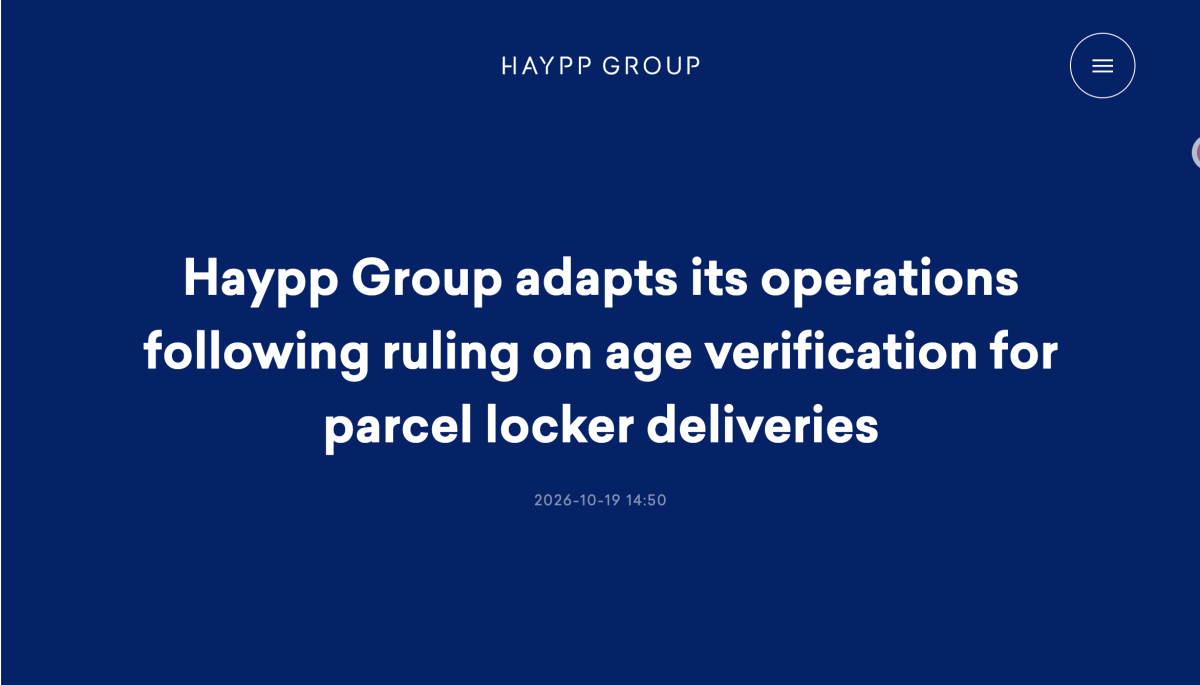
Haypp Group said on October 19 that Sweden's Supreme Administrative Court had declined to grant leave to appeal in a case involving age verification for tobacco and nicotine products collected from parcel lockers, leaving in place an earlier Administrative Court of Appeal ruling.
The case concerned age-verification procedures used by Haypp subsidiary Snusbolaget Norden AB. The lower-court ruling found that geo-located BankID verification at a parcel locker was insufficient to establish that the person who actually opened the locker and took possession of the products had been securely age-verified.
Haypp subsequently stopped tobacco and nicotine sales through Snusnetto and began deploying a new parcel-locker verification system across its other Swedish e-commerce operations.
Haypp Shuts Snusnetto, Affecting About 500 Active Customers
Snusbolaget Norden AB has stopped all tobacco and nicotine sales through Snusnetto and notified the relevant Stockholm licensing authority of the change.
Haypp said the move affects about 500 active Snusnetto customers and is not expected to have a material impact on group financial performance.
The broader operational change is taking place across Haypp's other Swedish e-commerce sites.
The company said it is rolling out a new parcel-locker age-verification solution that has been under development for about six months. The system is designed to verify the age of the person who actually opens the locker and collects the shipment, with full implementation planned during October 2026.
Orders delivered through traditional staffed collection points are unaffected because personnel verify age when handing over the parcel.
Haypp currently operates through 11 e-commerce brands across several European markets, the U.S. and Saudi Arabia, serving more than 1.1 million consumers. The immediate financial effect of closing Snusnetto is therefore limited, while the wider change concerns the group's Swedish fulfillment and age-verification infrastructure.
Verifying the Buyer No Longer Proves the Actual Recipient Was Verified
The dispute stems from a longer-running case involving Haypp's Swedish tobacco-sales permit and age-control procedures.
In 2024, a Stockholm licensing authority revoked Snusbolaget Norden AB's permit to sell traditional tobacco products. The case included concerns over age-control procedures at delivery as well as website marketing practices.
Haypp said at the time that it had used BankID to verify purchasers' identity and age in Sweden for nearly a decade, while about 60% of its Swedish orders were already being delivered through methods that included age checks at handover.
In 2025, the Stockholm Administrative Court found shortcomings in the company's age-control procedures but reduced the sanction from permit revocation to a warning after considering remedial measures taken by the company.
The case continued on appeal, and the Administrative Court of Appeal later upheld the original revocation. The Supreme Administrative Court's refusal to grant leave to appeal now leaves that ruling in place.
The central issue is whether verification at purchase is sufficient to establish who ultimately receives the product.
BankID can verify the identity and age of the online purchaser, while location data can show that the verified user is near the parcel locker. Those steps, however, do not by themselves establish that the same verified adult is the person who ultimately opens the locker and takes possession of the shipment.
Haypp's new system therefore extends age verification into the actual handover and collection stage.
Haypp Had Already Been Building Age Verification From Purchase Through Delivery
Haypp's investment in digital age verification predates the latest court decision.
In its 2025 Capital Markets Day materials, the company presented “Legal Age Access Only” as a core compliance principle and described age controls spanning the customer journey from browsing and adding products to a basket through purchase and final receipt.
Its materials listed technology and service providers including BankID, Yoti, AgeChecker.Net, Veratad and Instabox as part of its broader identity, age-verification and delivery ecosystem.
Haypp said digital verification could reduce human error and improve traceability across the customer and fulfillment process.
The company's October 19 announcement, however, did not disclose the full technical architecture of the new parcel-locker solution or identify which of those providers, if any, are directly involved in the latest rollout.
Markus Lindblad, Haypp's head of Legal & External Affairs, said he expects electronic age verification to become standard for tobacco and nicotine purchases in Sweden, both online and in physical retail, within two to three years. That is a company forecast rather than a regulatory timetable.
Reynolds Covers Nearly 183,000 Contracted Outlets as FDA Brings Verification Into Product Review
Haypp's change comes amid a broader expansion of age-verification technology across next-generation nicotine products.
In the U.S., Reynolds American Inc. says nearly 183,000 retail outlets are under contract, with its Retail Marketing Plan Contract covering about 94% of company volume and requiring point-of-sale age verification.
Reynolds also supports We Card, TruAge and POS-based digital verification, while enhanced retail requirements for Vuse Pro include ID scanning, purchase limits and stronger accountability for underage-sales violations.
Age verification has also moved into e-cigarette design and regulatory review.
In May 2026, FDA granted marketing authorization to the Glas G² device and four pods, including the first non-tobacco and non-menthol ENDS products to receive FDA authorization.
FDA cited device-access restriction technology as part of its assessment. The system uses government-issued ID to verify age and identity, pairs the device to a smartphone and employs additional controls, including biometric checks, to restrict use by people who have not been verified.
FDA's 2026 draft guidance for flavored ENDS applications also specifically discussed device-access restrictions as a tool that may reduce youth-use risk.
Age Verification Expands From Purchase to Retail, Delivery and Device Access
The approaches now emerging across markets operate at different points in the nicotine-product chain.
Reynolds is embedding age verification into retailer contracts, training and POS systems. Some FDA-authorized e-cigarettes have access controls built directly into product design. Haypp's latest change pushes verification further into the delivery process by focusing on the person who physically receives the product.
For nicotine pouches and traditional snus, which do not contain electronic devices that can be locked to a verified user, retail, e-commerce and delivery systems remain the primary points for technology-based age controls.
Haypp says the Swedish ruling means online operators using parcel lockers for tobacco and nicotine products will need alternative ways to verify the age of the actual recipient. That industry-wide interpretation is Haypp's position; the precise obligations for other operators will depend on Swedish law and enforcement.
The immediate financial impact on Haypp is limited, but the change raises the compliance threshold for the final stage of online nicotine distribution — from confirming who places the order to confirming who actually receives the product.
Follow 2Firsts for timely updates on global tobacco and nicotine industry developments, corporate strategy and market trends.
Cover Image: Haypp Group