Maldives President Announces Nationwide Ban on E-Cigarettes and Products

Oct.15.2024
Maldives President Announces Nationwide Ban on E-Cigarettes and Products
The Maldives President announces nationwide ban on e-cigarettes and related products, effective November 15, 2024, following public demand.

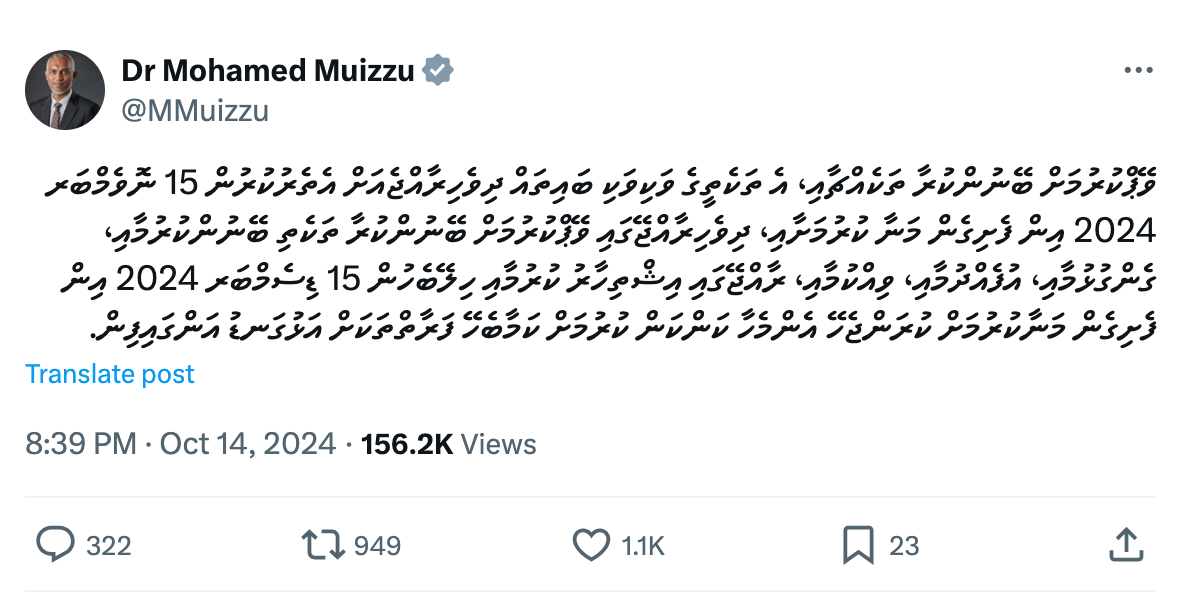
According to Edition on October 14th, President of Maldives Mohamed Muizzu announced through Twitter that e-cigarettes and related products will be completely banned nationwide. He instructed relevant departments to implement these changes on two specific dates.
Maldives President Announces Nationwide Ban on E-Cigarettes and Products
Translation: Maldives President announces through X that "e-cigarettes will be completely banned" | Image source: X


The statement declares that as of November 15, 2024, the import of all e-cigarette products and device components will be considered illegal. Additionally, as of December 15, 2024, the use, possession, production, sale, advertising, and distribution of all e-cigarette products will be completely banned. The president stated that relevant departments have been instructed to implement these decisions.


This decision was made following a large number of requests from parents and healthcare providers who strongly called for the prohibition of e-cigarette use in the Maldives.


After the president's statement, Maldives Attorney General Ahmed Usham stated that amendments to existing laws will be submitted to parliament this week in order to implement the ban.


We welcome news tips, article submissions, interview requests, or comments on this piece.

Please contact us at info@2firsts.com, or reach out to Alan Zhao, CEO of 2Firsts, on LinkedIn


Notice

1.  This article is intended solely for professional research purposes related to industry, technology, and policy. Any references to brands or products are made purely for objective description and do not constitute any form of endorsement, recommendation, or promotion by 2Firsts.

2.  The use of nicotine-containing products — including, but not limited to, cigarettes, e-cigarettes, nicotine pouchand heated tobacco products — carries significant health risks. Users are responsible for complying with all applicable laws and regulations in their respective jurisdictions.

3.  This article is not intended to serve as the basis for any investment decisions or financial advice. 2Firsts assumes no direct or indirect liability for any inaccuracies or errors in the content.

4.  Access to this article is strictly prohibited for individuals below the legal age in their jurisdiction.


Copyright


This article is either an original work created by 2Firsts or a reproduction from third-party sources with proper attribution. All copyrights and usage rights belong to 2Firsts or the original content provider. Unauthorized reproduction, distribution, or any other form of unauthorized use by any individual or organization is strictly prohibited. Violators will be held legally accountable.

For copyright-related inquiries, please contact: info@2firsts.com


AI Assistance Disclaimer


This article may have been enhanced using AI tools to improve translation and editorial efficiency. However, due to technical limitations, inaccuracies may occur. Readers are encouraged to refer to the cited sources for the most accurate information.

We welcome any corrections or feedback. Please contact us at: info@2firsts.com

PMI Plans $71 Million Philippine Smoke-Free Expansion: BLENDS Production Established, Batangas Plant Exports to 18 Markets
Philip Morris International (PMI) plans to invest approximately PHP 4.5 billion ($71 million) to expand its existing smoke-free manufacturing facility in Tanauan, Batangas, in the Philippines. The expansion is expected to be completed in 2027, with additional capacity serving domestic and export markets. The facility began manufacturing heated tobacco consumables in April 2024, including BLENDS sticks for the BONDS by IQOS platform. Philippine business media reported in October 2026 that products from the Batangas plant were being exported to 18 markets across Asia and Europe. PMI says it has invested more than $2 billion in the Philippines since 2010. The expansion adds to the country's existing manufacturing and export role within PMI's international supply chain.
company
Nov.16
Special Report | Vape bans and tougher rules: the South Caucasus takes different paths
Azerbaijan's sweeping e-cigarette ban has raised concerns over enforcement errors and the emergence of illicit sales, while neighboring Armenia is tightening technical rules and preparing higher excise taxes. Georgia, meanwhile, has resisted calls for broader vape restrictions and introduced preferential taxes for some domestically produced cigarettes. The divergent approaches across the South Caucasus highlight a regional policy dilemma: how to curb nicotine use and protect public health without encouraging black markets or creating unintended economic consequences for businesses and consumers.
Nov.03
Vape Manufacturer Ispire Expands Malaysia Operations, Negotiates Southeast Asia OEM Deal as Nicotine Pouch and US Age-Gating Businesses Develop
US-listed vaping technology and manufacturing company Ispire Technology reported fiscal first-quarter 2027 revenue of $27.5 million on November 9, 2026, down 9.3% year over year but up 3.2% sequentially. Gross margin recovered to 16.2%, while its net loss widened to $6.4 million from $3.3 million a year earlier. Management attributed the sales decline primarily to tighter European vaping regulation and reduced distributor orders. Ispire is expanding manufacturing in Malaysia and negotiating an OEM/ODM agreement with a Southeast Asian vaping brand, with an announcement anticipated in January 2027. The company estimates that Malaysian manufacturing offers an approximately 25% US tariff advantage over China-based production. However, it continues to purchase products from Shenzhen Yi Jia Technology Co., Ltd., a manufacturer controlled by its chairman, and reported $52 million in non-current related-party payables at September 30.
company
Nov.11 by 2Firsts Perspectives
Australia's Illicit Tobacco Market May Have Turned After Five Years of Growth, With Estimates Showing Up to 25% Decline Amid Tax-Cut Debate
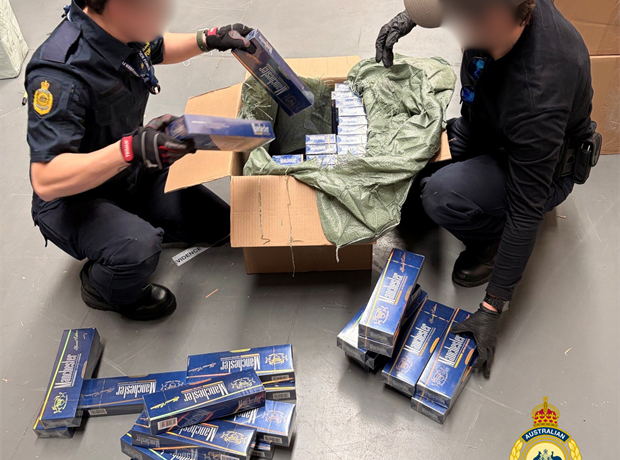
New Australian government estimates released on November 15, 2026, suggest that the country's illicit tobacco market may have contracted for the first time following five years of growth. Estimated market volume fell from a previous peak of 5,972 tonnes to a range of 4,453–5,893 tonnes. The government attributed the change to stronger border enforcement and coordinated domestic operations. Australian Border Force seized more than 2,300 tonnes of illicit tobacco and 13.2 million illicit vaping products in 2025–26, followed by approximately 730 tonnes of illicit tobacco in the first quarter of 2026–27. Separate experimental estimates from the Australian Bureau of Statistics indicate that illicit sources accounted for approximately 80% of nicotine consumption in 2025.
Regulations
Nov.16
Australia Adds 6-Methylnicotine to Schedule 9 Prohibited Substances, Effective October 1
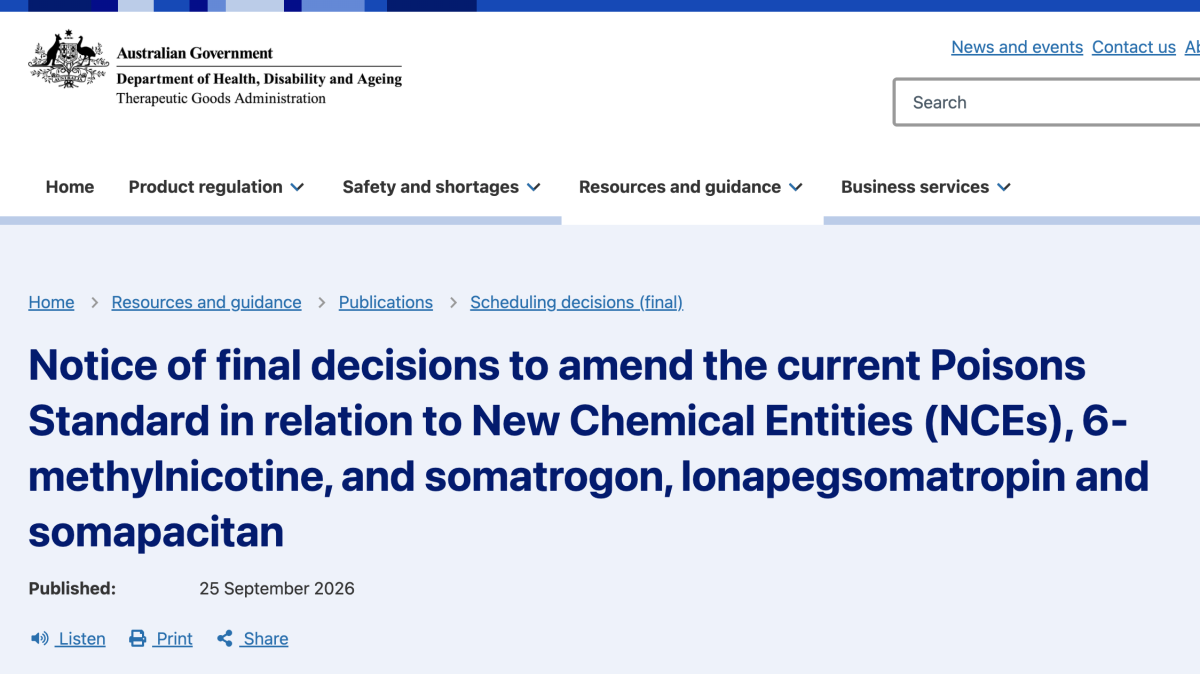
Australia's Therapeutic Goods Administration published a final decision on September 25 to classify 6-methylnicotine as a Schedule 9 prohibited substance under the Poisons Standard, effective October 1, 2026. TGA said the chemical has been reported in e-cigarette liquids sold in Australia and marketed as nicotine-free or nicotine alternatives, while evidence also indicates its use in preparations such as oral pouches. The government originally proposed a Schedule 7 classification but ultimately adopted the stricter Schedule 9 designation, citing acute toxicity, dependence risk, use in unapproved consumer products and misleading marketing.
News
Sep.29 by 2Firsts Perspectives
Russia's Vape Ban Decisions Reach 17 Regions With 39 More Considering Laws, Putting Over 3,000 St. Petersburg Retail Outlets in Focus
Russia's regional vape retail restrictions are expanding. State Duma Speaker Vyacheslav Volodin said on November 7 that 17 regions had adopted decisions to ban vape sales, while another 39 were preparing or considering similar legislation. On November 12, lawmakers in Leningrad Oblast and the Republic of Karelia adopted bans scheduled to begin on March 1, 2027. A day earlier, St. Petersburg unanimously approved a five-year ban proposal in its first reading. The city has 615 specialist vape shops and more than 2,400 other retail outlets selling vaping products alongside other goods. Under Federal Law No. 186-FZ, enacted in June 2026, Russian regions may prohibit retail sales of electronic nicotine delivery systems and related liquids between March 2027 and March 2032. The legislation also restricts licensed suppliers from delivering covered products to retail premises in regions where bans apply.
Regulations
Nov.13