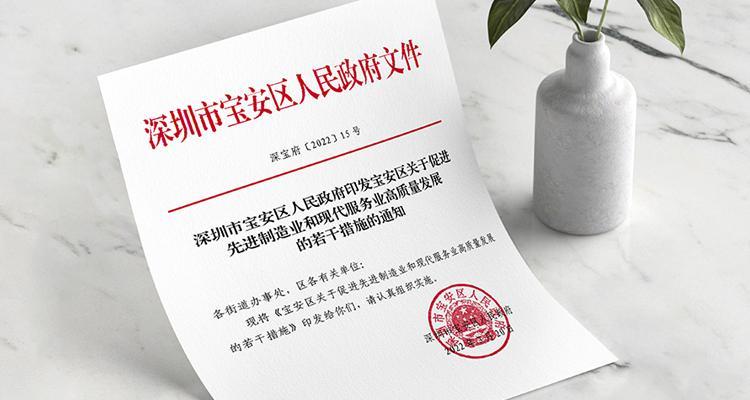
On March 20, 2022, Bao'an District released a red-letter document titled "Measures to Promote the High-Quality Development of Advanced Manufacturing and Modern Service Industries in Bao'an District (ShenBaoFu [2022] No. 15)" (hereinafter referred to as "Measures"). The "Measures" consist of five major chapters and a total of 56 articles, with 16 measures accurately outlining the implementation path for the vigorous development of advanced manufacturing. Of particular note is the eighth article of the "Measures," which explicitly mentions the encouragement and support for the "new electronic atomization device" industry, marking the first inclusion of "e-cigarettes" in a local government's industry support red-letter document.
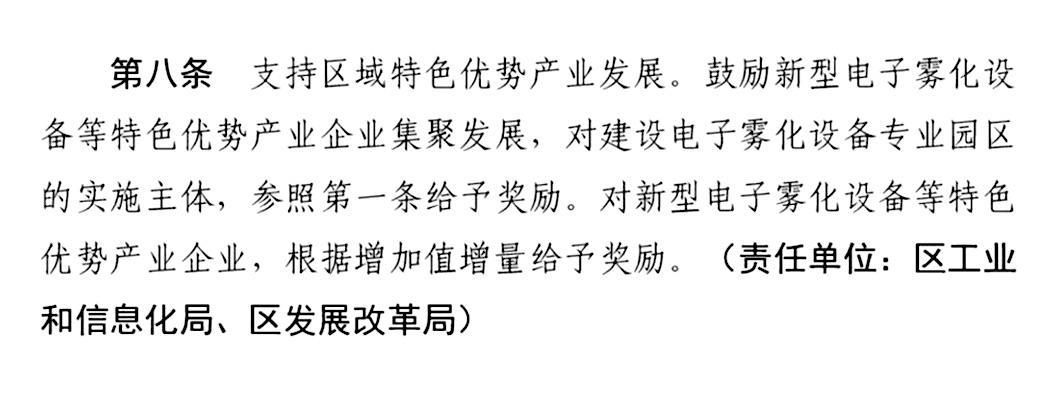
In the previously issued "Opinions on Supporting the High-Quality Development of Advanced Manufacturing Industry and Accelerating the Construction of a World-Class Advanced Manufacturing Hub in Bao'an District" in February 2022, encouragement was mentioned for the "regionally distinctive advantageous industries". It is understood that this actually refers to the e-cigarette manufacturing industry. The implementation of these "measures" is a further clarification of the intention to support this industry.
The "measures" propose supporting the development of regional characteristic advantage industries, particularly strategic emerging industries and future industries. It emphasizes encouraging the concentrated development of characteristic advantage industries such as new electronic atomization devices. Over 90% of global e-cigarettes are manufactured in China, with the manufacturing hub centered in Bao'an District, Shenzhen, extending to Shenzhen, Dongguan, and the entire Greater Bay Area. Currently, Bao'an District has formed a cluster advantage in the electronic atomization industry, covering the complete industry chain from raw materials, research and development, production, sales, logistics, exhibitions, and services.
Bao'an District is a major industrial, economic, and populous area in Shenzhen, ranking eighth among the top 100 districts nationwide, eighth among the top 100 districts in scientific and technological innovation, and third among the top 100 districts in investment competitiveness. In 2021, the GDP of Bao'an District reached 442.182 billion yuan, while the total export volume of China's aerosol companies reached 138.3 billion yuan in the same year. It is foreseeable that with the support of the Bao'an District government, the e-cigarette industry cluster will further innovate and upgrade, consolidating Shenzhen's position as a global "vapor valley" and continuing to lead the global development of the Chinese e-cigarette industry.
Attachment:
Measures to promote high-quality development of advanced manufacturing and modern service industries in Bao'an District (Bao'an Media)
Author: Song Chu Jiao
Editor: Ray Hu
Title: Mapping the Progress: A Journey Through Schism Caption: Visual representation showcases the division and fragmentation In the realm of visualization, we depict a striking manifestation of disunity and discord. This metaphorical canvas encapsulates the gradual deterioration and eventual fragmentation of a once cohesive entity. The image before us serves as a stark reminder of the fissures that have divided and torn apart a once united whole.
Reference sources:
Measures regarding the promotion of high-quality development in advanced manufacturing and modern service industries in Bao'an District.
Please provide the text you would like me to translate.
Bao'an District Implements 56 Measures to Support High-Quality Development of Advanced Manufacturing and Modern Service Industries
Title: Bao'an District in Shenzhen Implements Measures to Support Local Businesses Bao'an District, located in Shenzhen, China, has recently introduced several initiatives aimed at providing support to local businesses. These measures are designed to address the challenges faced by enterprises, boost economic growth, and enhance overall welfare in the region. Among the strategies implemented by the district government is the establishment of a support fund, which will provide financial aid to eligible companies. The fund aims to assist businesses in overcoming the difficulties caused by the COVID-19 pandemic and promote their sustained development. Furthermore, Bao'an District has vowed to streamline administrative procedures and expedite the approval processes for enterprises, in order to facilitate business operations. By reducing red tape, the district aims to create a more business-friendly environment, enabling companies to thrive and expand. Additionally, the local government is prioritizing the implementation of policies that increase funding channels for startups and small and medium-sized enterprises (SMEs). By easing access to capital, these initiatives aim to stimulate innovation and entrepreneurship, encouraging new businesses to emerge and flourish. Recognizing the integral role of technology in modern business ecosystems, the district government is actively promoting the integration of advanced technology solutions into various industries. By encouraging digital transformation, the goal is to improve productivity, competitiveness, and efficiency, propelling economic growth in the region. Efforts are also being made to enhance the skill sets of the local workforce. The government is working closely with educational institutions and vocational training centers to provide specialized training programs that align with the needs of businesses, thereby cultivating a skilled labor force capable of meeting industry demands. By implementing these comprehensive measures, Bao'an District is demonstrating its commitment to support local businesses and foster a favorable economic environment. Through financial assistance, simplified administrative processes, increased funding options, technological integration, and skills development, the district aims to create a thriving business ecosystem that promotes sustainable growth and prosperity for all stakeholders.
The Communists Party of China Bao'an District Committee and Bao'an District People's Government of Shenzhen have issued a notice entitled "Several Opinions on Supporting the High-Quality Development of Advanced Manufacturing and Accelerating the Building of a World-Class Advanced Manufacturing Hub in Bao'an District.
Title: Shenzhen Implements New Measures to Boost the "Smart City" Development Source: Shenzhen Bao'an District Government Official Website Date: [Insert Date] Shenzhen, China - Shenzhen Municipality has recently taken significant steps to further its progress towards becoming a fully-fledged "smart city." The city's Bao'an District has rolled out a series of new measures to facilitate this transformation and enhance its technological capabilities. As part of these efforts, Bao'an District has launched a pilot project to establish a comprehensive intelligent public transportation system. By incorporating advanced technologies such as artificial intelligence (AI), cloud computing, and big data, the district aims to improve the efficiency and convenience of public transportation for its residents. Additionally, Bao'an District has initiated the implementation of a "smart healthcare" solution to enhance the provision of medical services in the area. By leveraging cutting-edge technologies, such as telemedicine and electronic health records, the district strives to optimize healthcare accessibility and quality for its citizens. Furthermore, the district government has introduced a new initiative to bolster the construction of a robust "smart campus" program. By integrating technology into education, Bao'an District will promote digital learning and innovate teaching methods, providing students with an advanced and interactive learning environment. To address citizens' concerns about air quality, Bao'an District has also launched a "smart environmental protection" project. This project employs advanced monitoring systems to collect real-time data on air pollution, allowing for prompt interventions and valuable insights for future environmental policies. Moreover, the district government has called for the acceleration of the development of smart urban management through the use of smart grids, intelligent lighting, and other innovative solutions. These measures aim to improve the overall management and quality of urban life for Bao'an residents. As a critical part of Shenzhen's ambitious plans to become a leading smart city, Bao'an District is continuously striving to embrace technological advancements to improve the lives of its residents. By implementing these new measures, the city takes a significant step forward in its quest to achieve a smarter and more sustainable future.
We welcome news tips, article submissions, interview requests, or comments on this piece.
Please contact us at info@2firsts.com, or reach out to Alan Zhao, CEO of 2Firsts, on LinkedIn
Notice
1. This article is intended solely for professional research purposes related to industry, technology, and policy. Any references to brands or products are made purely for objective description and do not constitute any form of endorsement, recommendation, or promotion by 2Firsts.
2. The use of nicotine-containing products — including, but not limited to, cigarettes, e-cigarettes, nicotine pouchand heated tobacco products — carries significant health risks. Users are responsible for complying with all applicable laws and regulations in their respective jurisdictions.
3. This article is not intended to serve as the basis for any investment decisions or financial advice. 2Firsts assumes no direct or indirect liability for any inaccuracies or errors in the content.
4. Access to this article is strictly prohibited for individuals below the legal age in their jurisdiction.
Copyright
This article is either an original work created by 2Firsts or a reproduction from third-party sources with proper attribution. All copyrights and usage rights belong to 2Firsts or the original content provider. Unauthorized reproduction, distribution, or any other form of unauthorized use by any individual or organization is strictly prohibited. Violators will be held legally accountable.
For copyright-related inquiries, please contact: info@2firsts.com
AI Assistance Disclaimer
This article may have been enhanced using AI tools to improve translation and editorial efficiency. However, due to technical limitations, inaccuracies may occur. Readers are encouraged to refer to the cited sources for the most accurate information.
We welcome any corrections or feedback. Please contact us at: info@2firsts.com