Meeting between China's State Tobacco Monopoly Administration and China Coast Guard

News by 2FIRSTS.ai
Dec.19.2024
Meeting between China's State Tobacco Monopoly Administration and China Coast Guard
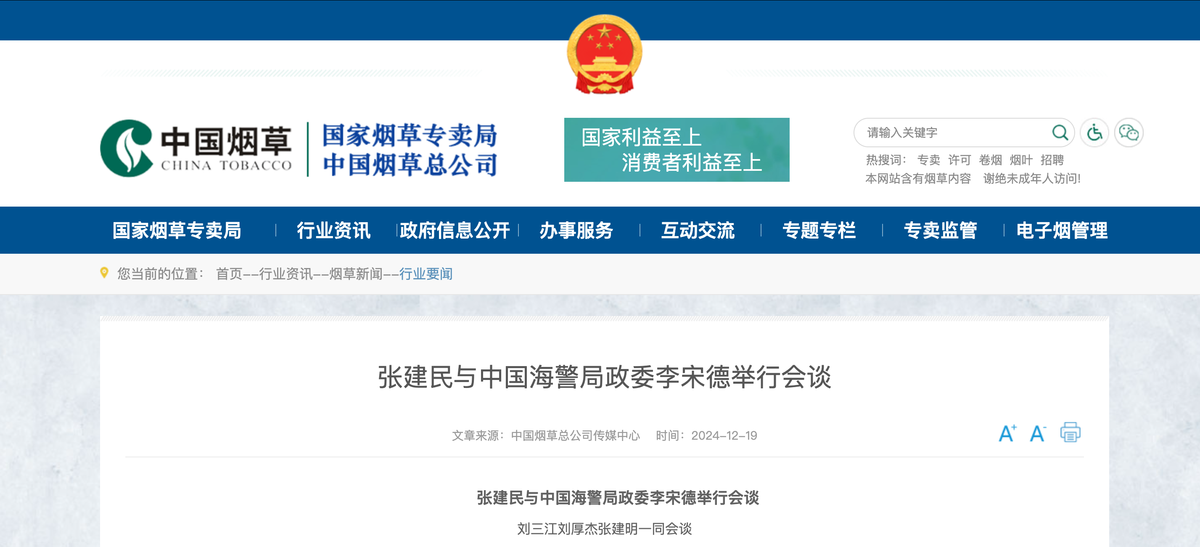
State Tobacco Monopoly Administration and China Coast Guard officials discuss cooperation in combating tobacco smuggling at sea in Beijing.

On December 19, the Secretary of the Party Committee and Director of the State Tobacco Monopoly Administration, and General Manager of the China National Tobacco Corporation, Zhang Jianmin, held talks in Beijing with the Political Commissar of the China Coast Guard, Li Songde, exchanging views on promoting the anti-smuggling work at sea.


Liu Sanjiang, a member of the Party Group and Deputy Director of the National Bureau, Liu Houjie, Deputy Political Commissar and Secretary of the Discipline Inspection Commission of the China Coast Guard, and Zhang Jianming, Chief of the Law Enforcement Department of the China Coast Guard, held a meeting together.


Officials from the National Bureau and the China Coast Guard participated in the meeting.


We welcome news tips, article submissions, interview requests, or comments on this piece.

Please contact us at info@2firsts.com, or reach out to Alan Zhao, CEO of 2Firsts, on LinkedIn


Notice

1.  This article is intended solely for professional research purposes related to industry, technology, and policy. Any references to brands or products are made purely for objective description and do not constitute any form of endorsement, recommendation, or promotion by 2Firsts.

2.  The use of nicotine-containing products — including, but not limited to, cigarettes, e-cigarettes, nicotine pouchand heated tobacco products — carries significant health risks. Users are responsible for complying with all applicable laws and regulations in their respective jurisdictions.

3.  This article is not intended to serve as the basis for any investment decisions or financial advice. 2Firsts assumes no direct or indirect liability for any inaccuracies or errors in the content.

4.  Access to this article is strictly prohibited for individuals below the legal age in their jurisdiction.


Copyright


This article is either an original work created by 2Firsts or a reproduction from third-party sources with proper attribution. All copyrights and usage rights belong to 2Firsts or the original content provider. Unauthorized reproduction, distribution, or any other form of unauthorized use by any individual or organization is strictly prohibited. Violators will be held legally accountable.

For copyright-related inquiries, please contact: info@2firsts.com


AI Assistance Disclaimer


This article may have been enhanced using AI tools to improve translation and editorial efficiency. However, due to technical limitations, inaccuracies may occur. Readers are encouraged to refer to the cited sources for the most accurate information.

We welcome any corrections or feedback. Please contact us at: info@2firsts.com

Puerto Rico House Files P.C. 1070 to Ban Flavored Vaping Product Sales to Under-21s
According to a statement from the Puerto Rico House of Representatives, House Speaker Carlos Méndez and Rep. Pedro Julio Santiago announced the filing of House Bill 1070 (P.C. 1070), which would prohibit sales to people under 21 of vaping devices, liquids, or cartridges featuring a flavor and/or aroma other than nicotine.
Jan.29 by 2FIRSTS.ai
FDA Highlights Product Characterization as a Foundational Requirement in ENDS PMTA Reviews
During its ongoing PMTA roundtable, FDA emphasized that product characterization is a foundational element in the review of electronic nicotine delivery systems (ENDS). The agency underscored the need for complete product identifying information, validation and verification of test methods on the specific product type, and the appropriate use of tobacco product master files (TPMFs) to support complex or proprietary ingredients in PMTA submissions.
Feb.10
Moldova adopts new sanitary rules for tobacco products, e-cigarettes and related goods
Moldova is introducing new sanitary standards for tobacco products, e-cigarettes and related goods, with regulations adopted on January 14 aimed at protecting public health and tightening control over tobacco sales. The rules include measures to limit minors’ access to tobacco products, including via online shops, and establish procedures for notifications, reporting and market monitoring.
Jan.16 by 2FIRSTS.ai
Small ENDS Manufacturers Press FDA on Abuse Liability Standards as Agency Defines Pharmacological Review Framework
At the third session of its PMTA roundtable, the FDA outlined its framework for assessing abuse liability in ENDS products, emphasizing the role of nicotine pharmacokinetics and product-specific data in APPH determinations. Small manufacturers questioned the high cost of clinical PK studies and the absence of defined numeric thresholds, while raising bridging strategies and PBPK modeling as potential alternatives.
Feb.11
Alabama SB9 would treat vaping like smoking under indoor public-space restrictions
Alabama’s Senate Bill 9 would modernize the state’s indoor air quality laws by treating electronic nicotine delivery systems, including e-cigarettes and vape pens, the same as traditional tobacco smoking in indoor public spaces. Sponsored by Sen.
Jan.05 by 2FIRSTS.ai
PMI AI White Paper Warns of “Cognitive Atrophy” and Attention Erosion, Calls for Focus on Human Cognition’s Evolution
Philip Morris International (PMI) has released a white paper calling for cross-sector dialogue on how AI may affect human cognitive abilities. The paper flags risks including “cognitive atrophy” and attention erosion, and warns of a widening cognitive divide and rising pressures on information verification and trust.
Jan.21 by 2FIRSTS.ai