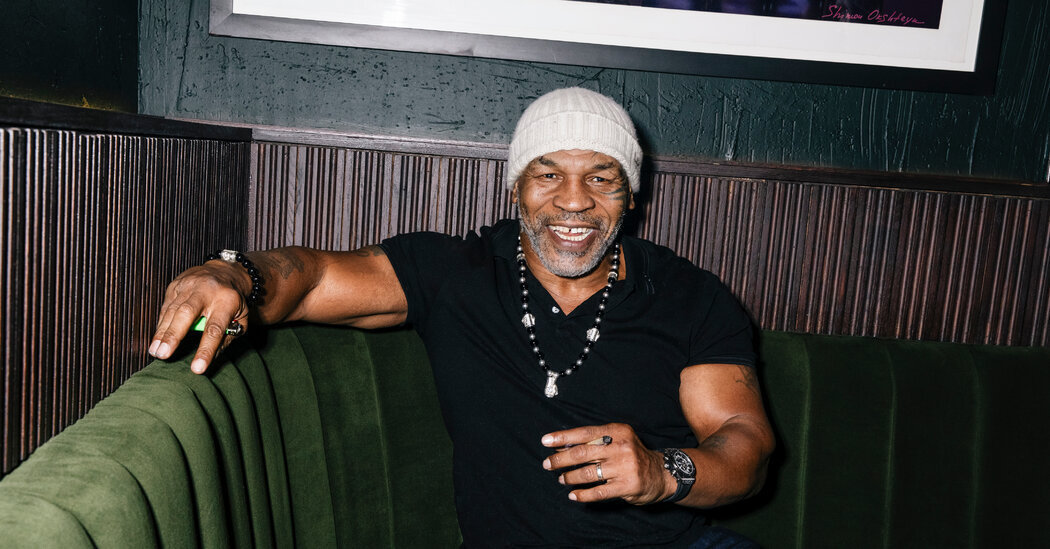
According to a recent report by The New York Times, hundreds of followers of Mike Tyson, one of the greatest boxers of all time, lined up at a pharmacy in New York over the weekend in hopes of getting a chance to meet him and show support for his latest business venture: selling marijuana in his home state.
According to reports, 57-year-old Tyson has recently launched the Tyson 2.0 brand, emerging as one of the most notable newcomers in the New York cannabis industry. As the legalization of cannabis gradually spreads across the United States, actors, athletes, and musicians have been profiting from the marijuana industry through product lines and sponsorship contracts for over a decade. However, the trend has only recently started to gain momentum in New York. Tyson is seeking to test his fame and become a prominent figure in what is projected to become the world's largest and most competitive market.
The evaluations of cannabis brands backed by celebrities are mixed. While their sales often surpass those of traditional brands, they cannot compete with the biggest brand that sells millions of dollars worth of cannabis every month.
According to data from Headset, a specialized cannabis data company, out of the top 30 bestselling brands in California, the largest market in the United States, only 9 of them are owned or endorsed by celebrities. These include Tyson 2.0, actor Seth Rogen's Houseplant, and musician Carlos Santana's Mirayo.
One of the company analysts, Mitchell Laferla, noted that the ultimate driving factor for consumers in emerging markets like New York is value, and this is precisely where celebrity-endorsed brands face difficulties.
Consumers who spend lavishly are now seeking the most powerful features at the lowest prices, while the quality of celebrity brands varies, often commanding higher prices. In California, a bag of 3.5 grams typically sells for around $23.14, whereas Tyson 2.0 is priced at approximately $28.44, representing a 23% difference.
Lafra states that the success of Tyson 2.0 can be attributed to the way Tyson interacts with its clients and their companies, its proactive expansion into new markets such as New York and Maryland, and the quality of its products.
"Your name may entice someone to give it a try," he said. "But it's your brand and product quality that are the factors that keep people coming back."
Yuvraj Singh, the CEO of Long Island Strain Stars, has stated that customers have returned to purchase more cannabis from Tyson Foods. On the first day of the launch of their Tyson 2.0 flower line, their customers bought a total of $30,000 worth of cannabis products, making the cannabis series one of the top five best-selling products in the store.
According to reports, he described its effect as a highly pleasurable and refreshing sensation.
Coss Marte, co-owner and CEO of Conbud, has stated that their pharmacy has also attracted more customers to make purchases, selling $10,000 worth of Tyson 2.0 within an hour, which is equivalent to the pharmacy's typical daily sales.
Former boxing champion Mike Tyson has emphasized the therapeutic effects of marijuana in his transformation from an arrogant athlete to a disciplined businessman. In an interview, he revealed that less than a decade ago, he was penniless and struggling with a cocaine addiction. Today, he is the owner of one of the most successful celebrity marijuana brands in the country.
Tyson stated that his goal is to solidify his legacy as a pioneer of cannabis. "This is more important to me than making money," he declared.
Tyson was born into a financially disadvantaged family in Brooklyn and later discovered his boxing talent at a reform school in the north. He quickly became a teenage sensation and eventually won 50 professional matches, most of which were victories by knockout.
However, his reputation has been tarnished due to his antics, such as biting Hollyfield's ear, as well as his legal troubles, including a three-year prison sentence for a rape case that he still denies. In 2014, he revealed his dependency on cocaine and claimed that marijuana helped him break free from addiction. He currently resides in Las Vegas and owns a marijuana farm in California.
His personal story has attracted many fans, who seem eager to support him. "He has gone through some difficult times, and I can relate to that," said 26-year-old Tony Pedroza, a boxing enthusiast from Brooklyn who was standing in line in Manhattan to see Tyson.
Monifa Jones-Tuck and her husband, Troy Tuck, drove from Bethlehem, Pennsylvania to show their support for him. Jones expressed that they have been following Tyson's boxing career since the beginning and admire his progress.
"After using marijuana, his mind is currently in a good and calm state," he said. "It suits him well, and he also looks great."
We welcome news tips, article submissions, interview requests, or comments on this piece.
Please contact us at info@2firsts.com, or reach out to Alan Zhao, CEO of 2Firsts, on LinkedIn
Notice
1. This article is intended solely for professional research purposes related to industry, technology, and policy. Any references to brands or products are made purely for objective description and do not constitute any form of endorsement, recommendation, or promotion by 2Firsts.
2. The use of nicotine-containing products — including, but not limited to, cigarettes, e-cigarettes, nicotine pouchand heated tobacco products — carries significant health risks. Users are responsible for complying with all applicable laws and regulations in their respective jurisdictions.
3. This article is not intended to serve as the basis for any investment decisions or financial advice. 2Firsts assumes no direct or indirect liability for any inaccuracies or errors in the content.
4. Access to this article is strictly prohibited for individuals below the legal age in their jurisdiction.
Copyright
This article is either an original work created by 2Firsts or a reproduction from third-party sources with proper attribution. All copyrights and usage rights belong to 2Firsts or the original content provider. Unauthorized reproduction, distribution, or any other form of unauthorized use by any individual or organization is strictly prohibited. Violators will be held legally accountable.
For copyright-related inquiries, please contact: info@2firsts.com
AI Assistance Disclaimer
This article may have been enhanced using AI tools to improve translation and editorial efficiency. However, due to technical limitations, inaccuracies may occur. Readers are encouraged to refer to the cited sources for the most accurate information.
We welcome any corrections or feedback. Please contact us at: info@2firsts.com