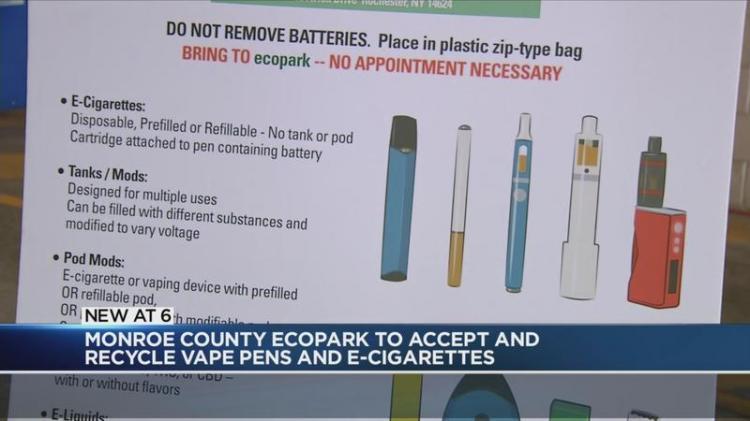
Monroe County has become the first in New York and the entire United States to accept and recycle electronic cigarettes and vaping products. These items can be disposed of in the household hazardous waste area of Monroe County's Ecopark. Monroe County Executive Adam Bello announced on Monday that the county's Department of Environmental Services is partnering with waste management company Clean Harbors to collect and safely dispose of used e-cigarette devices and e-liquids at the managed Ecopark located at 10 Avion Drive.
According to county executive Belo, electronic cigarettes are not only a public health issue but also an environmental problem. E-cigarette pens, devices, and e-liquids are considered hazardous waste and should not be discarded. Monroe County is proud to lead the way in New York by taking action to prevent these products from harming our environment.
The product and the liquid used in it are considered hazardous and should not be thrown away in the garbage. Monroe County is the first county in the country to properly dispose of electronic cigarette equipment. These products will be recycled and converted into renewable energy.
They will be shipped to a facility outside the state where they will be converted into energy. This is called the waste-to-energy process, effectively burning the material and recovering metal from the process," said Michael Galarno, Director of Environmental Services for Monroe County.
The recycling service will take place twice a week. At the Monroe County Waste Management Ecopark, the public can participate without the need for an appointment and without any charge for receiving electronic cigarettes and pods.
County Executive Belo announced that the Monroe County Department of Health and Environmental Services will accept the school district's electronic cigarette devices. These devices will be properly disposed of through the county's Conditionally Exempt Small Quantity Generator program. To participate, BOCES training schools, public school districts, and private schools will need to fill out a CESQG form and submit it to the Family Hazardous Waste Facility at the Ecopark.
The Monroe County School Supervision Committee expresses great satisfaction with the new electronic cigarette disposal service provided by the county. E-cigarettes have become prevalent among students in the area, resulting in the confiscation of a significant number of devices. The district now has a much-needed service to safely and properly dispose of these devices. "This is a vital service for our district," said Dr. Casey Kosiorek, Chairman of the Monroe County School Supervision Committee.
Statement.
This article is compiled from third-party information and is intended for industry-related communication and learning purposes only.
This article does not represent the views of 2FIRSTS, and 2FIRSTS cannot confirm the truthfulness and accuracy of its contents. The translation of this article is solely for the purpose of industry exchange and research.
Due to limitations in the level of translation, the translated article may not fully convey the original meaning. Please rely on the original text for accuracy.
2FIRSTS maintains complete consistency with the Chinese government regarding any domestic, Hong Kong, Macao, Taiwan, or foreign-related statements and positions.
Copyright of compiled information belongs to the original media and author. If there is any infringement, please contact for deletion.
Disclaimer
This article is provided solely for professional research, industry discussion, and informational purposes. Any references to brands, companies, products, technologies, or policies are made for factual reporting and analytical purposes only, and do not constitute endorsement, recommendation, promotion, or advertising by 2Firsts.
Nicotine-containing products, including but not limited to cigarettes, e-cigarettes, heated tobacco products, and nicotine pouches, carry significant health risks. Readers are responsible for complying with all applicable laws and regulations in their respective jurisdictions, including age restrictions and access limitations.
The information contained in this article should not be regarded as investment, legal, medical, regulatory, or commercial advice. While 2Firsts strives to ensure the accuracy and reliability of its content, it does not assume liability for any direct or indirect loss arising from errors, omissions, inaccuracies, or reliance on the information contained herein.
This article is not intended for individuals below the legal age for accessing tobacco or nicotine-related information in their jurisdiction.
Copyright Notice
This article is either original content produced by 2Firsts or content reproduced, translated, summarized, or adapted from third-party sources with attribution where applicable. The intellectual property rights of the original content remain with 2Firsts or the respective original rights holders.
No individual or organization may copy, reproduce, distribute, republish, modify, translate, or otherwise use this content without prior authorization. Any unauthorized use may result in legal action.
For copyright-related inquiries, corrections, or removal requests, please contact: info@2firsts.com.
AI-Assisted Translation and Editing Notice
Portions of this article may have been translated, edited, or reviewed with the assistance of artificial intelligence tools to improve efficiency and readability. Due to the limitations of AI-assisted translation and editing, discrepancies, omissions, or inaccuracies may exist when compared with the original source.
Where applicable, readers are advised to refer to the original source for the most complete and accurate information. If you identify any errors or believe that any content infringes upon your rights, please contact us at info@2firsts.com, and we will review and address the matter promptly.