South Korea: New Guidelines Released to Limit Smoking Content in Media

Regulations by 2FIRSTS.ai
Dec.22.2023
South Korea: New Guidelines Released to Limit Smoking Content in Media
South Korea's Ministry of Health and Welfare has released new guidelines to reduce smoking-related content in media production and broadcasting.

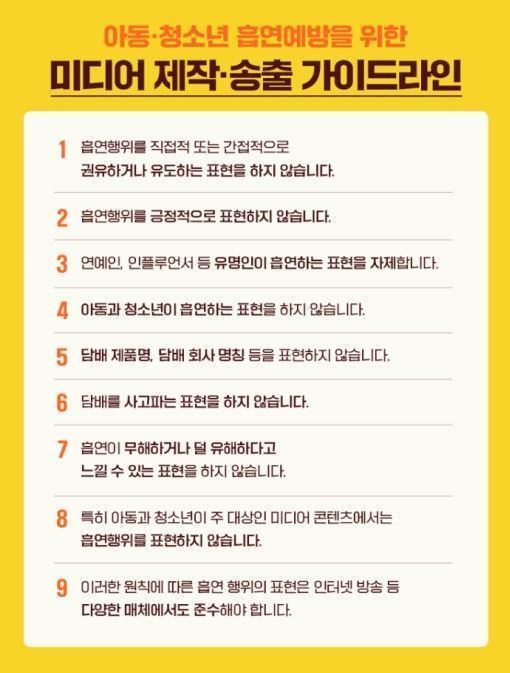
According to a report by South Korean media outlet MBN on December 22nd, the Ministry of Health and Welfare and the Korea Institute of Health Promotion and Development have jointly released new guidelines for media production and broadcasting. The aim is to enable television stations and platforms like YouTube to voluntarily reduce the display and description of smoking-related content during their broadcasts and productions.


The newly released guidelines aim to better protect children and adolescents by reducing their exposure to smoking scenes and images. The guidelines explicitly state that media should avoid promoting or glamorizing smoking in their content. They should refrain from depicting celebrities, children, and teenagers smoking, as well as mentioning specific cigarette brands, company names, or slang terms related to smoking.


We welcome news tips, article submissions, interview requests, or comments on this piece.

Please contact us at info@2firsts.com, or reach out to Alan Zhao, CEO of 2Firsts, on LinkedIn


Notice

1.  This article is intended solely for professional research purposes related to industry, technology, and policy. Any references to brands or products are made purely for objective description and do not constitute any form of endorsement, recommendation, or promotion by 2Firsts.

2.  The use of nicotine-containing products — including, but not limited to, cigarettes, e-cigarettes, nicotine pouchand heated tobacco products — carries significant health risks. Users are responsible for complying with all applicable laws and regulations in their respective jurisdictions.

3.  This article is not intended to serve as the basis for any investment decisions or financial advice. 2Firsts assumes no direct or indirect liability for any inaccuracies or errors in the content.

4.  Access to this article is strictly prohibited for individuals below the legal age in their jurisdiction.


Copyright


This article is either an original work created by 2Firsts or a reproduction from third-party sources with proper attribution. All copyrights and usage rights belong to 2Firsts or the original content provider. Unauthorized reproduction, distribution, or any other form of unauthorized use by any individual or organization is strictly prohibited. Violators will be held legally accountable.

For copyright-related inquiries, please contact: info@2firsts.com


AI Assistance Disclaimer


This article may have been enhanced using AI tools to improve translation and editorial efficiency. However, due to technical limitations, inaccuracies may occur. Readers are encouraged to refer to the cited sources for the most accurate information.

We welcome any corrections or feedback. Please contact us at: info@2firsts.com

Costa Rica Ruling Party Lawmaker Proposes Vape Ban as Experts Warn of Black Market Risks
A lawmaker from Costa Rica’s ruling party has introduced a bill to completely ban e-cigarettes and related products, covering their import, sale, use, and manufacturing, citing rising youth use and associated health risks. The proposal would repeal the current regulatory law and has raised concerns that a full ban, combined with weak enforcement, could fuel a black market.
Dec.03 by 2FIRSTS.ai
5th Circuit Reviews FDA’s Compliance on Small-Business Impact of Vape Rule
A Fifth Circuit panel expressed doubts about whether the U.S. Food and Drug Administration complied with the Regulatory Flexibility Act when issuing its 2021 final rule on premarket tobacco product applications. Vape companies argued the FDA relied on outdated and inaccurate economic data, while the government said the challenged requirements stem from the Tobacco Control Act.
Dec.03 by 2FIRSTS.ai
BREAKING: China Brings Nicotine Pouches Under Tobacco Monopoly Regulation, Signaling Major Shift for Oral Products
China has for the first time issued clear regulatory rules for nicotine pouches and other oral nicotine products, formally classifying them under the tobacco monopoly alongside cigarettes and tobacco, ending a long-standing legal grey zone and laying the regulatory groundwork for their potential domestic launch.
Jan.09 by Alan Zhao | 2Firsts Perspectives
Thailand’s health minister rejects vaping as a smoking cessation alternative
Thailand’s Public Health Minister Phatthana Phromphat has reaffirmed that the government does not support cigarettes or e-cigarettes in any form and opposes the use of e-cigarettes as a substitute for smoking cessation.
Dec.17 by 2FIRSTS.ai
Product | Semi-Embedded Display + “Smart Memory System”: OXBAR Launches New Magnetic Vape MAGLINK
OXBAR has launched the MAGLINK vape on its official website, featuring a magnetic structure and a smart memory function. The website lists the device as offering 50,000 puffs, a 1500 mAh battery, and four adjustable power levels. The product has already appeared across multiple Canadian sales channels, where the stated puff count, e-liquid capacity, and other specifications differ notably from those shown on the official site.
Dec.12 by 2FIRSTS.ai
Russia's Finance Ministry Proposes Regional Vape Sales Bans from 2026
Russian Finance Ministry has drafted amendments allowing regional governments to ban the retail sale of vapes and e-liquids between September 1, 2026, and September 1, 2031. Regions must enact their own legislation and notify the Federal Service for Alcohol and Tobacco Control (Rosalkogoltabakkontrol), which will publish a list of participating regions.
Dec.08 by 2FIRSTS.ai