New Zealand Government Passes Strict Anti-Smoking Regulations

Dec.13.2024
New Zealand Government Passes Strict Anti-Smoking Regulations
New Zealand government urgently passes anti-smoking regulations, including ban on disposable e-cigarettes and stricter sales restrictions.

According to a report by Radio New Zealand on December 13th, the New Zealand government has urgently passed a series of new regulations on smoking.


The bill prohibits disposable e-cigarettes and introduces further restrictions on the sale of e-cigarettes, including display restrictions. The maximum fine for retailers selling e-cigarettes to those under 18 years old will increase from the current 10,000 New Zealand dollars (5,800 US dollars) to 100,000 New Zealand dollars (58,000 US dollars). Specialty e-cigarette retailers must be at least 100 meters away from early childhood service facilities, with a distance restriction of 300 meters from schools and community centers.


Casey Costello, Deputy Minister of Health for New Zealand, stated that the Smoke-free Environments and Regulated Products Amendment Act 2020 aims to prevent adolescents from vaping e-cigarettes and introduces several practical changes and stricter regulatory measures.


The new law mainly includes four major changes: prohibiting the production, sale, supply, and distribution of disposable e-cigarettes; increasing fines for selling regulated products to minors; imposing restrictions on the retail display of e-cigarette products; and adding further distance restrictions for specialized e-cigarette retail stores.


Costello added that manufacturers, importers, or large retailers who violate the ban could face fines of up to $400,000 NZD ($230,000 USD), while individuals could face fines of up to $50,000 NZD ($30,000 USD). The new visibility restrictions require retailers exclusively selling e-cigarettes to not display e-cigarette products and packaging outside of their stores. Regular e-cigarette retailers such as supermarkets, gas stations, and convenience stores will be required to "follow the same regulations currently in place for other regulated products such as cigarettes.


She stated that the ban on disposable e-cigarettes and display restrictions will come into effect six months from now, giving retailers time to prepare for the new regulations.


During this period, efforts will also be made to recruit and train more smoking enforcement officers, so that the new regulations and stricter penalties can be more effectively enforced.


We welcome news tips, article submissions, interview requests, or comments on this piece.

Please contact us at info@2firsts.com, or reach out to Alan Zhao, CEO of 2Firsts, on LinkedIn


Notice

1.  This article is intended solely for professional research purposes related to industry, technology, and policy. Any references to brands or products are made purely for objective description and do not constitute any form of endorsement, recommendation, or promotion by 2Firsts.

2.  The use of nicotine-containing products — including, but not limited to, cigarettes, e-cigarettes, nicotine pouchand heated tobacco products — carries significant health risks. Users are responsible for complying with all applicable laws and regulations in their respective jurisdictions.

3.  This article is not intended to serve as the basis for any investment decisions or financial advice. 2Firsts assumes no direct or indirect liability for any inaccuracies or errors in the content.

4.  Access to this article is strictly prohibited for individuals below the legal age in their jurisdiction.


Copyright


This article is either an original work created by 2Firsts or a reproduction from third-party sources with proper attribution. All copyrights and usage rights belong to 2Firsts or the original content provider. Unauthorized reproduction, distribution, or any other form of unauthorized use by any individual or organization is strictly prohibited. Violators will be held legally accountable.

For copyright-related inquiries, please contact: info@2firsts.com


AI Assistance Disclaimer


This article may have been enhanced using AI tools to improve translation and editorial efficiency. However, due to technical limitations, inaccuracies may occur. Readers are encouraged to refer to the cited sources for the most accurate information.

We welcome any corrections or feedback. Please contact us at: info@2firsts.com

India Steps Up Nicotine Pouch Enforcement as ZYN, White Fox Circulate and Drug Panel Urges Halt to New Nicotine Formulations
India's Ministry of Health and Family Welfare has directed states to step up enforcement against nicotine pouch sales, citing increased availability through online and offline channels and concern about nicotine exposure among children. Reuters reported that international brands including ZYN and White Fox are being sold in India. A study led by ICMR-NICPR found pouches in seven of 10 surveyed locations and identified 68 brands and 445 flavors online. Separately, India's Drugs Technical Advisory Board recommended in August that no new nicotine formulation be approved.
Regulations
Sep.28 by 2Firsts Perspectives
Russia's Vape Ban Decisions Reach 17 Regions With 39 More Considering Laws, Putting Over 3,000 St. Petersburg Retail Outlets in Focus
Russia's regional vape retail restrictions are expanding. State Duma Speaker Vyacheslav Volodin said on November 7 that 17 regions had adopted decisions to ban vape sales, while another 39 were preparing or considering similar legislation. On November 12, lawmakers in Leningrad Oblast and the Republic of Karelia adopted bans scheduled to begin on March 1, 2027. A day earlier, St. Petersburg unanimously approved a five-year ban proposal in its first reading. The city has 615 specialist vape shops and more than 2,400 other retail outlets selling vaping products alongside other goods. Under Federal Law No. 186-FZ, enacted in June 2026, Russian regions may prohibit retail sales of electronic nicotine delivery systems and related liquids between March 2027 and March 2032. The legislation also restricts licensed suppliers from delivering covered products to retail premises in regions where bans apply.
Regulations
Nov.13
Sweden Threatens EU Tobacco Tax Deal as Nicotine Pouch Duty Dispute Looms Over November 9 Meeting
Sweden is expected to oppose a European Union proposal to raise minimum tobacco excise duties, Law360 reported on October 26, 2026, citing an EU official. A provisional Council agenda dated October 23 confirms that the tobacco taxation package is scheduled for discussion at the November 9 finance ministers' meeting, where member states will seek a general approach. The proposed reforms would raise minimum taxes on conventional tobacco products and establish EU-wide excise rules for vaping liquids, heated tobacco and nicotine pouches. Sweden supports harmonising tobacco taxation rules but objects to requiring nicotine pouches to bear the same minimum tax burden as certain smoking tobacco products. As EU indirect tax legislation requires unanimous Council approval, Swedish opposition could block the proposal in its current form.
Regulations
Oct.29
Special report|Indonesia's Vape Industry Has 200 Manufacturers and $1.7 Billion in Investment. Could a Regulatory Divide Derail Its Rise as the World's No. 2 Manufacturing Hub After Shenzhen?
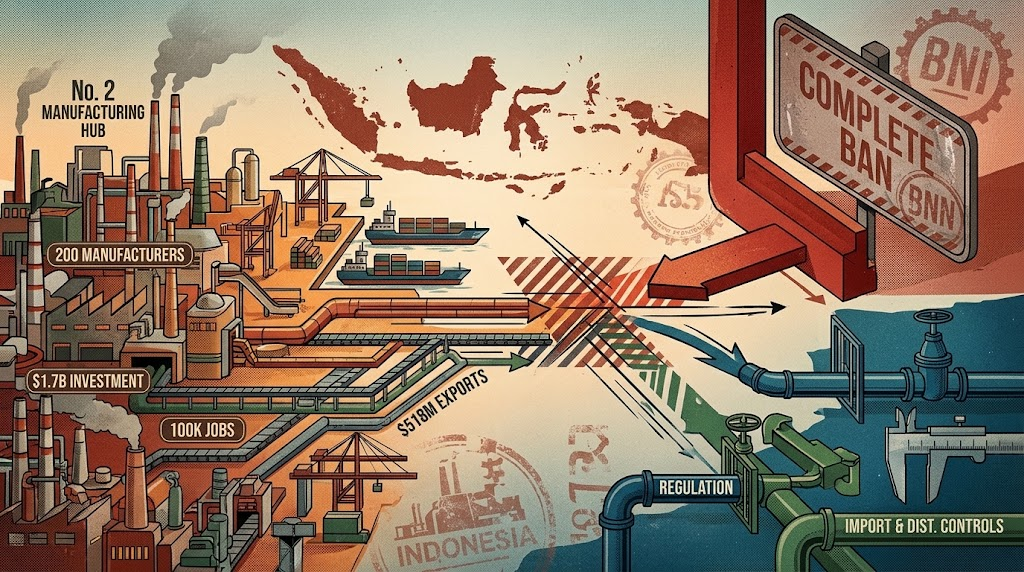
Indonesia's Ministry of Industry said at a November 3, 2026, policy forum that the country has about 200 electronic cigarette companies, Rp31 trillion (approximately $1.71 billion) in cumulative industry investment and around 100,000 jobs across the supply chain. The National Narcotics Agency is seeking a comprehensive ban on vape use and circulation, while the industry ministry favors tighter import, product-standard and distribution controls. Indonesia exported approximately $518 million in vaping products in 2025, and Chinese manufacturers including Smoore, GEEKVAPE and Jinjia Group have established local operations. An international logistics specialist interviewed by 2Firsts said more Chinese vape companies began production in Indonesia from the second half of 2025, accompanied by increased shipments of manufacturing equipment and investment in logistics facilities. The regulatory debate comes as Indonesia expands its role in international vaping manufacturing.
Special Report
Nov.05
U.S. Expands Illicit Vape Enforcement as ATF Brings PACT Act Powers Into Trade Fraud Task Force
The U.S. Bureau of Alcohol, Tobacco, Firearms and Explosives said on September 23 that it has joined the interagency Trade Fraud Task Force to strengthen enforcement against illegal, misdeclared and smuggled vape and tobacco products. ATF will bring its authority under the Prevent All Cigarette Trafficking Act into the task force, including registration, reporting, shipping and record-inspection requirements covering interstate sales of electronic nicotine delivery systems. ATF said the move will strengthen its ability to trace illicit products from U.S. points of entry through domestic trafficking and distribution networks.
News
Sep.28 by 2Firsts Perspectives
Imperial Brands Plans to Cut Nearly 18% of Workforce as German Plant Closure and Polish Outsourcing Drive Restructuring
Imperial Brands disclosed on November 17, 2026, that its global manufacturing and organisational restructuring is expected to reduce between 4,200 and 4,600 roles by the end of 2030, equivalent to approximately 16%–18% of its workforce at the end of 2025. The first phase covers 2,100 roles with departures confirmed or subject to consultation, while a further 2,100–2,500 positions are expected to be eliminated by 2030. The company is proceeding with the closure of its Langenhagen factory in Germany, has sold its manufacturing facility in Taiwan, and has transferred selected finance, procurement and supply-chain operations in Poland to Capgemini. The restructuring programme is expected to cost approximately £740 million, with Imperial targeting at least £320 million in annual cost savings by 2030.
company
Nov.18