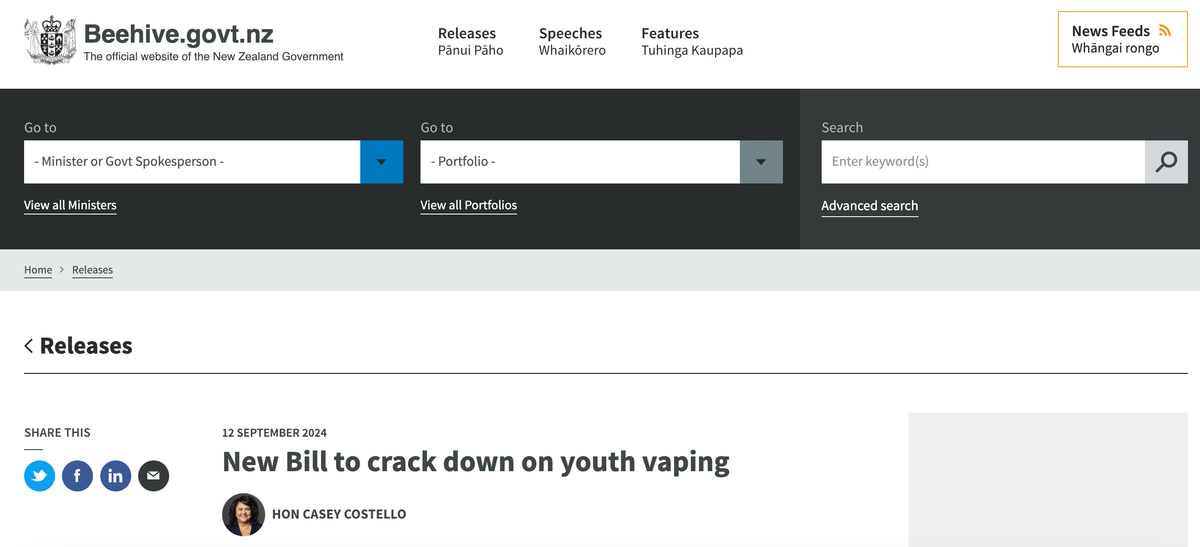
On September 12th, the New Zealand government announced on its official website that Deputy Health Minister Casey Costell revealed that the coalition government has introduced the Smoke-free Environments and Regulated Products (Vaping) Amendment Bill (No 2) aimed at preventing youth from using e-cigarettes.
The bill includes four main changes aimed at preventing minors from using e-cigarettes.
The ban on disposable e-cigarettes will be enforced across the board; significant increases in fines for selling e-cigarettes to minors; visibility restrictions for non-professional e-cigarette retailers; and distance limits near preschool education centers.
The deputy minister stated that
Many young people are using disposable e-cigarettes - they are cheap and easy to obtain. That is why we will completely ban disposable e-cigarette products. In addition, fines for retailers selling e-cigarettes, cigarettes, and other regulated products to minors will significantly increase.
The bill stipulates that the maximum fine for selling e-cigarettes or other regulated products to minors under the age of 18 will increase from 10,000 New Zealand dollars (approximately 6,100 US dollars) to 100,000 New Zealand dollars (approximately 61,000 US dollars). The fine for individual violations will increase from 500 New Zealand dollars (approximately 310 US dollars) to 1,000 New Zealand dollars (approximately 615 US dollars), and the fine for corporate violations will be raised to 2,000 New Zealand dollars (approximately 1,230 US dollars).
In addition, there are distance restrictions for opening a new e-cigarette specialty store near a childcare center. To apply for a new professional e-cigarette retail store, the retail location must be at least 100 meters away from the preschool education center. This is an additional requirement on top of the existing 300-meter distance requirement from gathering places or schools.
Kostro emphasized
Harsher penalties will be supported by stronger enforcement. In recent years, we have lacked the necessary level of enforcement, but by December, 16 full-time smoke-free enforcement officers will be added.
The New Zealand government is committed to achieving the smoke-free goal by 2025 and preventing the use of e-cigarettes among teenagers. This legislation will ensure that we can protect young people from the harms of e-cigarettes, while also continuing to support adult smokers in quitting by maintaining the availability of e-cigarettes as a smoking cessation tool.
I hope that the public can ensure the establishment of a practical system that can achieve these two goals through the submissions of a specialized committee. We aim to phase out e-cigarette products that are most popular among teenagers, while ensuring that effective smoking cessation products remain available to help people quit smoking and prevent relapse.
Costello also mentioned that the next step of the government's smoke-free plan will be to update and strengthen regulation of tobacco, e-cigarettes, and other nicotine-containing products, as well as to update the smoke-free action plan.
New Zealand Prime Minister Christopher Luxon stated on X that...
Our measures against teenage e-cigarette use are becoming increasingly strict. We have just implemented a new law banning all disposable e-cigarette products and imposing harsher penalties on selling e-cigarettes to teenagers under the age of 18.
We welcome news tips, article submissions, interview requests, or comments on this piece.
Please contact us at info@2firsts.com, or reach out to Alan Zhao, CEO of 2Firsts, on LinkedIn
Notice
1. This article is intended solely for professional research purposes related to industry, technology, and policy. Any references to brands or products are made purely for objective description and do not constitute any form of endorsement, recommendation, or promotion by 2Firsts.
2. The use of nicotine-containing products — including, but not limited to, cigarettes, e-cigarettes, nicotine pouchand heated tobacco products — carries significant health risks. Users are responsible for complying with all applicable laws and regulations in their respective jurisdictions.
3. This article is not intended to serve as the basis for any investment decisions or financial advice. 2Firsts assumes no direct or indirect liability for any inaccuracies or errors in the content.
4. Access to this article is strictly prohibited for individuals below the legal age in their jurisdiction.
Copyright
This article is either an original work created by 2Firsts or a reproduction from third-party sources with proper attribution. All copyrights and usage rights belong to 2Firsts or the original content provider. Unauthorized reproduction, distribution, or any other form of unauthorized use by any individual or organization is strictly prohibited. Violators will be held legally accountable.
For copyright-related inquiries, please contact: info@2firsts.com
AI Assistance Disclaimer
This article may have been enhanced using AI tools to improve translation and editorial efficiency. However, due to technical limitations, inaccuracies may occur. Readers are encouraged to refer to the cited sources for the most accurate information.
We welcome any corrections or feedback. Please contact us at: info@2firsts.com