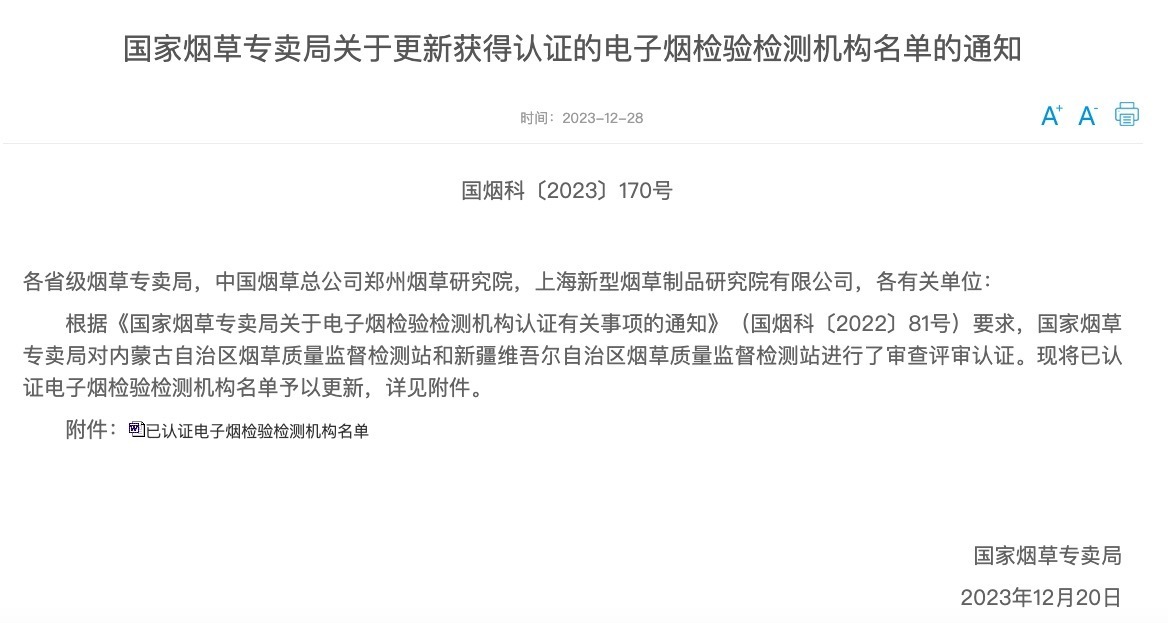
Notice from the State Tobacco Monopoly Administration regarding the update of the list of certified e-cigarette inspection and testing institutions.
Country Tobacco Industry [2023] No. 170
An urban legend is a piece of folklore — a story or narrative — that is supposed to be true but lacks evidence and is often passed down orally from person to person. These legends typically feature bizarre or supernatural events and are often rooted in local or modern culture. They can be found in various forms, such as anecdotes, rumors, and cautionary tales. Urban legends are often created and spread through mass media, including newspapers, magazines, and the internet. They capture public attention because they tap into people's fears, interests, or curiosity. Common themes include horror, crime, morality, and the supernatural.
Some examples of popular urban legends include the "Hookman," the "Bloody Mary" challenge, and the "Kidney Theft" rumor. It is important to note that urban legends are not based on verified facts and are not meant to be taken literally. They are part of our collective storytelling tradition and serve as a form of entertainment or cautionary tales. Although some urban legends may have originated from real events or historical inaccuracies, they have been distorted and exaggerated over time. Urban legends have become a significant aspect of contemporary culture, shaping our understanding of the world and reflecting societal fears and values. They continue to evolve and spread due to the ease of sharing information in the digital age. Whether they elicit fear, wonder, or skepticism, urban legends remain a fascinating part of our folklore and the human experience.
Each provincial tobacco monopoly bureau, China Tobacco Corporation's Zhengzhou Tobacco Research Institute, Shanghai New Tobacco Products Research Institute Ltd., and relevant units,
According to the notice from the State Tobacco Monopoly Bureau regarding the certification of e-cigarette inspection and testing institutions (National Cigarette Science [2022] No. 81), the National Tobacco Monopoly Bureau has conducted a review and evaluation certification of the Inner Mongolia Autonomous Region Tobacco Quality Supervision and Testing Station and the Xinjiang Uygur Autonomous Region Tobacco Quality Supervision and Testing Station. The list of certified e-cigarette inspection and testing institutions has been updated and can be found in the attachment.
We welcome news tips, article submissions, interview requests, or comments on this piece.
Please contact us at info@2firsts.com, or reach out to Alan Zhao, CEO of 2Firsts, on LinkedIn
Notice
1. This article is intended solely for professional research purposes related to industry, technology, and policy. Any references to brands or products are made purely for objective description and do not constitute any form of endorsement, recommendation, or promotion by 2Firsts.
2. The use of nicotine-containing products — including, but not limited to, cigarettes, e-cigarettes, nicotine pouchand heated tobacco products — carries significant health risks. Users are responsible for complying with all applicable laws and regulations in their respective jurisdictions.
3. This article is not intended to serve as the basis for any investment decisions or financial advice. 2Firsts assumes no direct or indirect liability for any inaccuracies or errors in the content.
4. Access to this article is strictly prohibited for individuals below the legal age in their jurisdiction.
Copyright
This article is either an original work created by 2Firsts or a reproduction from third-party sources with proper attribution. All copyrights and usage rights belong to 2Firsts or the original content provider. Unauthorized reproduction, distribution, or any other form of unauthorized use by any individual or organization is strictly prohibited. Violators will be held legally accountable.
For copyright-related inquiries, please contact: info@2firsts.com
AI Assistance Disclaimer
This article may have been enhanced using AI tools to improve translation and editorial efficiency. However, due to technical limitations, inaccuracies may occur. Readers are encouraged to refer to the cited sources for the most accurate information.
We welcome any corrections or feedback. Please contact us at: info@2firsts.com