Philip Morris South Africa calls for science-based tobacco regulation, emphasizing a "risk-proportionate" framework to accelerate smoking rate reduction

Aug.29.2025
Philip Morris South Africa calls for science-based tobacco regulation, emphasizing a "risk-proportionate" framework to accelerate smoking rate reduction
Philip Morris International (PMI) South Africa calls for scientific regulation of e-cigarettes to promote tobacco harm reduction.

Key points:


·Call for Science-Based Regulation: Philip Morris South Africa (PMSA) calls for a science-based regulatory approach to e-cigarettes.

·Risk-Proportionate Measures: The company supports risk-proportionate regulatory measures, emphasizing appropriate regulation for less harmful products.

·Behavior Change: Promoting the switch from traditional cigarettes to e-cigarettes through strict regulation of traditional cigarettes and appropriate regulation of e-cigarettes.

·Reducing Smoking Rates: The measure aims to reduce smoking rates in South Africa, in line with the core objectives of the Tobacco Bill.


According to a report by primediaplus on August 27th, 2025, Philip Morris International (PMI) South Africa is currently calling for the adoption of a "scientific approach" to regulate smoking, while parliament continues to hold public hearings on the Tobacco Products and Electronic Delivery Systems Control Act.


Philip Morris International's (PMI) Regional Affairs Director for South Africa, Themba Mathebula, explained the company's interpretation of appropriate regulation for "reduced-risk" tobacco products.


Mathebula stated that there is a considerable amount of scientific evidence indicating that regulated products on the market pose less harm than continuing to smoke, which is the most harmful way to ingest nicotine through combustion. He believed that the legislation should recognize this evidence and implement proportionate regulatory measures to acknowledge the differences in risks and benefits provided by these products. Mathebula also noted that Philip Morris International (PMI) fully supports regulations on the nicotine market, emphasizing that a proportionate risk-based approach would enable regulators to effectively fulfill their duties by focusing on the most harmful products, such as cigarettes.


If stricter measures are imposed on these products and then properly regulated, it encourages behavior change and promotes a shift from the most harmful products to those with less harm. Our position is that this bill should be an opportunity to accelerate the reduction in smoking rates by adopting multiple approaches to reduce harm.


Mathebula said that by implementing this approach, you are actually achieving the core goal of the legislation, which is to reduce the smoking rate in South Africa.


We welcome news tips, article submissions, interview requests, or comments on this piece.

Please contact us at info@2firsts.com, or reach out to Alan Zhao, CEO of 2Firsts, on LinkedIn


Notice

1.  This article is intended solely for professional research purposes related to industry, technology, and policy. Any references to brands or products are made purely for objective description and do not constitute any form of endorsement, recommendation, or promotion by 2Firsts.

2.  The use of nicotine-containing products — including, but not limited to, cigarettes, e-cigarettes, nicotine pouchand heated tobacco products — carries significant health risks. Users are responsible for complying with all applicable laws and regulations in their respective jurisdictions.

3.  This article is not intended to serve as the basis for any investment decisions or financial advice. 2Firsts assumes no direct or indirect liability for any inaccuracies or errors in the content.

4.  Access to this article is strictly prohibited for individuals below the legal age in their jurisdiction.


Copyright


This article is either an original work created by 2Firsts or a reproduction from third-party sources with proper attribution. All copyrights and usage rights belong to 2Firsts or the original content provider. Unauthorized reproduction, distribution, or any other form of unauthorized use by any individual or organization is strictly prohibited. Violators will be held legally accountable.

For copyright-related inquiries, please contact: info@2firsts.com


AI Assistance Disclaimer


This article may have been enhanced using AI tools to improve translation and editorial efficiency. However, due to technical limitations, inaccuracies may occur. Readers are encouraged to refer to the cited sources for the most accurate information.

We welcome any corrections or feedback. Please contact us at: info@2firsts.com

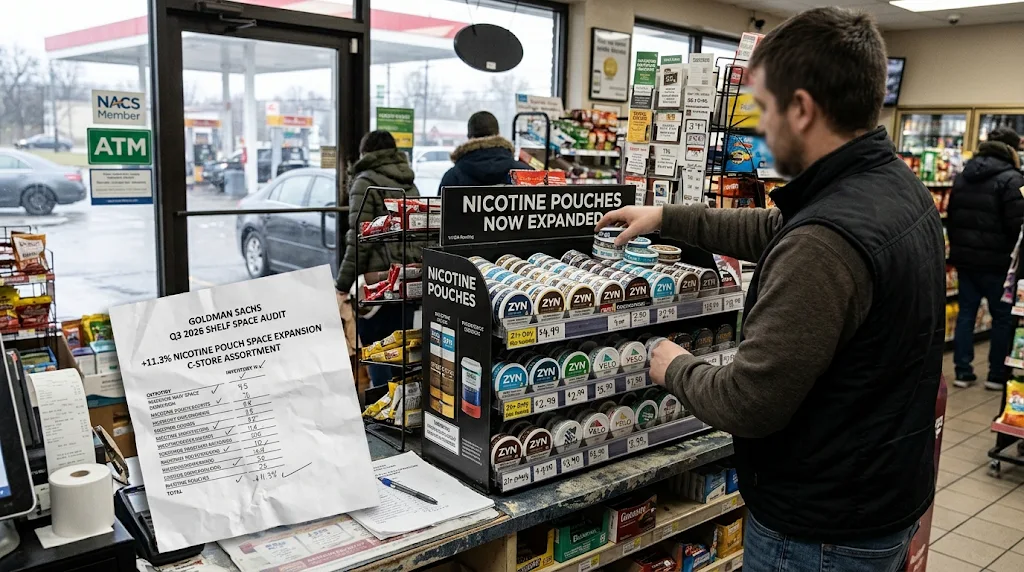
Goldman Sachs Survey Sees 11.3% More U.S. Shelf Space for Nicotine Pouches as ZYN, VELO Show Strong Growth and C-Stores Rework Assortments
Goldman Sachs' third-quarter 2026 Nicotine Nuggets survey found that U.S. tobacco and nicotine retailers expect nicotine pouch shelf space to increase by 11.3%, the largest projected gain among major nicotine product categories. Retailers and wholesalers participating in the survey represent approximately 40,000 U.S. retail locations. Respondents reported stronger third-quarter growth for ZYN and VELO, while on! growth was more moderate. Approximately 80% said deep-discount cigarettes gained market share. In an earlier interview with 2Firsts, the National Association of Convenience Stores (NACS) reported that convenience stores accounted for 92.9% of U.S. other tobacco product sales in 2025. Meanwhile, regional convenience store chains are reallocating nicotine pouch displays and managing vape assortments amid FDA authorization requirements and varying state regulations.
Market
Nov.23
Special Report|RLX Technology Consolidates European Distribution Business for First Time: Q3 2026 Revenue Rises Nearly 70%, Gross Margin Falls to 23.3%
RLX Technology reported a 69.7% year-on-year increase in third-quarter 2026 revenue to RMB1.92 billion ($285.9 million), driven primarily by the consolidation of a newly acquired Western European distributor. International markets accounted for 86.5% of revenue. The acquisition followed RLX's RMB744 million purchase of controlling interests in UK vaping company Totally Wicked in 2025, expanding the group's directly controlled European retail and distribution operations. SEC filings also show that purchases from Shenzhen Smoore Technology Limited declined from 80% of RLX's total purchases in 2022 to 23% in 2025. Third-quarter gross margin fell to 23.3%, while GAAP operating income declined 57.7%.
Business
Nov.20
Reynolds Puts Nearly 183,000 U.S. Contracted Outlets Under Age-Verification Rules, Covering 94% of Volume — Can It Shift an Unauthorized Vape Market?
Reynolds American says nearly 183,000 U.S. retail outlets are under contract, with its Retail Marketing Plan Contract covering about 94% of company volume and requiring point-of-sale age verification. The company combines those contracts with We Card, TruAge, NACS-linked infrastructure and POS integration, while enhanced Vuse Pro retail rules add ID scanning, purchase limits and stronger underage-sales accountability. The initial Vuse Pro rollout targets about 50,000 stores. The system is taking shape as unauthorized vapor products remain dominant in parts of the U.S. market: a 2026 study estimated they accounted for 69.4% of tracked brick-and-mortar e-cigarette dollar sales in December 2025.
Special Report
Oct.15
Russia's State Duma Passes Tobacco and Nicotine Ingredient Disclosure Bill, Targeting 2027 End to Trade-Secret Protection for Certain Harmful Ingredient Data
Russia's State Duma passed a government-sponsored amendment on November 11, 2026, by 414 votes to none, seeking to prevent businesses from classifying information on the presence and number of types of certain harmful ingredients in tobacco and nicotine-containing products as trade secrets. The measure covers ingredients capable of increasing nicotine dependence or exhibiting toxic, carcinogenic, mutagenic or reproductive toxicity, including substances that acquire such properties during heating or smoldering. Bill No. 1286415-8 would amend Article 5 of Federal Law No. 98-FZ on Commercial Secrets and is scheduled to take effect on January 1, 2027. The bill has cleared all three readings in the State Duma but has not completed the remaining legislative procedures.
Regulations
Nov.12 by 2Firsts Perspectives
Imperial Brands' NGP Revenue Rises 11.4% in FY2026 but Business Still Posts £63 Million Loss; Zone Reaches 114,000 US Stores as Smokeless Reporting Takes Shape
Imperial Brands reported an 11.4% increase in next-generation product (NGP) net revenue to £419 million in fiscal 2026, while its adjusted NGP operating loss narrowed to £63 million. European NGP revenue rose 16.8%, while the Americas recorded a 17.1% decline. Global modern oral nicotine volumes increased 27.8%, with US nicotine pouch brand Zone expanding to approximately 114,000 stores. The company also acquired Black Buffalo in the US and Helwit in Sweden, broadening its oral nicotine portfolio. From FY2027, Imperial Brands will adopt a new Smokeless reporting category combining NGP with traditional oral tobacco. On the new basis, FY2026 Smokeless net revenue was £554 million, with adjusted operating profit of £14 million.
company
Nov.18
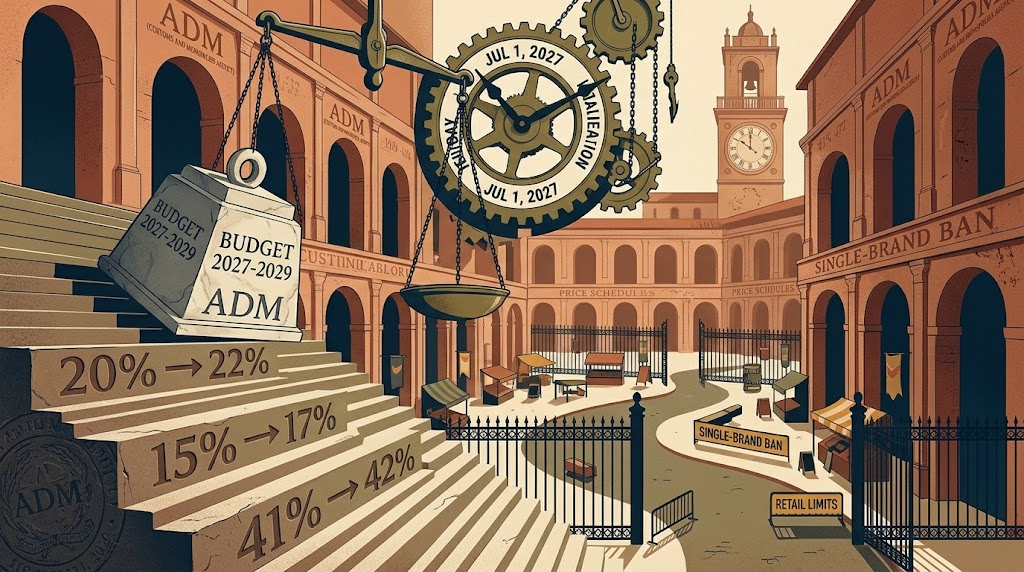
Italy Proposes Earlier Vape and HTP Tax Hikes, New Rules for E-Liquid Pricing, Exclusive Deals and Distribution
Italy's proposed 2027–2029 budget would bring forward scheduled tax increases for e-cigarette liquids and heated tobacco products from January 1, 2028, to July 1, 2027. The consumption tax coefficient for nicotine-containing e-liquids would rise from 20% to 22%, that for nicotine-free liquids and applicable flavorings from 15% to 17%, and the heated-tobacco coefficient from 41% to 42%. The bill would also introduce official retail price schedules for e-liquids, restrict exclusive agreements between retailers and suppliers, and limit single-brand-dominated displays, sales incentives and bundled offers. Importing, authorized warehousing and retailer sourcing arrangements would also change. The proposals remain subject to parliamentary approval and subsequent implementing regulations.
Regulations
Nov.04