Possible title: FDA May Authorize E-Cigarette Flavors Beyond Tobacco and Menthol.

Dec.29.2022
Possible title: FDA May Authorize E-Cigarette Flavors Beyond Tobacco and Menthol.
The FDA may authorize e-cigarette flavors beyond tobacco and menthol, favoring big tobacco companies over small businesses.

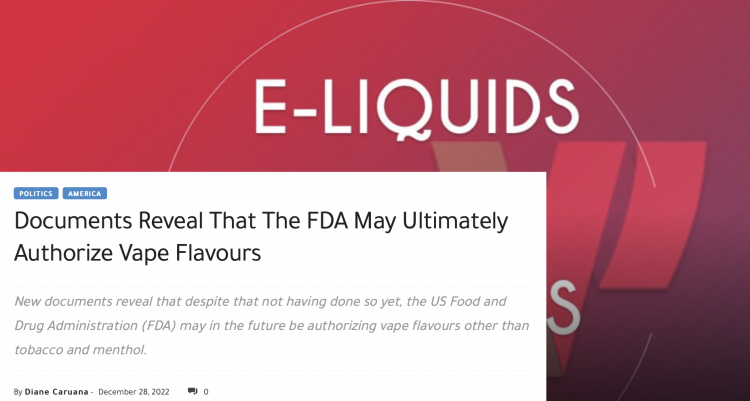
According to a report by Filter, the United States Food and Drug Administration (FDA) may authorize electronic cigarette flavors other than tobacco and menthol in the future.


New documents reveal that the FDA's relationship with big tobacco companies is not ordinary, as the FDA seems to favor big tobacco companies over small businesses.


Documents obtained by Filter earlier this year clearly indicate bias by FDA towards flavored electronic cigarette products. While PMTA applications from small and medium-sized businesses were rejected, PMTA reviewers created a process to swiftly reject many of these companies' tobacco products without reviewing their submitted files, allowing for the backlog of millions of PMTAs to be addressed.


Another article from Filter explains that this method is called the "deadly flaw" strategy, which involves "database queries to identify the top twelve manufacturers in the unscientifically reviewed non-tobacco flavored e-cigarette products by pending count," and determine if any of them include randomized controlled trials (RCTs) or longitudinal cohort studies.


Although the FDA may plan to authorize flavors, new documents discussed by Filter indicate that the FDA's relationship with large tobacco companies and its tendency to favor big corporations over small businesses are also factors to consider.


According to a report by Filter, while the overall plan is consistent with the FDA's extensive information, the focus of its PMTA review process will be on the companies with the largest market share, revealing how ridiculous this priority has become.


The guiding principles for the PMTA application process are as follows:


1. Simplicity: The chosen method should be easy to manage, explain, and implement.


Defensible: The decision was not arbitrary or capricious.


3. Flexibility: If necessary, the process provides an opportunity to adjust strategies easily.


4. Supporting public health goals: Minimize youth initiation as much as possible; ensure that various nicotine electronic cigarettes (delivery systems) ENDs have the opportunity to remain on the market to help adult smokers switch to less harmful tobacco products.


Disclaimer

This article is provided solely for professional research, industry discussion, and informational purposes. Any references to brands, companies, products, technologies, or policies are made for factual reporting and analytical purposes only, and do not constitute endorsement, recommendation, promotion, or advertising by 2Firsts.

Nicotine-containing products, including but not limited to cigarettes, e-cigarettes, heated tobacco products, and nicotine pouches, carry significant health risks. Readers are responsible for complying with all applicable laws and regulations in their respective jurisdictions, including age restrictions and access limitations.

The information contained in this article should not be regarded as investment, legal, medical, regulatory, or commercial advice. While 2Firsts strives to ensure the accuracy and reliability of its content, it does not assume liability for any direct or indirect loss arising from errors, omissions, inaccuracies, or reliance on the information contained herein.

This article is not intended for individuals below the legal age for accessing tobacco or nicotine-related information in their jurisdiction.


Copyright Notice

This article is either original content produced by 2Firsts or content reproduced, translated, summarized, or adapted from third-party sources with attribution where applicable. The intellectual property rights of the original content remain with 2Firsts or the respective original rights holders.

No individual or organization may copy, reproduce, distribute, republish, modify, translate, or otherwise use this content without prior authorization. Any unauthorized use may result in legal action.

For copyright-related inquiries, corrections, or removal requests, please contact: info@2firsts.com.


AI-Assisted Translation and Editing Notice

Portions of this article may have been translated, edited, or reviewed with the assistance of artificial intelligence tools to improve efficiency and readability. Due to the limitations of AI-assisted translation and editing, discrepancies, omissions, or inaccuracies may exist when compared with the original source.

Where applicable, readers are advised to refer to the original source for the most complete and accurate information. If you identify any errors or believe that any content infringes upon your rights, please contact us at info@2firsts.com, and we will review and address the matter promptly.


South Korea Imports 12,126 Kg of Nicotine Analogues From April to August After Bringing Synthetic Nicotine Under Tobacco Law
South Korea's liquid-vape market is showing changes across raw-material imports, product types and sales channels after synthetic nicotine came under the Tobacco Business Act on April 24. Customs data show nicotine-analogue imports totaled 12,126 kilograms from April through August, while synthetic-nicotine imports over the same five months totaled 231,663 kilograms, just 39.3% of the amount imported in March alone. Physical liquid-vape stores tracked in Seoul and Gyeonggi Province fell 9.9%, unmanned outlets edged higher and online sales listings increased from 27,774 to 42,437. Government testing of 105 liquid inhalation products promoted as nicotine-free separately found nicotine in 13 and 6-methylnicotine in 12.
Sep.22
EU Trade Department Faces Scrutiny Over Contacts With Tobacco Industry
European Ombudswoman Teresa Anjinho has opened an inquiry into how the European Commission’s Directorate-General for Trade handles interactions with the tobacco industry. The case follows a complaint from a civil society organisation that alleges regular, unnecessary and non-transparent contacts between DG TRADE and tobacco industry representatives, raising questions over compliance with the EU’s obligations under the WHO Framework Convention on Tobacco Control. The inquiry remains ongoing, and the Ombudswoman has not reached any finding of maladministration.
Aug.24
Philip Morris Malaysia Again Meets Religious Authority Over Cigarette Alternatives as Perlis Mufti Responds on Halal Criteria
Philip Morris Malaysia Managing Director Naeem Shahab Khan met Perlis Mufti Mohd Asri Zainul Abidin on September 17 and presented the company's shift from conventional cigarettes toward alternative products. The mufti said a product could be considered halal if it is clean, its side effects are not harmful or can be controlled, and it does not involve excessive waste. His remarks did not mention IQOS or any other specific PMI product and did not amount to a new product-specific religious ruling. It was at least the second publicly reported engagement between Philip Morris Malaysia and a Malaysian religious institution over cigarette alternatives within six months.
Regulations
Sep.18 by 2Firsts Perspectives
Retail Case Study | Wisconsin Vape Market One Year After New Regulations: Johnny Vapes Reports 80% Sales Decline as Consumers Shift Online and Across State Lines
According to WNCY on August 24, 2026, some independent vape retailers in Wisconsin say they have faced significant business pressure one year after new vape regulations took effect. Johnny Vapes, a retailer operating in northeast Wisconsin, said its store count fell from seven locations to four, sales declined by about 80%, and roughly 90% of its inventory was affected. Retailers said some consumers have shifted to online purchases or traveled to neighboring Michigan to buy vape products. The case highlights how local regulations can reshape retail operations, inventory management and consumer purchasing patterns.
Aug.28
Cochrane 2026 Update Adds Nine Trials, Keeps High-Certainty Finding That Nicotine E-Cigarettes Improve Quit Rates Over NRT
Cochrane’s 2026 update of its living review on electronic cigarettes for smoking cessation included 80 randomized controlled trials involving 29,861 adult smokers, with nine trials added in this update. The review retained its high-certainty conclusion that nicotine e-cigarettes increase smoking cessation rates compared with nicotine replacement therapy. In absolute terms, about 10 in 100 people using nicotine e-cigarettes may quit smoking for at least six months, compared with about 6 in 100 using NRT. The review found no clear difference in serious adverse event rates between the two groups, while longer-term safety and the relative effectiveness of newer device types remain less certain.
Sep.07
Product | PMI Japan Expands ZYN by IQOS Strength Portfolio With Strong Series, Increasing Lineup to 12 Products
Philip Morris Japan (PMJ) has expanded the ZYN by IQOS oral tobacco pouch portfolio in Japan with four new ZYN Strong products, adding a third intensity level alongside the existing Low and Medium ranges. The Strong series first entered selected duty-free channels in Japan on July 1, 2026, before expanding to IQOS stores, the ZYN Online Store and selected tobacco retailers from August 18. The expansion increases the Japanese ZYN by IQOS lineup from eight to 12 products.
Aug.20