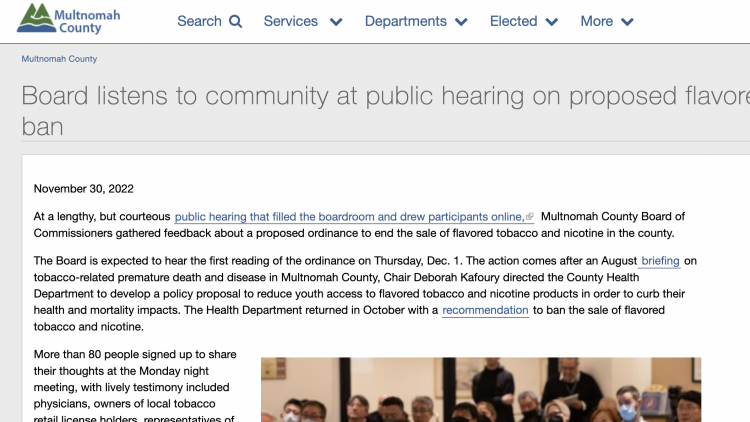
The Motenoma County Commission has gathered feedback regarding a proposed ordinance to end the sale of flavored tobacco and nicotine products in the county.
The committee is expected to hold the first round of discussions on the regulation on Thursday, December 1st. This action was taken after a briefing on tobacco-related premature death and disease in Multnomah County in August. Chair Deborah Kafoury instructed the county health department to develop a policy to reduce the chances of young people accessing flavored tobacco and nicotine products in order to curb their impact on health and mortality rates. In October, the health department recommended banning the sale of flavored tobacco and nicotine.
More than 80 people registered to share their ideas at Monday night's meeting, including doctors, owners of local tobacco retail licenses, representatives of community organizations and trade groups, college students, and other county residents.
Many speakers supporting the regulation expressed their concerns about the continued targeting of young people, the long-standing disparities in nicotine and tobacco use among African Americans and the LGBTQ+ community, and the overall harmful health effects experienced by tobacco and nicotine users.
Portland Public Schools students recently spoke with Mary Stevens-Krough from the Health Department about the impact of students using flavored tobacco products on schools and educators.
From a serious annoyance and distraction, it has now turned into a public health crisis, spreading to our high schools and forcing principals to remove bathroom stall doors to reduce opportunities for use on campus. Stevens-Krough discusses the use of electronic cigarettes in high schools.
Opponents of the ban argue that it could harm individuals who carry these products and local businesses that rely on sales of these products. Others caution that those who illegally sell these products would add more pressure to already overloaded law enforcement agencies.
The owner of a shop in Motunui County, Maher Makboul, expressed his concerns about the ban and the potential financial impact it could have on his business.
Makboul stated, "We are struggling to survive amidst the COVID pandemic, taxes, and other license fees.
The Tobacco Industry in Moterunoma County
Under the leadership of Multnomah County Chair Deborah Kafoury, the board and health department have been committed to addressing the health risks posed to county residents by tobacco and nicotine use.
In 2014, Dr. Jennifer Vines, who was the Deputy Health Officer at the time, alerted the committee to concerns regarding the use and accessibility of tobacco and e-cigarettes in the county of Mendocino. The Health Department's report at the time revealed that a survey conducted in 2012 among 1,700 teenagers in 17 high schools in Mendocino County found that one in every 15 teenagers claimed to smoke cigarettes daily, while one in every 25 teenagers reported using e-cigarettes.
In 2015, Multnomah County passed a law prohibiting minors from purchasing and using inhaling delivery systems such as electronic cigarettes, e-cigarettes, and electronic hookahs. The law also restricted their use indoors in smoke-free areas within the state of Oregon.
Several months later, the committee approved the licenses for companies selling tobacco and e-cigarette products based on state and federal regulatory agencies' recommendations, aiming to reduce illegal sales to minors in Mottanoma County, where the proportion of such sales was highest.
After the Ministry of Health made a request to the committee in 2017 to raise the legal age of purchasing tobacco products if the state government failed to take action, Governor Kate Brown of Oregon signed a bill to set the minimum age for purchasing cigarettes at 21 years old.
Young people and doctors are among those who support the ban.
Dr. Cynthia McPhee, who has worked as a pediatrician for 21 years, spoke in favor of the ban and stated that she is certain the number of children who are vaping or using flavored tobacco products is increasing.
I saw teenagers aged 12 to 14 as well as older adolescents admitting to either using flavored tobacco products or having friends who do," she said.
Community member Avery Dukes discussed her personal experience and the importance of approving the ban, as tobacco companies disproportionately target Black communities.
For generations, the economic growth strategy of white communities has been to entice Black people to become consumers of material goods," said Dukes. "And you have the power to put an end to this pattern in Motenonomah County.
As a young person born and raised here, I implore you to support this law," began Sophia Kogan, as she described in detail her personal experience of using electronic cigarettes during high school and college.
Kogan describes flavored tobacco products as something ubiquitous during high school lunches and equally prevalent in college. "My peers often raise their binders or laptops to hide their e-cigarettes because they swear they need it to get through the day.
E-cigarette shops and small businesses oppose the ban.
Emily Soles, who represents the Small Business Association of Oregon and the Oregon Vape Trade Association, voiced her opposition to the proposed ban. She stated that the ban would ultimately lead to "pushing sales to other counties and taking toys away from legal adult consumers.
The issue is not about taste," she continued. "The problem lies with inadequate law enforcement.
Chris Kim, Vice President of the Oregon Korean American Grocers Association, stated that the ban will impact over 180 members of their organization who own and operate businesses throughout the county.
Our many member stores will be forced to close," said Kim. "Instead, by partnering with retailers in Oregon and Sonoma County, they are the first line of defense in preventing children from purchasing flavored tobacco products.
Dawood Zainel, owner of a Hookah Lounge, stated that the proposal to ban flavored tobacco and nicotine products, including hookah, is incorrect.
Shisha is a traditional form of smoking that has been around for centuries. Many people in our community enjoy visiting shisha lounges as it is a part of their culture.
Next step. (This is already in English and does not need to be translated.)
The Committee of Motenoma County will conduct a first reading of a proposed regulation during their regular board meeting on Thursday, December 1. A second reading is scheduled for their regular board meeting on Thursday, December 15. If approved, the regulation will take effect on January 1, 2024.
2FIRSTS will continue to follow and report on this issue, with updates available on the '2FIRSTS APP'. Scan the QR code below to download the app.
Disclaimer
This article is provided solely for professional research, industry discussion, and informational purposes. Any references to brands, companies, products, technologies, or policies are made for factual reporting and analytical purposes only, and do not constitute endorsement, recommendation, promotion, or advertising by 2Firsts.
Nicotine-containing products, including but not limited to cigarettes, e-cigarettes, heated tobacco products, and nicotine pouches, carry significant health risks. Readers are responsible for complying with all applicable laws and regulations in their respective jurisdictions, including age restrictions and access limitations.
The information contained in this article should not be regarded as investment, legal, medical, regulatory, or commercial advice. While 2Firsts strives to ensure the accuracy and reliability of its content, it does not assume liability for any direct or indirect loss arising from errors, omissions, inaccuracies, or reliance on the information contained herein.
This article is not intended for individuals below the legal age for accessing tobacco or nicotine-related information in their jurisdiction.
Copyright Notice
This article is either original content produced by 2Firsts or content reproduced, translated, summarized, or adapted from third-party sources with attribution where applicable. The intellectual property rights of the original content remain with 2Firsts or the respective original rights holders.
No individual or organization may copy, reproduce, distribute, republish, modify, translate, or otherwise use this content without prior authorization. Any unauthorized use may result in legal action.
For copyright-related inquiries, corrections, or removal requests, please contact: info@2firsts.com.
AI-Assisted Translation and Editing Notice
Portions of this article may have been translated, edited, or reviewed with the assistance of artificial intelligence tools to improve efficiency and readability. Due to the limitations of AI-assisted translation and editing, discrepancies, omissions, or inaccuracies may exist when compared with the original source.
Where applicable, readers are advised to refer to the original source for the most complete and accurate information. If you identify any errors or believe that any content infringes upon your rights, please contact us at info@2firsts.com, and we will review and address the matter promptly.