Key Takeaways
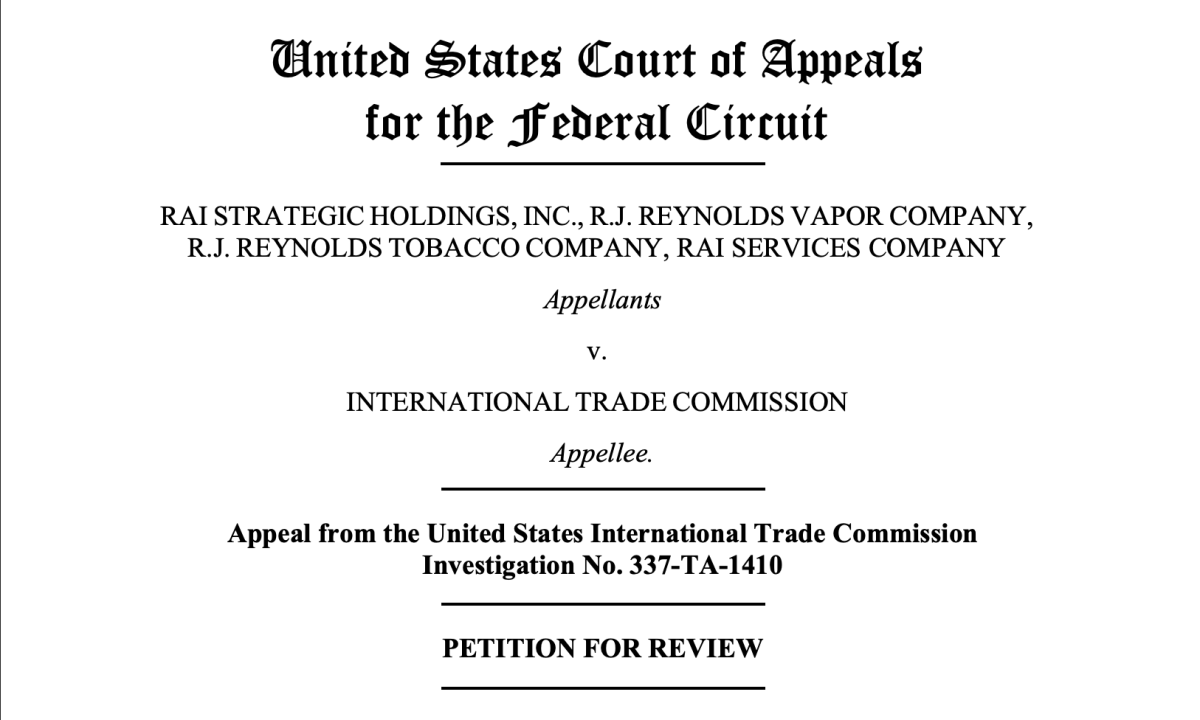
- Reynolds filed an appeal on March 13, 2026 with the U.S. Court of Appeals for the Federal Circuit seeking review of the ITC’s March 10 final ruling.
- The ITC invalidated claims 1, 4 and 12 of U.S. Patent No. 11,925,202 and terminated the Section 337 investigation.
- The investigation began on July 22, 2024 and involved 35 disposable vape companies.
- In August 2025, the administrative law judge found infringement of claims 4 and 12 and recommended a general exclusion order and a 136% bond.
- Reynolds paid a USD 600 filing fee when submitting the appeal.
2Firsts, March 16, 2026
R.J. Reynolds and its related companies have filed an appeal with the U.S. Court of Appeals for the Federal Circuit seeking to overturn the U.S. International Trade Commission’s final ruling in the disposable vape Section 337 investigation, Investigation No. 337-TA-1410.
The case began on July 22, 2024, when the ITC instituted a Section 337 investigation based on Reynolds’ complaint against 35 companies accused of infringing U.S. Patent No. 11,925,202. The respondents included Chinese manufacturers and U.S. brands such as Breeze Smoke, Kangvape and IVPS.
On August 29, 2025, the ITC administrative law judge issued a final initial determination finding that the respondents infringed claims 4 and 12 of the “202 patent” and that those claims were valid. The administrative law judge also recommended that the ITC issue a general exclusion order and impose a 136% bond.
The respondents later petitioned for review. On January 9, 2026, the ITC Commission decided to review portions of the administrative law judge’s determination, focusing on patent validity.
On March 10, 2026, the ITC issued its Commission Opinion and final determination, reversing the administrative law judge and holding that claims 1, 4 and 12 of the “202 patent” were invalid. The Commission also found no violation of Section 337 and terminated the investigation.
According to the original report, the ITC concluded that the claimed invention would have been obvious to a person of ordinary skill in the art in view of the Kim reference, U.S. Patent App. Pub. No. 2006/0016453, and the Pienemann reference, WO 00/28843.
With respect to porous wicking, the ITC said that using porous material to store and guide liquid was a basic principle and that a skilled person would naturally consider such a design to improve e-cigarette function.
With respect to airflow and heater structure, the ITC said the prior art had already disclosed central passageways and heating coil structures, and that allowing air to pass through the heater and mix with aerosol was a conventional design choice.
Three days after the ITC issued its final ruling, Reynolds filed a petition for review with the U.S. Court of Appeals for the Federal Circuit on March 13, 2026, and paid a USD 600 filing fee. According to the original report, Reynolds asked the court to review all adverse rulings issued by the ITC on March 10.
The original report also said the case affects Reynolds’ position in the reduced-risk product market and the ability of the respondent Chinese vape manufacturers and U.S. distributors to continue operating in the U.S. market.
Related reading:
We welcome news tips, article submissions, interview requests, or comments on this piece.
Please contact us at info@2firsts.com, or reach out to Alan Zhao, CEO of 2Firsts, on LinkedIn
Notice
1. This article is intended solely for professional research purposes related to industry, technology, and policy. Any references to brands or products are made purely for objective description and do not constitute any form of endorsement, recommendation, or promotion by 2Firsts.
2. The use of nicotine-containing products — including, but not limited to, cigarettes, e-cigarettes, nicotine pouchand heated tobacco products — carries significant health risks. Users are responsible for complying with all applicable laws and regulations in their respective jurisdictions.
3. This article is not intended to serve as the basis for any investment decisions or financial advice. 2Firsts assumes no direct or indirect liability for any inaccuracies or errors in the content.
4. Access to this article is strictly prohibited for individuals below the legal age in their jurisdiction.
Copyright
This article is either an original work created by 2Firsts or a reproduction from third-party sources with proper attribution. All copyrights and usage rights belong to 2Firsts or the original content provider. Unauthorized reproduction, distribution, or any other form of unauthorized use by any individual or organization is strictly prohibited. Violators will be held legally accountable.
For copyright-related inquiries, please contact: info@2firsts.com
AI Assistance Disclaimer
This article may have been enhanced using AI tools to improve translation and editorial efficiency. However, due to technical limitations, inaccuracies may occur. Readers are encouraged to refer to the cited sources for the most accurate information.
We welcome any corrections or feedback. Please contact us at: info@2firsts.com