Russia Introduces New Tobacco Regulations to Protect Public Health

Jan.20.2025
Russia Introduces New Tobacco Regulations to Protect Public Health
Russia introduces new law restricting non-smoking additives in tobacco products, with potential fines up to $20,000 for selling to minors.

According to a report from Пронедра.ru on January 18th, the Russian government has recently introduced a new regulation limiting the use of non-cigarette type additives in tobacco products.


This regulation will involve chewing tobacco and snuff, and is planned to take effect from March 1, 2025. In addition, lawmakers are also considering introducing penalties for selling tobacco and e-cigarettes to minors, with fines of up to 2 million rubles (20,000 US dollars).


According to the new regulations, nicotine salts, ammonium, ammonia, acetaldehyde, and sugars are not allowed to be added to tobacco products. These substances are typically used to enhance flavor or accelerate nicotine absorption, but they also significantly increase the risk of addiction and health hazards.


In addition to the existing restrictions on additives, the Republic of Udmurtia State Council has proposed legislation to the national Duma meeting to prohibit the retail sale of nicotine-containing products, including hookah, e-cigarette e-liquid, and e-cigarettes.


We welcome news tips, article submissions, interview requests, or comments on this piece.

Please contact us at info@2firsts.com, or reach out to Alan Zhao, CEO of 2Firsts, on LinkedIn


Notice

1.  This article is intended solely for professional research purposes related to industry, technology, and policy. Any references to brands or products are made purely for objective description and do not constitute any form of endorsement, recommendation, or promotion by 2Firsts.

2.  The use of nicotine-containing products — including, but not limited to, cigarettes, e-cigarettes, nicotine pouchand heated tobacco products — carries significant health risks. Users are responsible for complying with all applicable laws and regulations in their respective jurisdictions.

3.  This article is not intended to serve as the basis for any investment decisions or financial advice. 2Firsts assumes no direct or indirect liability for any inaccuracies or errors in the content.

4.  Access to this article is strictly prohibited for individuals below the legal age in their jurisdiction.


Copyright


This article is either an original work created by 2Firsts or a reproduction from third-party sources with proper attribution. All copyrights and usage rights belong to 2Firsts or the original content provider. Unauthorized reproduction, distribution, or any other form of unauthorized use by any individual or organization is strictly prohibited. Violators will be held legally accountable.

For copyright-related inquiries, please contact: info@2firsts.com


AI Assistance Disclaimer


This article may have been enhanced using AI tools to improve translation and editorial efficiency. However, due to technical limitations, inaccuracies may occur. Readers are encouraged to refer to the cited sources for the most accurate information.

We welcome any corrections or feedback. Please contact us at: info@2firsts.com

Germany's Four-Year Tobacco Tax Plan Heads to Parliament as BAT, JTI and PMI Push for Changes
Germany's parliament is scheduled to hold a first reading of amendments to the Tobacco Tax Act on September 24. The government plans annual tax increases from 2027 through 2030 covering cigarettes, heated tobacco, vaping liquids and other categories. It expects the reform to generate €756 million in additional revenue in 2027, rising to €3.589 billion in additional annual revenue by 2030. Ahead of the parliamentary debate, the German Association of the Tobacco Industry and Novel Products, or BVTE, launched the "Tabaksteuer mit Augenmaß" campaign backed by BAT, JTI, Philip Morris, Reemtsma and wholesale and retail groups.
Sep.23
Juul Sublicense Reshapes Vuse Alto Patent Bill as Court Ends R.J. Reynolds’ 5.25% Royalty Obligation to Altria
According to Law360 on August 31, 2026, a federal judge in North Carolina ruled that a patent sublicense between R.J. Reynolds Vapor Co. and Juul Labs Inc. relieves Reynolds of its obligation to continue paying royalties to Altria Client Services LLC over Vuse Alto. A jury had previously found that Vuse Alto infringed three Altria patents and awarded approximately $95.2 million in past damages, after which Reynolds was ordered to pay an ongoing royalty equal to 5.25% of positive net sales. The new ruling finds that a valid sublicense can eliminate future infringement, potentially ending what Altria described as hundreds of millions of dollars in future royalties.
Sep.01
FDA Authorizes Four More Nicotine Pouches as Review Pilot Expands Beyond Initial Decisions
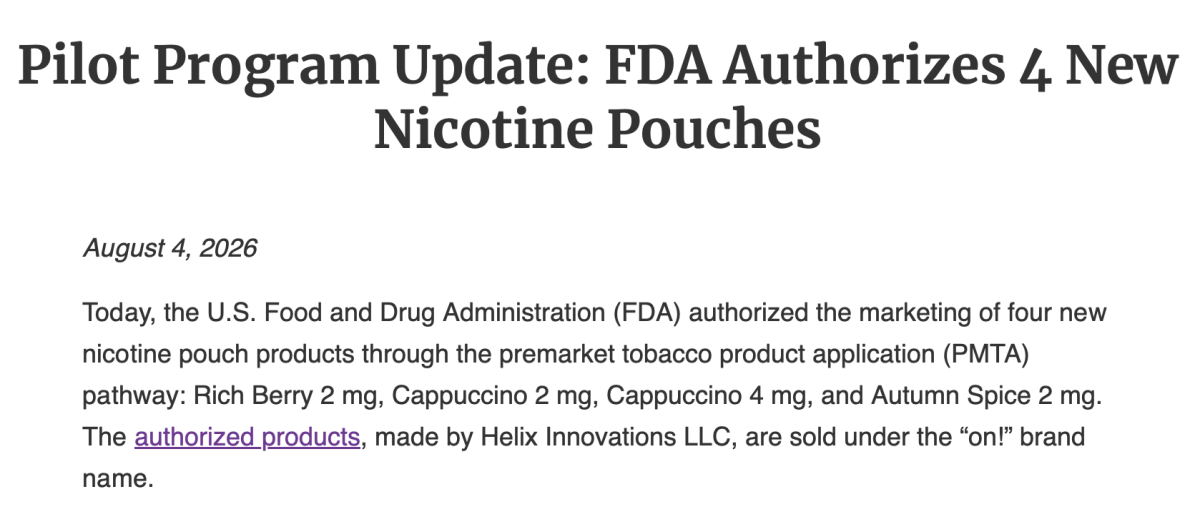
The FDA has authorized four additional on! nicotine pouches, bringing the U.S. total to 30. The decision marks another outcome of the agency’s nicotine pouch review pilot, whose communication and review practices are now being applied more broadly across the category. It also extends Helix’s authorized portfolio from on! PLUS to the earlier on! line. Yet all FDA-authorized nicotine pouches still come from subsidiaries of PMI or Altria, underscoring how concentrated U.S. regulatory access remains.
Aug.05
Product | JTI Launches Ploom AURA Teal Electric Pop in South Korea, Its First Dual-Color Edition
JTI Korea launched the Ploom AURA Teal Electric Pop limited edition in South Korea on September 1, 2026, marking the first dual-color design in the Ploom AURA range. The device combines a dark green body with teal accents and is accompanied by matching Front Panel, Back Cover and Pocket Bag accessories. The standalone device is priced at KRW 29,000, with three additional device-and-accessory bundles available. The release continues JTI Korea's use of limited colorways and interchangeable accessories to expand the Ploom AURA portfolio without introducing a new hardware platform.
Sep.03
2Firsts Data | China’s Vape-Related Exports Rise 16.5% in July 2026 as U.S.-Bound Shipments Jump 53.5%
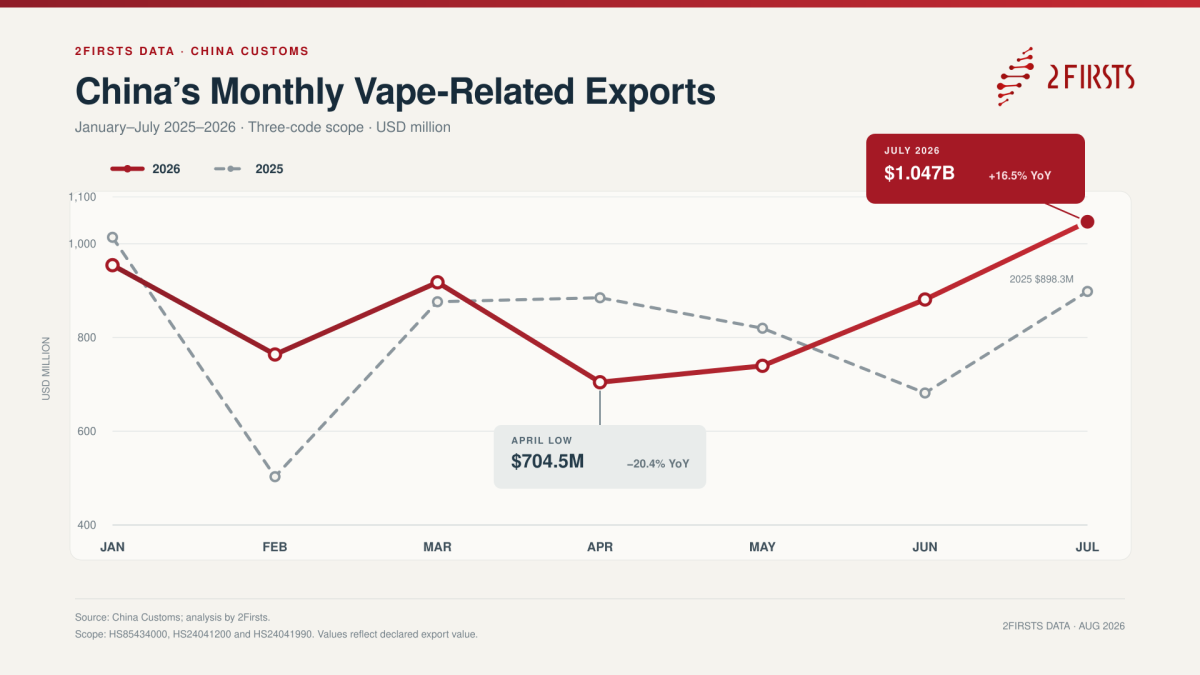
China’s vape-related exports reached $1.047 billion in July 2026, up 16.5% year on year and the highest monthly total of the year. Growth was heavily concentrated in the U.S., where exports jumped 53.5% to $404 million and accounted for 94.9% of the overall increase. Exports to all other markets rose just 1.2%. By category, nicotine-containing non-combustible products—primarily vapes—under HS24041200 rose 24.7% and generated 95.5% of the total increase. Vape-device exports under HS85434000 fell 0.4%, while other nicotine-substitute products under HS24041990 grew 88.9% but remained comparatively small.
DATA
Aug.24
Arizona Turns to a 50% Retail Vape Tax as Tobacco Tax Revenue Falls 47% From 2008
Arizona's First Things First is pushing for an excise tax equal to 50% of the retail price of vaping products, estimating that the measure could generate about $100 million annually. The agency says its tobacco-tax revenue has fallen 47% from 2008 levels. Arizona has attempted to broaden its nicotine tax base in each of the past two years: a 2025 bill proposed a 50% wholesale-price tax, while a 2026 measure shifted to a 50% retail-price tax covering alternative nicotine products and vapor products. Separately, the state enacted HB 4001 this year to establish a new licensing and sales framework for alternative nicotine products.
Sep.21