Philippines Seizes $21 Million in Counterfeit Goods, Including Kylinbar E-Cigarettes

Mar.13.2025
Philippines Seizes $21 Million in Counterfeit Goods, Including Kylinbar E-Cigarettes
Philippine Customs has sealed a warehouse holding counterfeit goods, including Kylinbar disposable e-cigarettes, valued at approximately 1.2 billion pesos ($21 million). The warehouse operator could face charges.

Key Points:


1. A warehouse in the Philippines was raided and found to contain $12 billion pesos ($210 million) worth of suspected illegal e-cigarettes and counterfeit goods.


2. The products seized involved the Kylinbar brand of disposable e-cigarettes.


3. The warehouse management party may face legal charges if they fail to provide legal import documentation within 15 days.


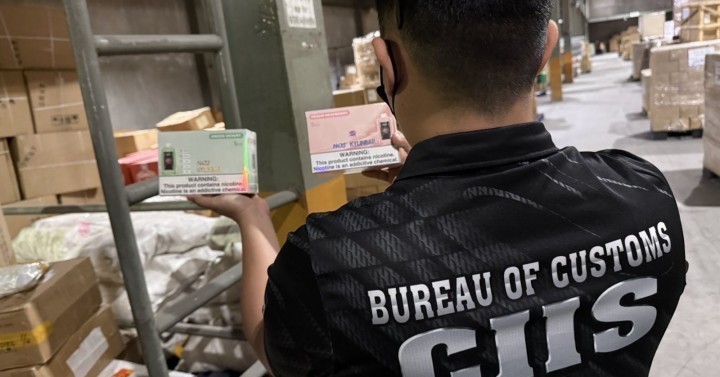
2Firsts, reporting from Shenzhen - The Philippine Bureau of Customs (BOC) seized a warehouse in Malabon City, allegedly storing approximately 1.2 billion pesos ($21 million) worth of suspicious illegal e-cigarettes and counterfeit goods.


Bienvenido Rubio, the Customs Commissioner, stated at a press conference on Wednesday that the items seized included disposable e-cigarettes, shoes, bags, and cosmetics.


Verne Enciso, Director of the Customs Intelligence and Investigation Service (CIIS), said that upon receiving authorization from the Customs Director, they immediately went to a warehouse in Malabon City. 


The CIIS team and investigators from the Manila International Container Port (MICP) found disposable e-cigarettes from Kylinbar in the warehouse without labels from the Bureau of Internal Revenue (BIR) and Department of Trade and Industry (DTI).


The investigation team temporarily sealed the warehouse and planed to conduct an inventory of the items with customs inspectors, CIIS, the Enforcement and Security Service (ESS), and warehouse representatives. 


Warehouse operators were required to provide documents proving the legal acquisition and tax payment of imported goods within 15 days of receiving the authorization letter, or face potential charges under Articles 1113, 117, and 1400 of the Customs Modernization and Tariff Act (CMTA)


They may also face charges under the Intellectual Property Code of the Philippines or Republic Act 8293.


We welcome news tips, article submissions, interview requests, or comments on this piece.

Please contact us at info@2firsts.com, or reach out to Alan Zhao, CEO of 2Firsts, on LinkedIn


Notice

1.  This article is intended solely for professional research purposes related to industry, technology, and policy. Any references to brands or products are made purely for objective description and do not constitute any form of endorsement, recommendation, or promotion by 2Firsts.

2.  The use of nicotine-containing products — including, but not limited to, cigarettes, e-cigarettes, nicotine pouchand heated tobacco products — carries significant health risks. Users are responsible for complying with all applicable laws and regulations in their respective jurisdictions.

3.  This article is not intended to serve as the basis for any investment decisions or financial advice. 2Firsts assumes no direct or indirect liability for any inaccuracies or errors in the content.

4.  Access to this article is strictly prohibited for individuals below the legal age in their jurisdiction.


Copyright


This article is either an original work created by 2Firsts or a reproduction from third-party sources with proper attribution. All copyrights and usage rights belong to 2Firsts or the original content provider. Unauthorized reproduction, distribution, or any other form of unauthorized use by any individual or organization is strictly prohibited. Violators will be held legally accountable.

For copyright-related inquiries, please contact: info@2firsts.com


AI Assistance Disclaimer


This article may have been enhanced using AI tools to improve translation and editorial efficiency. However, due to technical limitations, inaccuracies may occur. Readers are encouraged to refer to the cited sources for the most accurate information.

We welcome any corrections or feedback. Please contact us at: info@2firsts.com

 Philip Morris Lowers Profit Outlook as Zyn Faces Competition and FDA Delays
Philip Morris Lowers Profit Outlook as Zyn Faces Competition and FDA Delays
According to Reuters, Philip Morris International (PMI) lowered its 2026 adjusted earnings-per-share forecast amid regulatory uncertainty around Zyn nicotine pouches, rising competition and shipment pressure in the U.S. market.
PMI
Jun.02
How AI Is Rewriting the Talent Playbook for the Nicotine Industry: JTI’s Case
AI is moving from a back-office tool to a core organizational capability in the nicotine industry. Based on JTI’s responses, this 2Firsts feature examines how AI is reshaping talent strategy, internal mobility, decision-making and human accountability as global tobacco companies compete in the shift toward new nicotine categories.
Jun.17
BAT Estimates U.S. Unauthorized Vape Market at $9.4 Billion, Plans New Vuse and Velo Launches After FDA Enforcement Shift
British American Tobacco (BAT) CEO Tadeu Marroco said the U.S. unauthorized vape market is worth about £7 billion, or US$9.43 billion. Following a shift in FDA enforcement policy, BAT plans to launch flavored Vuse products in the third quarter and an updated Velo pouch in August or September.
Jun.15
Special Report | Russia, Ukraine and Belarus Launch Fresh Push to Rein in Vaping
Russia, Ukraine and Belarus are tightening vape regulation through different tools, from Ukraine’s stronger enforcement push and Belarus’s proposed advertising restrictions to Russia’s new GOST standard and regional sales-ban mechanism. As black-market concerns persist, some Russian experts argue that China’s tightly controlled but legalised model — built around licensing, traceability and taxation — may offer a more effective alternative to blanket prohibition.
Jul.15
Indiana’s Foreign-Made Vape Ban Takes Effect, Forcing Brands and Retailers to Adjust Supply Chains
A new Indiana law restricting the sale of foreign-made vape products has taken effect, requiring retailers to adjust inventory and sourcing practices. According to The Sun, WDRB and other reports, some local vape shops are reviewing product origins and supplier information to comply with the new requirements. The measure represents a broader shift in U.S. vape regulation, with oversight expanding beyond product authorization and sales rules toward manufacturing origin and supply-chain management.
Jul.24
Japan’s Heated Tobacco Tax Reform Drives Price Increase as JT Raises All Ploom Sticks by ¥40
Japan Tobacco Inc. (JT) has applied to Japan’s finance minister for approval to revise retail prices of its Ploom heated tobacco sticks following planned changes to the heated tobacco tax system from October 1, 2026. If approved, all 31 Ploom stick products will increase by ¥40. After the adjustment, EVO products will cost ¥620 per 20-stick pack, MEVIUS products ¥590 and CAMEL products ¥570. JT said the price revision is intended to respond to tax changes while maintaining product quality and brand value. The tax reform is expected to narrow the tax gap between combustible cigarettes and heated tobacco products, potentially reshaping pricing strategies in Japan’s heated tobacco market.
Jul.22