Smol International Supports China's E-cigarette Tax Policy

Nov.04.2022
Smol International Supports China's E-cigarette Tax Policy
Smoore International (6969) supports China's e-cigarette consumption tax policy and will monitor updates and its impact.

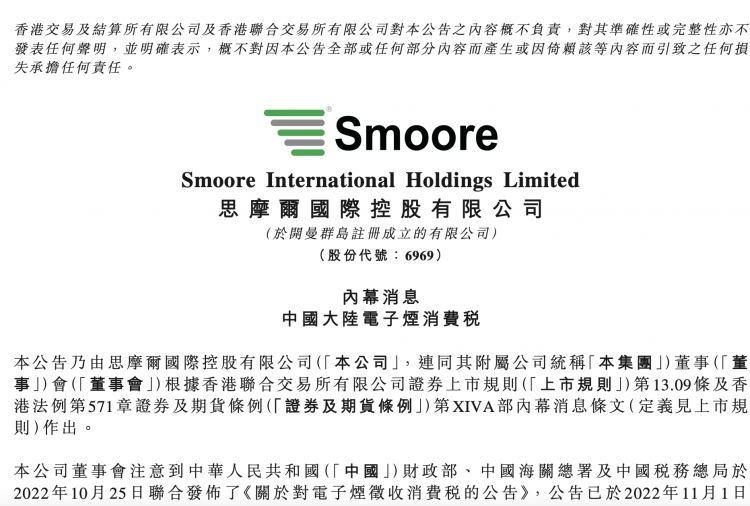
Smore International (6969) has issued a statement through the Hong Kong Stock Exchange, stating that according to their preliminary understanding of the interpretation of the Chinese electronic cigarette consumption tax announcement by Smore Group, Smore Group is exempt from paying consumption tax when it receives licenses from brand companies for the production and sale of electronic cigarettes or exports them within mainland China. Smore Group is supportive of and advocates for the consumption tax, and will continue to keep track of any updates to relevant policies, regulations, and implementation details (if any), and evaluate their impact on the group in a timely manner.


Simal Group announced that approximately 22% of their revenue in Q3 of 2022 came from mainland China. Regarding the proposed electronic cigarette consumption tax, the group stated its firm support and approval.


The following is a screenshot of the original announcement made by Simore International on the Hong Kong Stock Exchange:


Symon International announced in a screenshot of its original statement on the Hong Kong Stock Exchange.


Statement:


1. This article is intended solely for internal industry communication and exploration, and does not serve as any kind of endorsement or promotion of brands or products. 2. Smoking is detrimental to one's health. Minors are prohibited from reading this article.


This article contains excerpts from third-party sources. Copyright belongs to the original media and author(s). If there is any infringement, please inform us for deletion. Any organization or individual who wishes to reprint must contact the author, and should not do so directly.


Disclaimer

This article is provided solely for professional research, industry discussion, and informational purposes. Any references to brands, companies, products, technologies, or policies are made for factual reporting and analytical purposes only, and do not constitute endorsement, recommendation, promotion, or advertising by 2Firsts.

Nicotine-containing products, including but not limited to cigarettes, e-cigarettes, heated tobacco products, and nicotine pouches, carry significant health risks. Readers are responsible for complying with all applicable laws and regulations in their respective jurisdictions, including age restrictions and access limitations.

The information contained in this article should not be regarded as investment, legal, medical, regulatory, or commercial advice. While 2Firsts strives to ensure the accuracy and reliability of its content, it does not assume liability for any direct or indirect loss arising from errors, omissions, inaccuracies, or reliance on the information contained herein.

This article is not intended for individuals below the legal age for accessing tobacco or nicotine-related information in their jurisdiction.


Copyright Notice

This article is either original content produced by 2Firsts or content reproduced, translated, summarized, or adapted from third-party sources with attribution where applicable. The intellectual property rights of the original content remain with 2Firsts or the respective original rights holders.

No individual or organization may copy, reproduce, distribute, republish, modify, translate, or otherwise use this content without prior authorization. Any unauthorized use may result in legal action.

For copyright-related inquiries, corrections, or removal requests, please contact: info@2firsts.com.


AI-Assisted Translation and Editing Notice

Portions of this article may have been translated, edited, or reviewed with the assistance of artificial intelligence tools to improve efficiency and readability. Due to the limitations of AI-assisted translation and editing, discrepancies, omissions, or inaccuracies may exist when compared with the original source.

Where applicable, readers are advised to refer to the original source for the most complete and accurate information. If you identify any errors or believe that any content infringes upon your rights, please contact us at info@2firsts.com, and we will review and address the matter promptly.

Indonesia’s BNN Pushes Total Vape Ban as Health Ministry Tightens Tobacco Packaging Rules, Putting $40 Billion Industry at Risk
Indonesia is entering a new phase of debate over vape and tobacco regulation. The National Narcotics Agency (BNN) has proposed a total vape ban, with some lawmakers supporting stronger restrictions. At the same time, the Health Ministry is advancing tobacco and nicotine regulations under Government Regulation No. 28/2024, including measures such as plain packaging and product controls. Tobacco and vape industries have warned that tighter rules could affect a sector worth around $40 billion, supporting about 6 million jobs and contributing significant tax revenue.
Jul.27
FDA Foreign Tobacco Registration Proposal Could Strengthen ENDS Import Oversight, Azim Chowdhury Says
FDA’s proposed rule requiring foreign tobacco manufacturers to register establishments and list products is more than routine paperwork, Keller and Heckman LLP partner Azim Chowdhury told 2Firsts. He said it could strengthen FDA’s import enforcement, inspections and market surveillance. Chinese e-cigarette OEM/ODM manufacturers, specification developers, brand owners and component suppliers may need to review their roles, product data and U.S. market authorization status.
Special Report
Jun.29
Putin Signs Russia’s Tobacco and Nicotine Product Licensing Law, Banning Unlicensed Sales From 2027
Russian President Vladimir Putin has signed a law introducing mandatory licensing for wholesale and retail trade in tobacco and nicotine-containing products, with the system taking effect on October 1, 2026, and unlicensed operations banned from March 1, 2027, while vape and e-liquid retail may also face uncertainty from temporary regional sales-ban powers.
Jul.01
Senate Democrat Wyden Probes Trump Administration Vape Policy Shift, Seeks Records From HHS and Reynolds American
U.S. Senator Ron Wyden, the Democratic ranking member of the Senate Finance Committee, has launched an investigation into flavored vape policy changes and requested records from the Department of Health and Human Services (HHS), Reynolds American and Botanic Tonics. The investigation focuses on a timeline involving Reynolds American’s $5 million donation to MAGA Inc. in April 2026 and subsequent vape policy developments. Wyden said the review aims to examine potential links between political donations, corporate communications and government decisions. The investigation does not represent a finding of wrongdoing.
Innovation
Aug.07 by 2Firsts Perspectives
Philippine Customs Seizes $2.22 Million in Misdeclared Vape Products From China
The Philippine Bureau of Customs said it intercepted nine containers of misdeclared vape and vape-related products from China at the Manila International Container Port, with an estimated value of about ₱137 millionor, about $2.22 million.
Jul.10
South Korea Vape Strategies Diverge as BAT Reconsiders Exit and PMI Takes VEEV to About 14,000 Stores
BAT Rothmans says it previously considered exiting South Korea's vaping market because of competitive pressure from unregulated products, but is now reassessing conditions following changes to the country's nicotine regulatory framework. Vuse and other BAT vaping products remain available through existing distribution channels. The statement followed a South Korean media report that interpreted BAT's broader withdrawal from selected Vapour markets as a full exit from South Korea. Meanwhile, Philip Morris International launched VEEV inPRIME in the country in June and began expanding distribution to around 14,000 convenience stores and other retail channels in July. The contrasting moves highlight differing investment strategies as South Korea's regulated vaping market evolves.
Aug.14