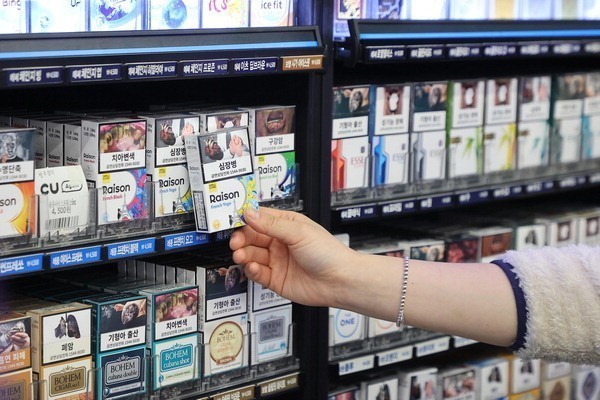
South Korea Requires Regular Testing of Harmful Substances in Tobacco

Feb.07.2025
South Korea Requires Regular Testing of Harmful Substances in Tobacco
South Korea Government requires tobacco manufacturers to regularly test harmful substances and publicly disclose results starting November.

According to a report from N.News on February 6th, the South Korean government will require tobacco manufacturers and sellers to conduct regular inspections of harmful substances in tobacco starting in November, and to publicly disclose detailed inspection results.


The Ministry of Health and Welfare and the Food and Drug Safety Ministry of South Korea announced on the 6th the implementation decree and detailed rules of the "Tobacco Harmfulness Management Law". The law requires harmful ingredient testing to be conducted within one month after tobacco products are marketed. Tobacco manufacturers and importers are required to test the harmful ingredient content of their products every two years and submit the results to the Food and Drug Safety Ministry, which will then be made public to the national public. E-cigarette e-liquid and heated tobacco devices are also included in the inspection scope.


According to the newly enacted regulations and implementation guidelines, tobacco manufacturers and importers must conduct harmful ingredient tests on existing products within three months of the law's implementation date, and apply for testing again by June every two years thereafter.


Tobacco manufacturers are required to submit their test results to the Director of the Food and Drug Safety Administration within 15 days of receiving them. The Director will then publicly disclose information on harmful ingredients, as well as details on their toxicity and carcinogenicity, on the official website by December 31st each year.


We welcome news tips, article submissions, interview requests, or comments on this piece.

Please contact us at info@2firsts.com, or reach out to Alan Zhao, CEO of 2Firsts, on LinkedIn


Notice

1.  This article is intended solely for professional research purposes related to industry, technology, and policy. Any references to brands or products are made purely for objective description and do not constitute any form of endorsement, recommendation, or promotion by 2Firsts.

2.  The use of nicotine-containing products — including, but not limited to, cigarettes, e-cigarettes, nicotine pouchand heated tobacco products — carries significant health risks. Users are responsible for complying with all applicable laws and regulations in their respective jurisdictions.

3.  This article is not intended to serve as the basis for any investment decisions or financial advice. 2Firsts assumes no direct or indirect liability for any inaccuracies or errors in the content.

4.  Access to this article is strictly prohibited for individuals below the legal age in their jurisdiction.


Copyright


This article is either an original work created by 2Firsts or a reproduction from third-party sources with proper attribution. All copyrights and usage rights belong to 2Firsts or the original content provider. Unauthorized reproduction, distribution, or any other form of unauthorized use by any individual or organization is strictly prohibited. Violators will be held legally accountable.

For copyright-related inquiries, please contact: info@2firsts.com


AI Assistance Disclaimer


This article may have been enhanced using AI tools to improve translation and editorial efficiency. However, due to technical limitations, inaccuracies may occur. Readers are encouraged to refer to the cited sources for the most accurate information.

We welcome any corrections or feedback. Please contact us at: info@2firsts.com

AHA Journal Study: WS-23 Triples Premature Heartbeats, Raising Concerns Over Vape Cooling Agents
A University of Louisville research team published a study in an American Heart Association journal suggesting that synthetic cooling agents used in e-cigarettes, including WS-3 and WS-23, may disrupt cardiac electrical activity and increase arrhythmia risk. In animal experiments, WS-23 tripled premature heartbeats.
Jun.16
U.S. FDA: Youth E-Cigarette Prevention Campaign Prevented About 444,000 Initiations and Reduced Illegal Vape Sales
The U.S. Food and Drug Administration (FDA) said its youth e-cigarette prevention campaign, “The Real Cost,” prevented about 444,000 U.S. youth from starting e-cigarette use between 2023 and 2024 and blocked more than $42 million in unauthorized e-cigarette sales that would have been used by youth.
Market
Jun.25
 Former DHS Spokesperson Analyzes CBP’s $175 Million Illegal Vape Seizure
Former DHS Spokesperson Analyzes CBP’s $175 Million Illegal Vape Seizure
The Washington Examiner published an opinion article by Tricia McLaughlin, former Assistant Secretary for Public Affairs and spokesperson at the U.S. Department of Homeland Security, arguing that the Trump administration is strengthening enforcement against illegal vape supply chains through the FDA, CBP, and DHS.
Regulations
May.25
Imperial Brands Pulls myblu Vape Business From U.S., Citing Prolonged FDA Approval Process
Imperial Brands said it will phase out its myblu vaping business in the United States, citing prolonged FDA approval timelines for new vape products. The company said it will instead focus on modern oral nicotine products in the U.S., including the expansion of its Zone brand and new flavors. While overall next-generation product revenue continued to grow, revenue from the category in the Americas declined sharply.
May.12
Malaysian Court Rules Liquid Nicotine Exemption Irrational, Renewing Vape Regulation Debate
Malaysia’s High Court ruled that the government’s earlier decision to remove liquid nicotine from the country’s Poisons List was “irrational,” reigniting debate over vape regulation, illicit trade, and youth protection.
Regulations
May.18
Ukrainian Media: Polish Vape Distributor Evapify Allegedly Linked to Russian Businessman Named in U.S. “Russia Oligarch Report”
According to an investigative report by Euromaidan Press, a Ukrainian English-language independent media outlet, Russian businessman Oleg Boyko has been sanctioned by Ukraine, Poland, Australia and Canada, but has not been added to the European Union’s sanctions list. The report alleges that Evapify, a Polish vape distributor with financial and personal ties to Boyko, holds a significant position in Poland’s disposable vape market.
News
Jun.01