According to a new report, the percentage of teenagers and children who are vaping is on the rise, with many being influenced by social media websites.
A study specially shared with PA News Agency has revealed that disposable e-cigarettes are steadily gaining popularity. These products are sold for approximately £5 each and come in a variety of fruity flavors.
According to data from a study conducted by the Action on Smoking and Health (ASH), partially funded by the Department of Health, many young people are attracted to these devices which are being featured on social media sites like Tik Tok and Instagram.
Approximately 52% of young people who use e-cigarettes stated that disposable e-cigarettes are their preferred product, which is a significant increase from 7% in 2020.
A new generation of disposable e-cigarettes containing nicotine known as "PuffBar" hit the market over the past year.
According to reports, the most popular brands are ElfBar and GeekBar, with only 32% of young e-cigarette users indicating that they use a different brand.
Although it is illegal to sell e-cigarettes to individuals under 18 years old, posts featuring teenagers showcasing new e-cigarette products and discussing flavors such as pink lemonade, strawberry banana, and mango are being widely spread on social media.
Around 2,613 teenagers in the United Kingdom participated in a survey conducted by YouGov in March, providing information for ASH's report.
Overall, the results indicate that while there has been a significant increase in the frequency of electronic cigarette use, the majority of people between the ages of 11 and 17 (84%) have never tried e-cigarettes. Currently, the vast majority of e-cigarette users are smokers or former smokers.
According to data, the proportion of children and teenagers aged 11 to 17 who vape has surged from 4% in 2020 to 7% in 2022.
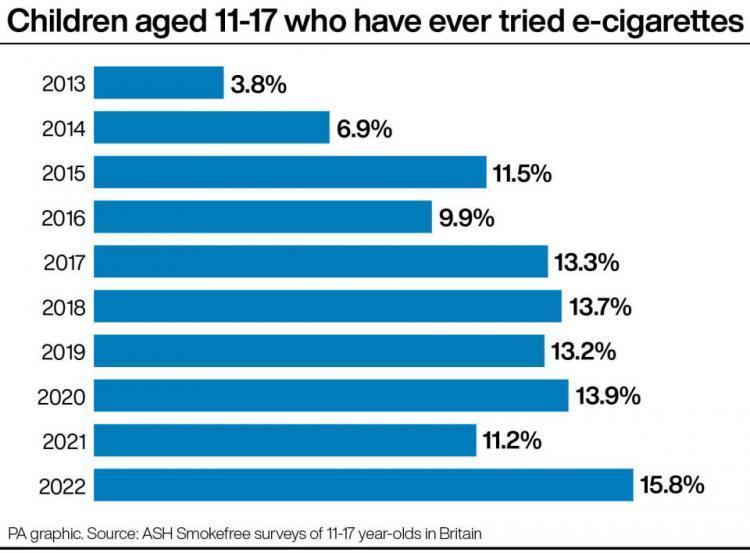
The percentage of individuals who have tried electronic cigarettes has increased from 14% in 2020 to 16% in 2022.
In 2013, only 3% of children aged 11 to 15 had tried electronic cigarettes, but this number rose to 8% in 2020 and is projected to rise to 10% by 2022.
For the age group of 16-17 year olds, this figure has skyrocketed from 7% in 2013 to 29% in 2022. For those aged 18 and older, the percentage has increased from 9% to 41%.
Overall, currently 4% of 11 to 15-year-olds are using electronic cigarettes, while the figure for children aged 16 and 17 is 14%.
When it comes to regular smoking, the number of young people aged 11 to 17 who smoke has decreased from 16% in 2020 to 14% in 2022.
This year, the survey for the first time asked young people about their knowledge regarding the promotion of electronic cigarettes.
More than half (56%) of individuals between the ages of 11 and 17 have seen electronic cigarette promotion, with the highest awareness rate (72%) among previous electronic cigarette users.
According to a recent survey, TikTok is the most commonly cited source for promotional messages among teenagers, with 45% of them mentioning it. Instagram ranks second with 31%, followed by Snapchat with 22%.
Minors are most likely to obtain e-cigarettes from retail stores (47%), while 10% purchase them online. According to the survey, fruit flavors remain the most popular type (57%).
When it comes to why young people use e-cigarettes, "just trying it out" is still the most common reason for non-smokers using e-cigarettes (65%).
Among smokers, the most common reason cited for smoking is "because I enjoy the taste" (21%), followed by "I like the experience" (18%), and then "just trying it out" (15%).
Currently, approximately one-tenth of smokers are using e-cigarettes as a means to quit smoking.
Deborah Arnott, CEO of ASH, stated that last year's surge in popularity of disposable e-cigarettes involved brightly colored pocket-sized products with fruity flavors and cute names.
They are widely available for children under the age of five - no wonder they are attractive to them.
She stated the need for additional funding to enforce laws prohibiting the sale of products to underage individuals, taking action towards child-friendly packaging, labeling, and social media promotions.
She said, "Online platforms do not need to wait; they must take action now.
The rampant promotion of electronic cigarettes on social media, particularly Tik Tok, is completely inappropriate and ought to be shut down.
Ann McNeill, a tobacco addiction professor at King's College London and author due to review evidence on e-cigarettes for the government, has expressed concern about the rise of electronic cigarettes. She emphasizes the importance of understanding the reasons behind their popularity, such as packaging, accessibility, flavor, and addiction.
Given the risks smoking poses to young people's health and the ample evidence indicating that electronic cigarettes can be an effective smoking cessation aid, our response must be commensurate. The government should ensure existing laws are enforced and identify areas where regulations can be extended. However, this must be done while ensuring a more rapid decline in smoking among young people and helping more smokers quit.
A report shows that among individuals aged 11 to 17 who have tried e-cigarettes, the proportion of those who started smoking for the first time in 2022 (40%) is higher than those who started smoking (36%).
Around 40% of people have never smoked a traditional cigarette but have tried e-cigarettes, which is an increase from 30% in 2020.
Gillian Golden, CEO of the Independent British Vape Trade Association (IBVTA), has stated that social media platforms should implement policies to prevent the promotion of electronic cigarettes to children, but they have largely failed to enforce these policies.
We monitor and report instances of infringement to social media platforms, but they rarely take action, with TikTok being the worst offender. Companies illegally selling products to those under 18 are also more likely to break UK regulations by selling non-compliant products. Most retailers and importers do not sell to children and want stricter enforcement to ensure others don't do so either.
A spokesperson for TikTok stated: "At TikTok, nothing is more important than protecting the safety of our community, especially our youngest users. Regardless of age, we strictly prohibit content that describes or promotes the sale or trade of tobacco, including e-cigarette products, and we will remove any content that violates our community guidelines. We also do not recommend displaying or promoting tobacco product content in TikTok user highlights.
Instagram declined to comment.
Earlier this year, the Fair Trade Standards Institute conducted 442 mystery shopper visits to stores and found that 145 sales were made to minors under the age of 18, which was illegal.
The CEO of the Accreditation Standards Institute, John Herriman, has stated that more funds are needed. However, he added that the trade standards team is working hard to protect young people from the sale of e-cigarettes and tobacco products.
This article contains information compiled from a third-party source and is intended solely for educational and informational purposes. The copyright of the compiled information belongs to the original media outlet and author. If there is any infringement, please contact us for deletion.
Disclaimer
This article is provided solely for professional research, industry discussion, and informational purposes. Any references to brands, companies, products, technologies, or policies are made for factual reporting and analytical purposes only, and do not constitute endorsement, recommendation, promotion, or advertising by 2Firsts.
Nicotine-containing products, including but not limited to cigarettes, e-cigarettes, heated tobacco products, and nicotine pouches, carry significant health risks. Readers are responsible for complying with all applicable laws and regulations in their respective jurisdictions, including age restrictions and access limitations.
The information contained in this article should not be regarded as investment, legal, medical, regulatory, or commercial advice. While 2Firsts strives to ensure the accuracy and reliability of its content, it does not assume liability for any direct or indirect loss arising from errors, omissions, inaccuracies, or reliance on the information contained herein.
This article is not intended for individuals below the legal age for accessing tobacco or nicotine-related information in their jurisdiction.
Copyright Notice
This article is either original content produced by 2Firsts or content reproduced, translated, summarized, or adapted from third-party sources with attribution where applicable. The intellectual property rights of the original content remain with 2Firsts or the respective original rights holders.
No individual or organization may copy, reproduce, distribute, republish, modify, translate, or otherwise use this content without prior authorization. Any unauthorized use may result in legal action.
For copyright-related inquiries, corrections, or removal requests, please contact: info@2firsts.com.
AI-Assisted Translation and Editing Notice
Portions of this article may have been translated, edited, or reviewed with the assistance of artificial intelligence tools to improve efficiency and readability. Due to the limitations of AI-assisted translation and editing, discrepancies, omissions, or inaccuracies may exist when compared with the original source.
Where applicable, readers are advised to refer to the original source for the most complete and accurate information. If you identify any errors or believe that any content infringes upon your rights, please contact us at info@2firsts.com, and we will review and address the matter promptly.