Thai Police Seize Over 80,000 Illegal E-cigarettes Worth $463,783

Regulations by 2FIRSTS.ai
Jun.21.2024
Thai Police Seize Over 80,000 Illegal E-cigarettes Worth $463,783
Thai internet police raided two locations in the "Operation Smokeless," seizing over 80,000 illegal e-cigarettes worth $463,783 in total.

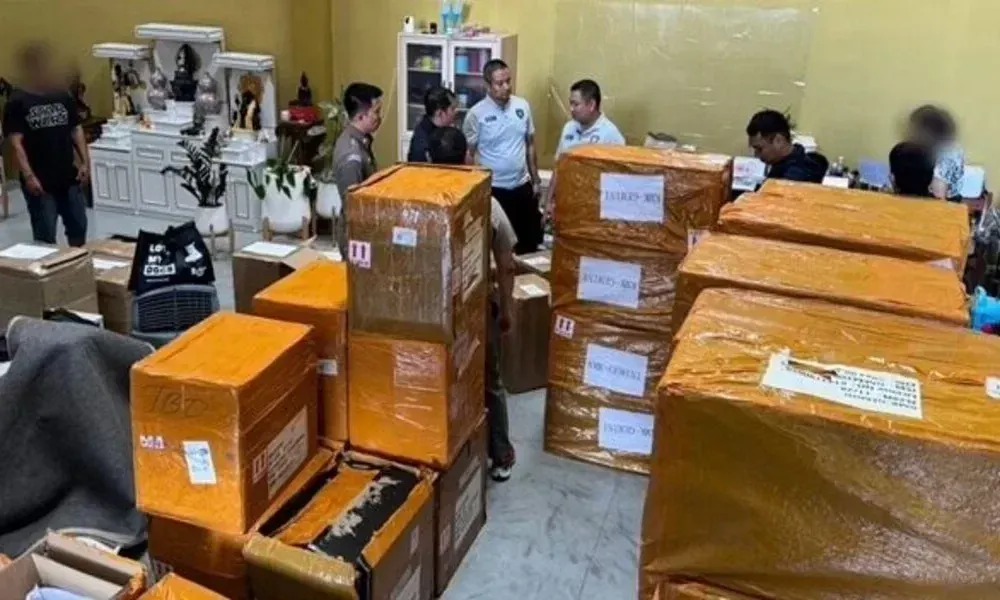
According to a report by CTN News on June 21st, Thai internet police raided two locations as part of "Operation Smokeless" and seized over 80,000 illegal e-cigarettes with a total value exceeding 17 million Thai Baht ($463,783).


The investigation began on April 23, when authorities arrested a man in Songkhla Province for selling e-cigarettes online. Subsequent investigations found various brands of e-cigarettes and related equipment stored at two locations in Phetchabun Province and Bangkok.


The first raid took place at a large rented warehouse in the Bang Krathuek area of Pathum Thani province. Police searches uncovered over 9,000 large boxes containing various brands of e-cigarette pods and e-liquid. Additionally, a delivery truck nearby was found to be concealing over 43,000 boxes of e-cigarette liquid and pods.


Authorities have confiscated all e-cigarette products and arrested the 44-year-old warehouse keeper, Thanochot, with a total of over 53,000 e-cigarette products valued at over 8 million Thai baht ($218,251).


The second raid was conducted under a warrant from the Criminal Court, at a house in a village in Prawet District, Bangkok. In the search, police found various e-cigarettes, including disposable pods and e-cigarette liquids from well-known brands, totaling over 37,000 e-cigarette items worth 8.9 million baht ($242,804). Police arrested 30-year-old Natthaporn.


In two raids, a total of over 80,000 e-cigarette items were seized, with a total value exceeding 17 million Thai Baht (463,783 USD).


The suspect claimed they were just caretakers, but authorities are skeptical of this claim and the investigation is ongoing.


We welcome news tips, article submissions, interview requests, or comments on this piece.

Please contact us at info@2firsts.com, or reach out to Alan Zhao, CEO of 2Firsts, on LinkedIn


Notice

1.  This article is intended solely for professional research purposes related to industry, technology, and policy. Any references to brands or products are made purely for objective description and do not constitute any form of endorsement, recommendation, or promotion by 2Firsts.

2.  The use of nicotine-containing products — including, but not limited to, cigarettes, e-cigarettes, nicotine pouchand heated tobacco products — carries significant health risks. Users are responsible for complying with all applicable laws and regulations in their respective jurisdictions.

3.  This article is not intended to serve as the basis for any investment decisions or financial advice. 2Firsts assumes no direct or indirect liability for any inaccuracies or errors in the content.

4.  Access to this article is strictly prohibited for individuals below the legal age in their jurisdiction.


Copyright


This article is either an original work created by 2Firsts or a reproduction from third-party sources with proper attribution. All copyrights and usage rights belong to 2Firsts or the original content provider. Unauthorized reproduction, distribution, or any other form of unauthorized use by any individual or organization is strictly prohibited. Violators will be held legally accountable.

For copyright-related inquiries, please contact: info@2firsts.com


AI Assistance Disclaimer


This article may have been enhanced using AI tools to improve translation and editorial efficiency. However, due to technical limitations, inaccuracies may occur. Readers are encouraged to refer to the cited sources for the most accurate information.

We welcome any corrections or feedback. Please contact us at: info@2firsts.com

Russia’s Vape Device Labeling Regime Enters Force: Registration Starts in September, Mandatory Coding in December
Russia's digital labeling regime for reusable e-cigarettes and similar personal vaping devices entered its first mandatory phase in September 2026. From September 1, manufacturers, importers and other market participants must register with the national Chestny ZNAK tracking system. From December 1, newly manufactured and imported covered devices will be required to carry digital identification codes and be reported as entering circulation. Russia has also issued new operational guidance for imports, marking the transition from a voluntary pilot to phased mandatory implementation.
Sep.15
Malaysia's Poisons Board Backs New Vape Nicotine Exemption After Unanimously Opposing 2023 Proposal
Malaysia's Poisons Board has endorsed Health Minister Dzulkefly Ahmad's proposal to exempt liquid nicotine used in vaping products from the Poisons List, according to a November 2, 2026, report by CodeBlue. The Board unanimously opposed a similar proposal in 2023, but the government proceeded with the exemption. The Kuala Lumpur High Court invalidated the 2023 decision in May 2026, and the government withdrew its appeal in August. No new ministerial order has been published. The development raises questions about the interaction between Malaysia's two regulatory frameworks and the treatment of RM354.51 million in excise duties collected on e-cigarette and vape products between May 2023 and June 11, 2026.
Regulations
Nov.03
Swedish Match Faces Broader Labeling Order After ZYN Inspection, Documents Obtained by 2Firsts Show
Documents obtained by 2Firsts show that Sweden's Public Health Agency ordered Swedish Match to revise ingredient labels beyond the five ZYN products inspected. The dispute centers on whether flavoring ingredients must be individually disclosed, with Swedish Match citing trade-secret protection and the regulator insisting on full ingredient disclosure. The company faces a conditional penalty of SEK 2 million per month for noncompliance. As of October 22, the agency had received no appeal, despite the company's stated intention to challenge the decision.
Oct.22
India Duty-Free Nicotine Pouch Sales Face Regulatory Test as ZYN, FOX Classification Remains Open
The Bombay High Court has ruled that airport duty-free shops are not exempt from India's domestic regulatory laws merely because they operate beyond the customs barrier, leaving in place a sales halt covering ZYN and FOX nicotine pouches at Mumbai's international airport. The court, however, did not determine that the products necessarily qualify as "drugs" under India's Drugs and Cosmetics Act. The retailers have four weeks to submit product information to the appropriate authorities, including CDSCO, which must complete its review within 30 days of receiving the submissions.
Sep.24
Russia Expands Temporary Administration of JTI Assets in Second Round: From Four to All Seven Russian Entities, With Approximately $9.5 Billion in Related Assets
Japan Tobacco Inc. (JT) confirmed on November 9, 2026, that all seven of its Russian entities had been placed under temporary administration after a second presidential decree added three companies to the four designated a day earlier. The additional entities are associated with importing, management, holdings and the former supply of Ploom heated-tobacco devices. JT disclosed approximately ¥1.5 trillion in Russian business-related assets as of September 30, including ¥360 billion in cash and deposits, and approximately ¥200 billion in liabilities. Under its revised FY2026 forecast, Russia accounts for about 25% of adjusted operating profit. JT said operations in Russia were continuing, while the financial impact remained under assessment.
company
Nov.09
As Regulators Focus on Nicotine Pouch Child Safety, Safeguard Pursues an External Packaging Route
As regulators pay closer attention to child safety in nicotine pouches, manufacturers face a practical challenge: how to strengthen child-resistant packaging without unnecessarily reworking products, production lines and regulatory submissions already in place. In a written interview with 2Firsts, Chemular detailed Safeguard’s external packaging approach, its customer-specific testing requirements and possible PMTA pathways. The model remains early-stage, but it offers a new way to think about an increasingly important regulatory and manufacturing issue.
Industry Insight
Sep.19