Richard Kinlaw, of Dab City Tobacco & Vape, stated, "It's a way to alleviate stress, and to be honest, it can be addictive and is socially acceptable.
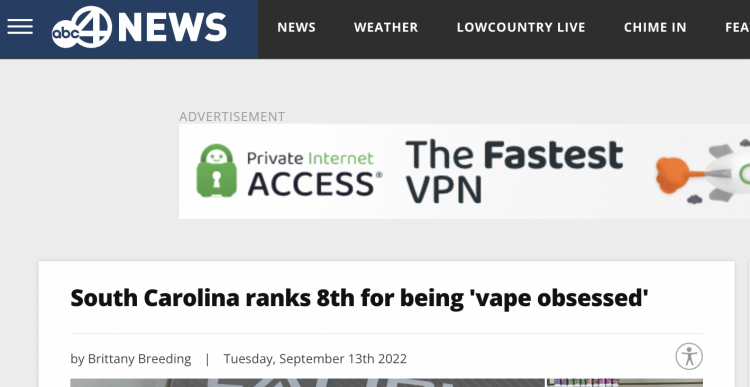
This study is based on search terms, such as "vape" and "vape shops". Staff members at electronic cigarette shops report that it is typically young people who are turning to nicotine pods.
It is more suitable for college students," said Jin Luo.
According to data from the Centers for Disease Control and Prevention (CDC) in 2019, 27.5% of high school students in our state use tobacco, including e-cigarettes. A report from the Department of Health and Environmental Control (DHEC) stated that the number of high school students using e-cigarettes in South Carolina increased by 21% between 2015 and 2017. Doctors, including Dr. Stephen Siben, express concern about this trend.
Seben stated, "Let's be clear. If you smoke frequently, you are an addict. You are addicted to nicotine, which is known to be the most easily addictive substance due to its long withdrawal symptoms. Nicotine withdrawal can last up to six months.
This reality led to a $438 million settlement with the manufacturer JUUL, as they were deemed responsible for causing a teenage vaping crisis. However, this fact does not seem to deter the public.
I don't think it will have a significant impact," said Jin Luo. "We are usually very busy.
Officials say that interesting flavors and ultra-thin ink cartridges are causing addiction in teenagers.
According to Kinlaw, "You won't smell the typical tobacco aroma, there are usually various flavors that are pleasant to smell.
While some people boast that e-cigarettes are a healthier alternative to cigarettes, doctors say that it's not a good choice if you haven't started smoking.
“Dependence products, like combustible cigarettes, also carry all the other potential harms of cigarettes,” said Dr. Leeds Wessler of MUSC.
South Carolina has confirmed one death in 2019 as a result of vaping, while the national death toll as of 2020 has risen to 68. Doctors warn that even though vaping may not kill you outright, the long-term health effects are still unknown.
Statement:
This article is compiled from third-party information and is intended only for industry communication and learning.
This article does not represent the views of 2FIRSTS, and 2FIRSTS cannot confirm the authenticity or accuracy of the content. The translation of this article is intended solely for industry exchange and research purposes.
Due to limitations in translation ability, the compiled article may not express the same meaning as the original. Please refer to the original article for accuracy.
In regards to any domestic, Hong Kong, Macau, Taiwan, and foreign-related expressions and stances, 2FIRSTS maintains complete alignment with the Chinese government.
The ownership of the compiled information belongs to the original media and author. In the event of infringement, please contact us for removal.
Disclaimer
This article is provided solely for professional research, industry discussion, and informational purposes. Any references to brands, companies, products, technologies, or policies are made for factual reporting and analytical purposes only, and do not constitute endorsement, recommendation, promotion, or advertising by 2Firsts.
Nicotine-containing products, including but not limited to cigarettes, e-cigarettes, heated tobacco products, and nicotine pouches, carry significant health risks. Readers are responsible for complying with all applicable laws and regulations in their respective jurisdictions, including age restrictions and access limitations.
The information contained in this article should not be regarded as investment, legal, medical, regulatory, or commercial advice. While 2Firsts strives to ensure the accuracy and reliability of its content, it does not assume liability for any direct or indirect loss arising from errors, omissions, inaccuracies, or reliance on the information contained herein.
This article is not intended for individuals below the legal age for accessing tobacco or nicotine-related information in their jurisdiction.
Copyright Notice
This article is either original content produced by 2Firsts or content reproduced, translated, summarized, or adapted from third-party sources with attribution where applicable. The intellectual property rights of the original content remain with 2Firsts or the respective original rights holders.
No individual or organization may copy, reproduce, distribute, republish, modify, translate, or otherwise use this content without prior authorization. Any unauthorized use may result in legal action.
For copyright-related inquiries, corrections, or removal requests, please contact: info@2firsts.com.
AI-Assisted Translation and Editing Notice
Portions of this article may have been translated, edited, or reviewed with the assistance of artificial intelligence tools to improve efficiency and readability. Due to the limitations of AI-assisted translation and editing, discrepancies, omissions, or inaccuracies may exist when compared with the original source.
Where applicable, readers are advised to refer to the original source for the most complete and accurate information. If you identify any errors or believe that any content infringes upon your rights, please contact us at info@2firsts.com, and we will review and address the matter promptly.