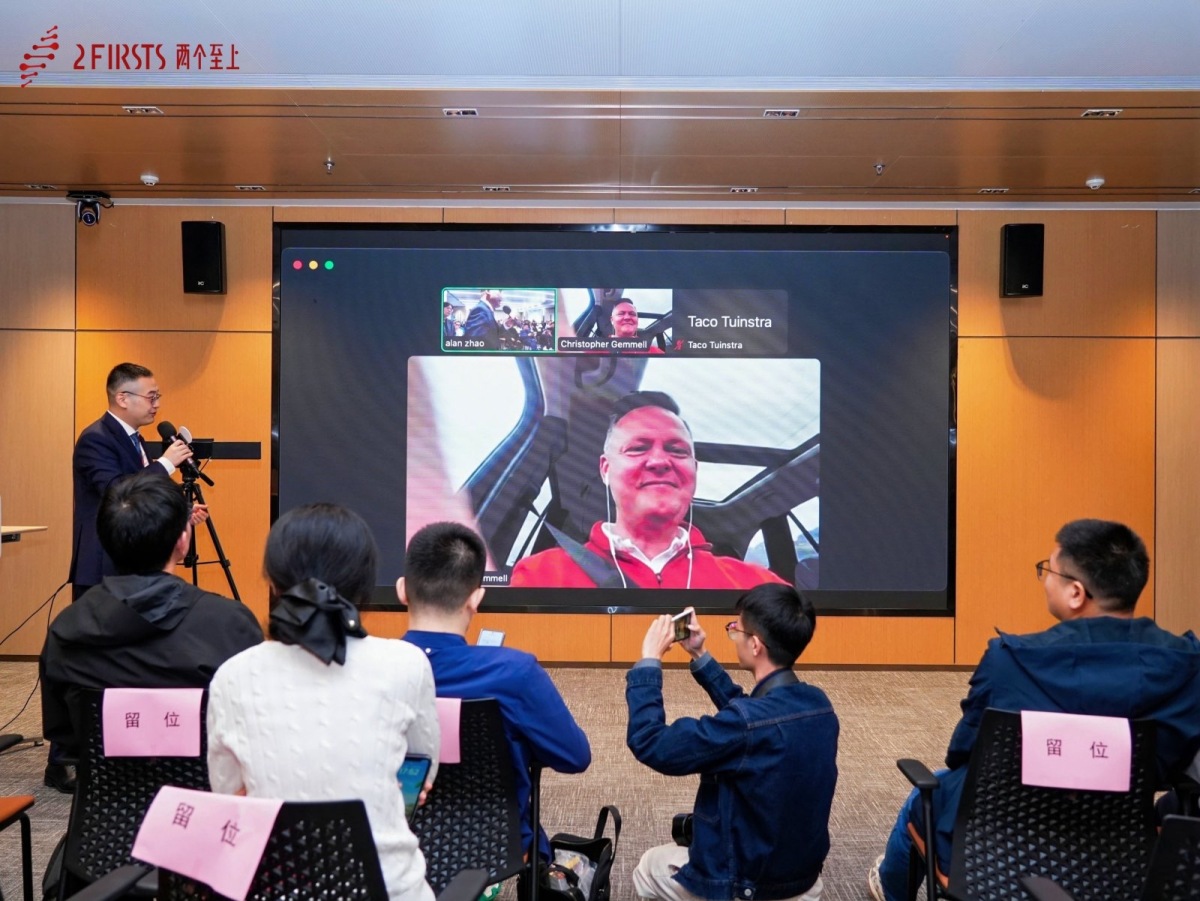
In the competitive and heavily regulated Next Generation Products (NGP) market, success largely depends on a company's ability to identify pain points and address these issues effectively. By anticipating restrictions surrounding their operations and consumers earlier than their competitors, businesses can unlock growth potential and maintain a competitive edge. This was one of the key messages delivered by Chris Gemmell, Managing Director and Founding Partner of Elna Limited, at the 2Firsts Global NGP Innovation and Technology Forum held in Shenzhen on February 20, 2025. The forum attracted over 160 professionals from the new tobacco industry, including Imperial Brands, various leading Chinese e-cigarette companies, representatives specializing in analytical testing, and the organizers of the Dubai World e-cigarette exhibition, Quartz Business Media.

As a senior professional in the fast-moving consumer goods (FMCG) and next-generation products (NGP) industries, Gemmell has extensive experience in product development. Before founding his own company in September 2024, he served as the Global Innovation Portfolio Strategy and Product Lifecycle Management Lead at British American Tobacco (BAT). During his nearly 12-year career at BAT, Gemmell led teams responsible for portfolio management, new product introduction, and invention strategies to identify, prioritize, and deliver growth initiatives. As the Global Innovation Transformation Lead for new product categories, he was responsible for comprehensive innovation transformation plans. While serving as the interim Global Head of Research and Development for new product categories, he guided innovators in developing groundbreaking consumer products and providing solutions for productivity, sustainability, patent, or regulatory challenges.
Gemmell has previously served as the President of American Snuff Co., the Executive Vice President of Operations at R.J. Reynolds Tobacco Co., the Vice President of Operations and Leaf in Mexico, Canada, and Central America at British American Tobacco, and the Operations Director of the company's Romania division.
As one of the leading companies in the NGP industry, British American Tobacco is investing heavily in reducing the health impact of its business by developing more enjoyable and lower risk products. This strategy requires a deep understanding of the constraints faced by both consumers and businesses. According to Gemmell, each group must address a unique set of limitations. Consumers want products that are simple, affordable, and convenient. Additionally, products must be sustainable, safe, easily accessible, and adaptable to users' lifestyles. Meanwhile, businesses face technological, budgetary, and time constraints, as well as legal, physical, and ethical limitations.
Gemmell said:
Understanding, explaining, and addressing these constraints are the key drivers of our business growth. By eliminating consumer constraints, we remove barriers to adult consumers choosing our products over alternatives.
The Way of Balance
However, balancing various constraints requires careful consideration. Gemmell stated, "Even as a business, we may face time constraints, but we should not compromise on product safety.
The environmental impact of disposable e-cigarettes needs to be weighed against their important contribution in helping smokers transition from deadly traditional cigarettes to potentially less harmful alternatives. Responsible innovation also requires companies to exercise restraint in product development, especially in an era of unprecedented technological possibilities.
Gemmell displayed a gold-plated Ferrari and stated, "Just because you can do something, doesn't mean you should.
The trend of NGP manufacturers adding display screens to their products has value, as long as these screens show relevant information — such as data that addresses consumers' anxiety about remaining battery life or the number of puffs taken. However, when these displays are used to showcase dancing flowers and other gimmicks, developers are entering dangerous territory. Gemmell emphasizes, "This is an adult product." Companies should focus on solving real problems, not imagined ones. An atomizer device integrated with headphones may be a creative combination, but it does not address users' most pressing concerns about reliability and usability.
Philip Morris International is well aware of this when improving its IQOS HNB device. A key limitation of the first generation IQOS product was blade breakage and cleaning requirements, which over time could lead to unpleasant odors.
Gemmell said, "Instead of letting others or another product solve the problem, the PMI team focused on these constraints and developed the Smartcore sensing technology we see on the Iluma platform." The success of IQOS is partly attributed to PMI's relentless efforts to eliminate flaws. Gemmell observed, "People outside of PMI tend to focus on the strengths of IQOS, while those inside PMI are obsessed with its shortcomings. They constantly ask themselves, 'How can we do better?'
However, constraints are a challenge that needs to be overcome in product development, and in product development, constraints are considered a virtue that needs to be practiced. This includes keeping things simple. Engineers may love technical features, but most consumers just want a product that is easy to use. British American Tobacco learned this the hard way when they introduced Glo Sens (an early hybrid product using liquid and tobacco) in Japan in 2019. Gemmell mentioned that the product had great taste and high satisfaction levels, but because the category was still new at the time, users struggled to understand how it worked, leading Glo Sens to be unpopular among consumers.
Gemmell believes that all of these experiences are opportunities for learning. The lesson from British American Tobacco is that products must be intuitive. He stated:
Consumers should not have to exert effort to understand a product. If they need to do so, the product will become complicated and hinder business success.
Other constraints
In addition to ensuring product safety, reliability, and usability, companies must also ensure that their products are easily accessible. After all, even the best devices can't reach their full potential if users can't purchase them. This is especially true in low and middle-income countries where 1 billion smokers reside, affordability is a major constraint. Gemmell stated, "A $30 tobacco heating product is not easily accessible to many smokers worldwide.
Another factor limiting the industry is a lack of awareness. Many smokers have misconceptions about the relative risks of NGPs. Therefore, education and affordability are key to growth. Gemmell said, "By combining these two factors, you have a winning formula.
Looking ahead to the future, NGP businesses will face increasing regulatory constraints. For example, in 2025, there will be more restrictions on disposable products and flavors, while enforcement in key markets (such as the United States) will intensify. Gemmell believes that these constraints will drive new developments. He expects to see more pod innovations, a continued shift towards rechargeable closed systems, more regulatory-compliant flavors targeted towards adults, and innovation in cost and supply chain management.
He predicts that the atomization industry will face unprecedented pressure through tariffs, profit margin compression, and taxation. Gemmell stated, "Sustainable profitability will be key, companies need to become leaner and smarter." Not all suppliers will be able to withstand regulatory shocks. He warned, "There will be casualties this year. Those that survive will be the ones that adapt the fastest and are most innovative in the new reality.
On the positive side, Gemmell pointed out that many consumers have not returned to combustible cigarettes, but instead have stayed within NGP product categories. Consumers are increasingly evaluating the value and benefits of product range - closed system vapor products, HNB products, or oral nicotine products - and feeling proud of their successful smoking cessation. He said, "In the near future, I hope to see a liquid-based product that consumers can proudly display on their table, just like they do with IQOS products.
According to Gemmell, sales of nicotine pouches are accelerating at an annual compound growth rate of up to 30%. He noted that as consumers gradually become accustomed to their novelty, nicotine pouches are becoming more standardized in many non-traditional markets.
Looking ahead, Gemmell encourages NGP suppliers to study the experiences of other rapidly developing industries. Just like NGP companies, electric vehicle (EV) manufacturers are also facing the challenge of transitioning a large portion of the population to new technology platforms.
Gemmell stated that the electric vehicle industry is teaching us many lessons, not necessarily in terms of technology, but in how they understand and address consumer pain points, such as range anxiety, charging speed, and engine noise. He also pointed out that there are valuable lessons to learn from inventory surplus and inventory challenges, which are issues the vape industry is currently facing.
He also urged suppliers to abandon "stopgap measures." In recent years, many innovations have been concentrated in regulatory gray areas. He hopes to see genuine innovations with regulatory sustainability.
Finally, Gemmell warned against falling into the trap of what some may see as the greatest constraint - complacency. He explained, "That sense of satisfaction will prevent us from working harder." He added, "But there are still one billion smokers, now is not the time to relax." Of course, this state of self-satisfaction also provides an opportunity for more ambitious participants.
He said, "If someone becomes complacent, that's when others can surprise them.
The 2025 Global NGP Innovation and Technology Forum, organized by 2Firsts, is a series of increasingly popular and influential events aimed at providing industry professionals with education on industry trends and best practices.
Earlier this year, the organization successfully held the 2Firsts Open Day and Global NGP Compliance Development New Year Seminar, looking ahead to 2025. These forums brought together leading tobacco companies, top supply chain businesses, and globally renowned experts. Each event attracted nearly 1,000 on-site participants and reached over 100,000 industry professionals through the extensive global media network of 2Firsts.
On March 21st, 2Firsts will be hosting a Global NGP Brand and Market Development Forum in Shenzhen. The theme of this forum is "Two Supremes: Global New Tobacco Brands and Market Development Seminar," focusing on global brand development strategies, key market trends for 2025, and innovative marketing techniques.
Please refer to the English original version for an accurate translation from Chinese.
Agenda released: Registration opens for two upcoming global conferences on new tobacco brands and market development.
Please stay tuned. Two top global new tobacco brands and market development seminars will be held on March 21st.
With Innovation, Returning to the Original Aspiration - Two Supremes Global New Tobacco Innovation and Technology Seminars Conclude Successfully.
We welcome news tips, article submissions, interview requests, or comments on this piece.
Please contact us at info@2firsts.com, or reach out to Alan Zhao, CEO of 2Firsts, on LinkedIn
Notice
1. This article is intended solely for professional research purposes related to industry, technology, and policy. Any references to brands or products are made purely for objective description and do not constitute any form of endorsement, recommendation, or promotion by 2Firsts.
2. The use of nicotine-containing products — including, but not limited to, cigarettes, e-cigarettes, nicotine pouchand heated tobacco products — carries significant health risks. Users are responsible for complying with all applicable laws and regulations in their respective jurisdictions.
3. This article is not intended to serve as the basis for any investment decisions or financial advice. 2Firsts assumes no direct or indirect liability for any inaccuracies or errors in the content.
4. Access to this article is strictly prohibited for individuals below the legal age in their jurisdiction.
Copyright
This article is either an original work created by 2Firsts or a reproduction from third-party sources with proper attribution. All copyrights and usage rights belong to 2Firsts or the original content provider. Unauthorized reproduction, distribution, or any other form of unauthorized use by any individual or organization is strictly prohibited. Violators will be held legally accountable.
For copyright-related inquiries, please contact: info@2firsts.com
AI Assistance Disclaimer
This article may have been enhanced using AI tools to improve translation and editorial efficiency. However, due to technical limitations, inaccuracies may occur. Readers are encouraged to refer to the cited sources for the most accurate information.
We welcome any corrections or feedback. Please contact us at: info@2firsts.com