Turkish Security Forces Successfully Raid Huge Tobacco Smuggling Operation

Regulations by 2FIRSTS.ai
Jan.10.2024
Turkish Security Forces Successfully Raid Huge Tobacco Smuggling Operation
Turkish military and police forces seize large amounts of smuggled e-cigarettes and tobacco in a crackdown operation.

According to reports from Turkish media outlet iha on January 10th, the military and police forces in Mersin province are currently engaged in combatting smuggling activities. Based on intelligence they have received, there are suspects in the Mezitli region allegedly involved in smuggling tobacco trade.


In their operation, the police acted swiftly and conducted a search of the suspect's residence, resulting in the seizure of a significant amount of smuggled e-cigarettes and hookahs. They recovered a total of 86 e-cigarettes and 96 kilograms of shisha.


The suspect, who was arrested, was subsequently taken away for questioning. This operation marks a significant progress in combating illegal tobacco trade. Turkish authorities have stated that they will continue to enhance efforts to curb smuggling activities, ensuring stability in social security and public health.


We welcome news tips, article submissions, interview requests, or comments on this piece.

Please contact us at info@2firsts.com, or reach out to Alan Zhao, CEO of 2Firsts, on LinkedIn


Notice

1.  This article is intended solely for professional research purposes related to industry, technology, and policy. Any references to brands or products are made purely for objective description and do not constitute any form of endorsement, recommendation, or promotion by 2Firsts.

2.  The use of nicotine-containing products — including, but not limited to, cigarettes, e-cigarettes, nicotine pouchand heated tobacco products — carries significant health risks. Users are responsible for complying with all applicable laws and regulations in their respective jurisdictions.

3.  This article is not intended to serve as the basis for any investment decisions or financial advice. 2Firsts assumes no direct or indirect liability for any inaccuracies or errors in the content.

4.  Access to this article is strictly prohibited for individuals below the legal age in their jurisdiction.


Copyright


This article is either an original work created by 2Firsts or a reproduction from third-party sources with proper attribution. All copyrights and usage rights belong to 2Firsts or the original content provider. Unauthorized reproduction, distribution, or any other form of unauthorized use by any individual or organization is strictly prohibited. Violators will be held legally accountable.

For copyright-related inquiries, please contact: info@2firsts.com


AI Assistance Disclaimer


This article may have been enhanced using AI tools to improve translation and editorial efficiency. However, due to technical limitations, inaccuracies may occur. Readers are encouraged to refer to the cited sources for the most accurate information.

We welcome any corrections or feedback. Please contact us at: info@2firsts.com

PMI Pushes Smoke-Free Business in Latin America as Argentina Lifts Heated Tobacco Ban, Mexico City Share Tops 7%
Philip Morris International (PMI) showcased IQOS heated tobacco systems and nicotine pouch products at Technovation 2026 in Buenos Aires on October 7–8, presenting research on consumer attitudes, regulatory developments and illicit cigarette trade across Latin America. PMI Chief Global Growth Officer Stefano Volpetti said smoke-free products accounted for more than 7% of the Mexico City market. Argentina repealed its heated tobacco ban in May 2026 and introduced registration requirements for tobacco and nicotine products, while local media reported nicotine pouch sales in Mendoza. A PMI-commissioned survey found that only 8% of respondents across four Latin American countries were familiar with nicotine pouches. A separate KPMG study estimated illicit cigarette consumption at 77 billion sticks across 11 markets in Latin America and Canada in 2025.
PMI
Oct.13
2Firsts Data|China’s Vape-Related Exports Rose 3.3% in August 2026 as UK Shipments Jumped 51.4% and U.S. Exports Fell 12.4%
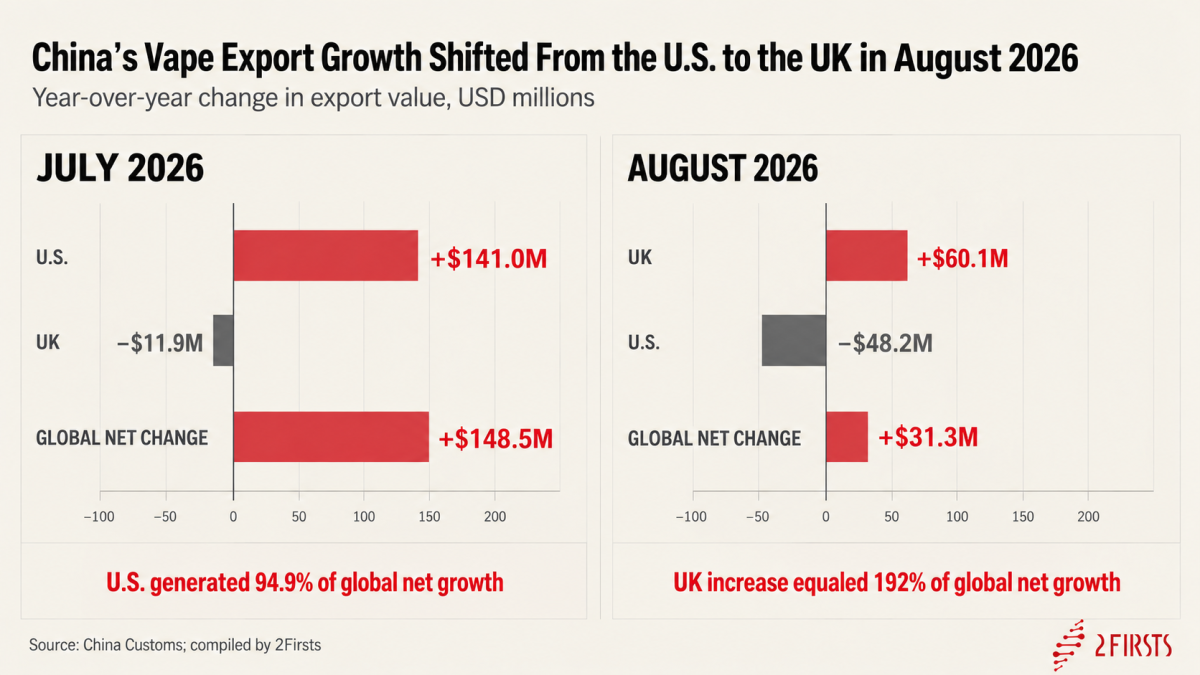
China exported $979 million of vape-related products in August 2026, up 3.3% from a year earlier but down 6.4% from July. The UK replaced the U.S. as the main source of growth: UK-bound shipments jumped 51.4% to a 2026 high of $177 million, while exports to the U.S. fell 12.4% to $339 million. Shipments to markets outside the U.S. increased 14.2%, broadening growth beyond the market that had driven July’s rebound.
News
Sep.23 by 2Firsts Perspectives
Malaysia Liquid Nicotine Returns to Poisons List, Leaving Vape Retail and RM354 Million Tax Collection in Legal Uncertainty
Malaysia’s withdrawal of its appeal in a landmark liquid-nicotine case has left a High Court ruling that struck down the 2023 nicotine exemption in force, bringing liquid and gel nicotine used in vaping products back under the Poisons Act 1952. At the same time, the Control of Smoking Products for Public Health Act 2024 continues to provide a regulatory framework for vaping products, creating uncertainty over retail sales, taxation and existing inventory. MPs are calling for nicotine vape sales and excise collection to stop, including refunds of more than RM354 million collected since 2023, while industry and consumer groups are asking the government to clarify the current legal position.
Sep.04
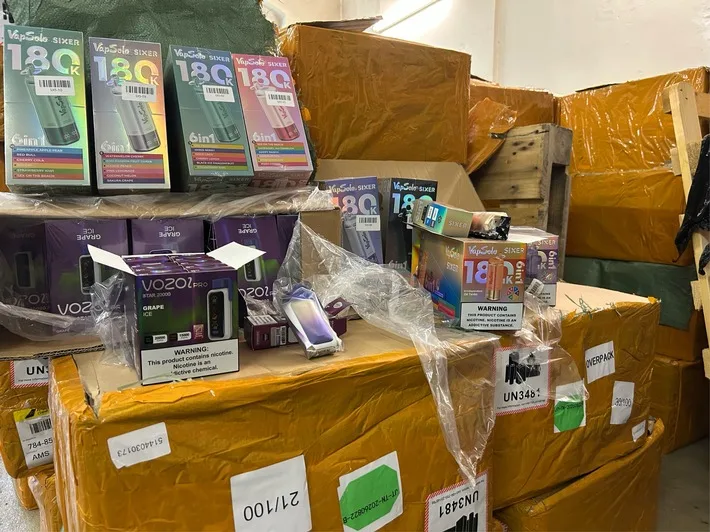
German Customs Seize 115,800 Vapes in €1.4 Million Tax Case
Germany's Magdeburg Main Customs Office seized 115,800 untaxed e-cigarettes containing a combined 4.366 million mL of e-liquid during four truck inspections between August 10 and September 4, 2026. The seizures prevented an estimated €1.397 million in tax losses and set a record for the customs office's jurisdiction. Criminal proceedings have been initiated against four truck drivers. The case follows a separate German investigation involving more than 7.6 million illicit vapes and an estimated €33.3 million in excise-tax losses.
Enforcement
Oct.13
Charlie’s Bets on Age-Gating and 678 PMTA Assets as U.S. Vape Enforcement Landscape Shifts
Charlie’s Holdings said in its latest shareholder letter that it is moving to commercialize PACHA products and monetize its PMTA assets as the FDA changes enforcement priorities for unauthorized ENDS products. Thirty PACHA SKUs were previously tentatively identified for a proposed public list of products that the FDA generally does not intend to prioritize for enforcement. Charlie’s is also preparing test-market sales of age-gated flavored disposables and says it currently holds 678 PMTA-related product assets while seeking additional strategic transactions and partnerships.
Sep.11
Cochrane 2026 Update Adds Nine Trials, Keeps High-Certainty Finding That Nicotine E-Cigarettes Improve Quit Rates Over NRT
Cochrane’s 2026 update of its living review on electronic cigarettes for smoking cessation included 80 randomized controlled trials involving 29,861 adult smokers, with nine trials added in this update. The review retained its high-certainty conclusion that nicotine e-cigarettes increase smoking cessation rates compared with nicotine replacement therapy. In absolute terms, about 10 in 100 people using nicotine e-cigarettes may quit smoking for at least six months, compared with about 6 in 100 using NRT. The review found no clear difference in serious adverse event rates between the two groups, while longer-term safety and the relative effectiveness of newer device types remain less certain.
Sep.07