Ukrainian Representatives Consider Restricting Tobacco Sales in Kiosks

Regulations by 2FIRSTS.ai
Apr.08.2024
Ukrainian Representatives Consider Restricting Tobacco Sales in Kiosks
Ukrainian officials may ban or restrict tobacco sales in kiosks due to lack of proper sales documentation.

According to Ukrainian media Apostrophe, representatives of the Ukrainian people may ban or restrict the sale of tobacco products in small kiosks. This action is related to sellers not using cash registers (РРО) for sales transactions.


Ukrainian representative Danil Getmantsev wrote this message on Telegram.


He made a request to the owners of the kiosks that sell tobacco. He said that if the sellers do not start "fully using POS machines" for all sales without exception, "stop stealing from the army", there could be several possible outcomes.


Firstly, there were sudden actual inspections with no warning from tax "friends". These inspections have caused issues for the pavilion owner. The second situation is that the reasons for permit cancellations due to lack of receipts may increase. The bill is being digested in the council and it will be accepted. Another possible development is the ban on selling tobacco in the pavilion. It hasn't happened yet, but if you don't take action, it will definitely happen," confirmed Daniel Getman-Carp.


We welcome news tips, article submissions, interview requests, or comments on this piece.

Please contact us at info@2firsts.com, or reach out to Alan Zhao, CEO of 2Firsts, on LinkedIn


Notice

1.  This article is intended solely for professional research purposes related to industry, technology, and policy. Any references to brands or products are made purely for objective description and do not constitute any form of endorsement, recommendation, or promotion by 2Firsts.

2.  The use of nicotine-containing products — including, but not limited to, cigarettes, e-cigarettes, nicotine pouchand heated tobacco products — carries significant health risks. Users are responsible for complying with all applicable laws and regulations in their respective jurisdictions.

3.  This article is not intended to serve as the basis for any investment decisions or financial advice. 2Firsts assumes no direct or indirect liability for any inaccuracies or errors in the content.

4.  Access to this article is strictly prohibited for individuals below the legal age in their jurisdiction.


Copyright


This article is either an original work created by 2Firsts or a reproduction from third-party sources with proper attribution. All copyrights and usage rights belong to 2Firsts or the original content provider. Unauthorized reproduction, distribution, or any other form of unauthorized use by any individual or organization is strictly prohibited. Violators will be held legally accountable.

For copyright-related inquiries, please contact: info@2firsts.com


AI Assistance Disclaimer


This article may have been enhanced using AI tools to improve translation and editorial efficiency. However, due to technical limitations, inaccuracies may occur. Readers are encouraged to refer to the cited sources for the most accurate information.

We welcome any corrections or feedback. Please contact us at: info@2firsts.com

Juul Sublicense Reshapes Vuse Alto Patent Bill as Court Ends R.J. Reynolds’ 5.25% Royalty Obligation to Altria
According to Law360 on August 31, 2026, a federal judge in North Carolina ruled that a patent sublicense between R.J. Reynolds Vapor Co. and Juul Labs Inc. relieves Reynolds of its obligation to continue paying royalties to Altria Client Services LLC over Vuse Alto. A jury had previously found that Vuse Alto infringed three Altria patents and awarded approximately $95.2 million in past damages, after which Reynolds was ordered to pay an ongoing royalty equal to 5.25% of positive net sales. The new ruling finds that a valid sublicense can eliminate future infringement, potentially ending what Altria described as hundreds of millions of dollars in future royalties.
Sep.01
2Firsts Data | China’s Vape Exports Rise 3.1% in H1 2026 as 6-Methyl Nicotine-Related Products Surge 65.2%
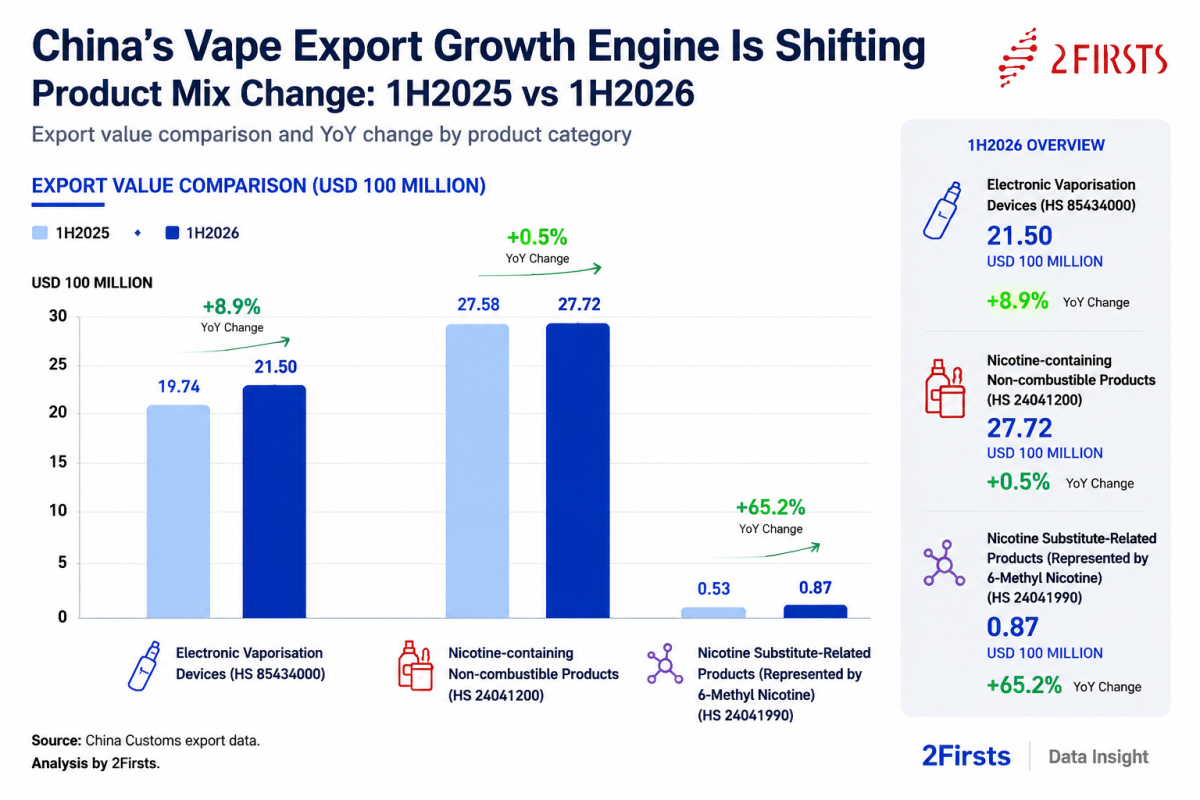
China’s vape exports showed resilience in the first half of 2026 after a short-term shock from China’s export rebate adjustment. But customs data points to more than a simple recovery: the structure of growth is changing. Vaping devices and atomization hardware emerged as the strongest growth driver, while nicotine-containing vaping products remained broadly stable. Meanwhile, nicotine substitute-related products represented by 6-methyl nicotine expanded rapidly, becoming a new category to watch for both industry and regulators. After the U.S. market went through a cycle of shortages, replenishment and inventory rebuilding in 2025, China’s vape supply chain is entering a new phase of reallocation.
Special Report
Jul.20
Germany Plans Tobacco Tax Hike, With Cigarette Prices Nearing €12 Per Pack by 2030
Germany plans to raise tobacco taxes over the coming years, potentially pushing the average price of a 20-cigarette pack to about €11.78 by 2030. The proposal also covers fine-cut tobacco, cigars, pipe tobacco and e-cigarette liquids.
Jul.14
China’s Jiangsu Tobacco Monopoly Bureau and Drug Regulator Target Illegal Vape Sales Disguised as Medical Devices, Define Six Violations
China’s Jiangsu Tobacco Monopoly Bureau and Jiangsu Provincial Medical Products Administration have issued a joint notice targeting illegal production and sales of vape products disguised as medical devices. The notice identifies six categories of violations, including obtaining medical licenses through false materials, misusing medical device credentials, expanding production beyond approved scopes, and using medical device-related online platforms to promote or sell vape products. The action is based on China’s tobacco and medical device regulations and aims to strengthen vape oversight and consumer protection.
Aug.04
Kantar Study Finds More Than 93% of Vape Products in Ukraine Fail Regulatory Requirements
According to Interfax-Ukraine, a study conducted by market research firm Kantar Ukraine at the request of major tobacco companies found that more than 93% of vape products in Ukraine did not fully comply with regulatory requirements. The research examined product categories, brand distribution and consumer purchasing channels, showing that pod systems and disposable vapes represent major segments of the market, while offline retail remains the dominant purchasing channel. The findings highlight ongoing compliance challenges in Ukraine’s vape market.
Aug.26
Former FDA Scientist Questions ZYN Review Over Pouch Material and Microplastic Risk
A former FDA toxicologist has questioned whether the agency fully assessed the material used in ZYN nicotine pouches before authorizing them for sale, raising concerns over possible microplastic exposure, according to STAT and The Examination.
Jul.16