UKVIA Updates Underage Sales Guide for Retailers

Mar.01.2023
UKVIA Updates Underage Sales Guide for Retailers
UKVIA updates guidelines to prevent underage sales of e-cigarettes for UK retailers. Free 20-page guide available on their website.

The UK Vaping Industry Association (UKVIA) has released an updated version of its "Preventing Sales to Underage Persons Guide" for retailers. The 20-page guide was jointly developed by UKVIA's main authoritative partner, the Trading Standards organizations of Buckinghamshire and Surrey. It is available for free on the UKVIA website.


The General Secretary of UK Vaping Industry Association, John Dunne, stated that the entire membership of UKVIA is united in its commitment to preventing the sale of e-cigarette products to minors. He also emphasized that the implementation of strict age verification processes is crucial in ensuring the healthy development of the e-cigarette industry.


The guide provides a detailed explanation of how to implement the "Challenge 25" policy and why it is necessary to require ID from anyone who looks under 25 years old. The UKVIA has made this guide available to all retailers free of charge to assist them in complying with UK law and preventing the sale of electronic cigarettes to minors.


Deng En stated that policymakers, politicians, and consumers must believe that the e-cigarette industry is a responsible field. If companies cannot implement and adhere to strict age verification processes, it will undermine this belief.


References:


UK Vaping Industry Association (UKVIA) has revised its ‘Preventing Underage Sales Guide’ in order to help UK retailers in preventing the sale of vaping products to minors. The guide lays out the necessary procedures for retailers to comply with the Tobacco and Related Products Regulations 2016 as well as identifying the correct age verification methods to limit instances of underage sales. 【2】The update comes as the UK's Committee of Advertising Practice (CAP) came up with guidelines that ban online promotions of e-cigarette products specifically designed for children. This can be viewed as a further step towards restricting the sale of e-cigarettes among minors. 【3】UKVIA explained that the revisions are to ensure that the guide is up to date with changing regulatory policies. Furthermore, the association hopes to build upon the early success of the guide since its initial publication in 2017.


Disclaimer

This article is provided solely for professional research, industry discussion, and informational purposes. Any references to brands, companies, products, technologies, or policies are made for factual reporting and analytical purposes only, and do not constitute endorsement, recommendation, promotion, or advertising by 2Firsts.

Nicotine-containing products, including but not limited to cigarettes, e-cigarettes, heated tobacco products, and nicotine pouches, carry significant health risks. Readers are responsible for complying with all applicable laws and regulations in their respective jurisdictions, including age restrictions and access limitations.

The information contained in this article should not be regarded as investment, legal, medical, regulatory, or commercial advice. While 2Firsts strives to ensure the accuracy and reliability of its content, it does not assume liability for any direct or indirect loss arising from errors, omissions, inaccuracies, or reliance on the information contained herein.

This article is not intended for individuals below the legal age for accessing tobacco or nicotine-related information in their jurisdiction.


Copyright Notice

This article is either original content produced by 2Firsts or content reproduced, translated, summarized, or adapted from third-party sources with attribution where applicable. The intellectual property rights of the original content remain with 2Firsts or the respective original rights holders.

No individual or organization may copy, reproduce, distribute, republish, modify, translate, or otherwise use this content without prior authorization. Any unauthorized use may result in legal action.

For copyright-related inquiries, corrections, or removal requests, please contact: info@2firsts.com.


AI-Assisted Translation and Editing Notice

Portions of this article may have been translated, edited, or reviewed with the assistance of artificial intelligence tools to improve efficiency and readability. Due to the limitations of AI-assisted translation and editing, discrepancies, omissions, or inaccuracies may exist when compared with the original source.

Where applicable, readers are advised to refer to the original source for the most complete and accurate information. If you identify any errors or believe that any content infringes upon your rights, please contact us at info@2firsts.com, and we will review and address the matter promptly.

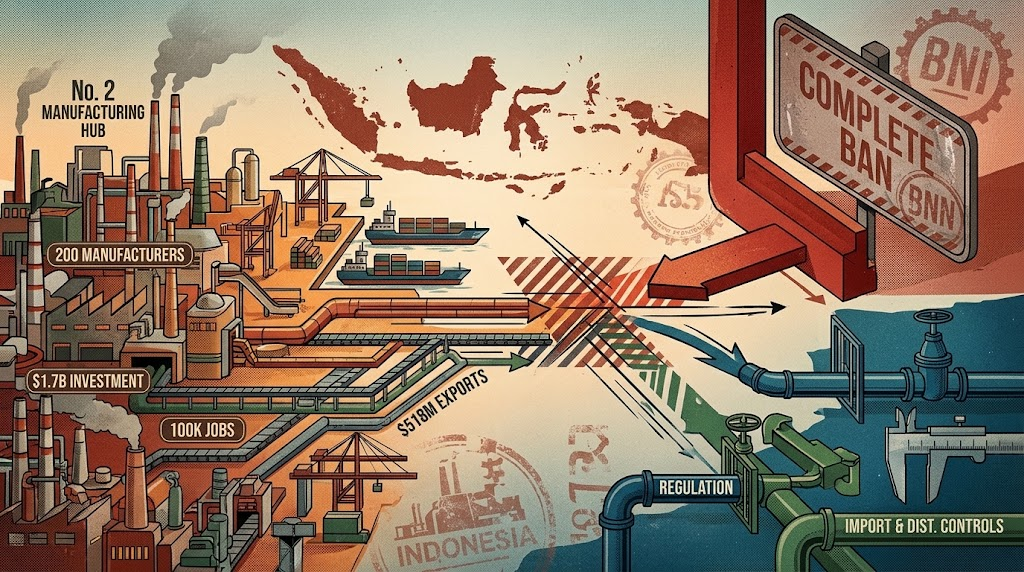
Special report|Indonesia's Vape Industry Has 200 Manufacturers and $1.7 Billion in Investment. Could a Regulatory Divide Derail Its Rise as the World's No. 2 Manufacturing Hub After Shenzhen?
Indonesia's Ministry of Industry said at a November 3, 2026, policy forum that the country has about 200 electronic cigarette companies, Rp31 trillion (approximately $1.71 billion) in cumulative industry investment and around 100,000 jobs across the supply chain. The National Narcotics Agency is seeking a comprehensive ban on vape use and circulation, while the industry ministry favors tighter import, product-standard and distribution controls. Indonesia exported approximately $518 million in vaping products in 2025, and Chinese manufacturers including Smoore, GEEKVAPE and Jinjia Group have established local operations. An international logistics specialist interviewed by 2Firsts said more Chinese vape companies began production in Indonesia from the second half of 2025, accompanied by increased shipments of manufacturing equipment and investment in logistics facilities. The regulatory debate comes as Indonesia expands its role in international vaping manufacturing.
Special Report
Nov.05
Sweden Threatens EU Tobacco Tax Deal as Nicotine Pouch Duty Dispute Looms Over November 9 Meeting
Sweden is expected to oppose a European Union proposal to raise minimum tobacco excise duties, Law360 reported on October 26, 2026, citing an EU official. A provisional Council agenda dated October 23 confirms that the tobacco taxation package is scheduled for discussion at the November 9 finance ministers' meeting, where member states will seek a general approach. The proposed reforms would raise minimum taxes on conventional tobacco products and establish EU-wide excise rules for vaping liquids, heated tobacco and nicotine pouches. Sweden supports harmonising tobacco taxation rules but objects to requiring nicotine pouches to bear the same minimum tax burden as certain smoking tobacco products. As EU indirect tax legislation requires unanimous Council approval, Swedish opposition could block the proposal in its current form.
Regulations
Oct.29
India Duty-Free Nicotine Pouch Sales Face Regulatory Test as ZYN, FOX Classification Remains Open
The Bombay High Court has ruled that airport duty-free shops are not exempt from India's domestic regulatory laws merely because they operate beyond the customs barrier, leaving in place a sales halt covering ZYN and FOX nicotine pouches at Mumbai's international airport. The court, however, did not determine that the products necessarily qualify as "drugs" under India's Drugs and Cosmetics Act. The retailers have four weeks to submit product information to the appropriate authorities, including CDSCO, which must complete its review within 30 days of receiving the submissions.
Sep.24
Kumulus Vape2026 H1 Revenue Falls 8.3% but Profit Rises 24% as B2B Weakens and Consumer Channels Grow
French vaping company Kumulus Vape reported first-half 2026 revenue of €25.5 million, down 8.3% year over year, as its core B2B distribution business fell 11% to €21.6 million. B2C and store-network revenue rose 5.6% and 17.8%, respectively. Commercial margin increased to 26.3% from 21.7%, while net profit rose 24.1% to €0.8 million. The company attributed the profitability improvement to catalog optimization, logistics restructuring and the ramp-up of Labster, its in-house production unit for proprietary brands.
Market
Sep.17 by 2Firsts Perspectives
UK Extends Age-18 Rules to Zero-Nicotine Vapes and Nicotine Pouches From Oct. 29, Bans Vending Machines and Promotional Giveaways
Key provisions of the UK's Tobacco and Vapes Act 2026 will take effect on Oct. 29, extending an age-18 sales restriction to all vaping and non-medicinal nicotine products. In England, Wales and Northern Ireland, the change brings zero-nicotine vapes within statutory age-of-sale rules and also covers products including nicotine pouches, strips and pearls. The law will also prohibit proxy purchasing for under-18s, consumer-facing vending machines, promotional giveaways and substantial discounts intended to promote vaping and nicotine products.
Regulations
Oct.10
Special Report | Vape bans and tougher rules: the South Caucasus takes different paths
Azerbaijan's sweeping e-cigarette ban has raised concerns over enforcement errors and the emergence of illicit sales, while neighboring Armenia is tightening technical rules and preparing higher excise taxes. Georgia, meanwhile, has resisted calls for broader vape restrictions and introduced preferential taxes for some domestically produced cigarettes. The divergent approaches across the South Caucasus highlight a regional policy dilemma: how to curb nicotine use and protect public health without encouraging black markets or creating unintended economic consequences for businesses and consumers.
Nov.03