US Appeals Court Rejects Gripum's Marketing Refusal Order

Aug.31.2022
US Appeals Court Rejects Gripum's Marketing Refusal Order
US appeals court rejects marketing refusal order against Gripum, an Illinois-based e-liquid manufacturer.

Source: Mikhail Reshetnikov


According to a report from Vaped360, the US Court of Appeals has rejected Gripum's application for review of the FDA's Marketing Denial Order (MDO) to the Illinois-based e-liquid manufacturer.


In September 2020, Gripum submitted pre-market tobacco product applications (PMTA) for approximately 200 bottled electronic liquid products with non-tobacco flavors. The company received a marketing denial order (MDO) in September 2021. In October 2021, Gripum submitted a review application and was granted a pause on FDA enforcement in November 2021. On April 20, the company had a verbal argument in court.


Gripum believes that the FDA and Congress' release of the MDO is unfair because there are no "definable standards" in place to determine if the company's products are "suitable for protecting public health." The company claims that after the application deadline passed, the organization changed the evidence standards required for a successful PMTA, and did not conduct personalized PMTA reviews as required by the Tobacco Control Act.


The Seventh Circuit Court of Appeals has rejected all of Gripum's arguments, finding that the FDA's approach to the application was both reasonable and consistent with the Tobacco Control Act.


The failure of Gripum followed after six e-cigarette companies successfully challenged the MDO. On August 23rd, the US Eleventh Circuit Court of Appeals approved the petition for rehearing submitted by Bidi Vapor, Diamond Vapor and four other companies, questioning the FDA's denial of their e-cigarette applications.


Statement:


This article is compiled from third-party information and is only for industry exchange and learning purposes.


This article does not represent the views of 2FIRSTS, and 2FIRSTS cannot confirm the truthfulness or accuracy of its contents. The translation of this article is solely for the purpose of internal industry exchange and research.


Due to limitations in translation proficiency, the translated article may not depict the original expression accurately. Please refer to the original article for accuracy.


2FIRSTS fully aligns its statements and positions concerning domestic, Hong Kong, Macau, Taiwan, and foreign matters with the Chinese government.


Translation: The copyright of compiled information belongs to the original media and author. If there is any infringement, please contact us to request deletion.


Disclaimer

This article is provided solely for professional research, industry discussion, and informational purposes. Any references to brands, companies, products, technologies, or policies are made for factual reporting and analytical purposes only, and do not constitute endorsement, recommendation, promotion, or advertising by 2Firsts.

Nicotine-containing products, including but not limited to cigarettes, e-cigarettes, heated tobacco products, and nicotine pouches, carry significant health risks. Readers are responsible for complying with all applicable laws and regulations in their respective jurisdictions, including age restrictions and access limitations.

The information contained in this article should not be regarded as investment, legal, medical, regulatory, or commercial advice. While 2Firsts strives to ensure the accuracy and reliability of its content, it does not assume liability for any direct or indirect loss arising from errors, omissions, inaccuracies, or reliance on the information contained herein.

This article is not intended for individuals below the legal age for accessing tobacco or nicotine-related information in their jurisdiction.


Copyright Notice

This article is either original content produced by 2Firsts or content reproduced, translated, summarized, or adapted from third-party sources with attribution where applicable. The intellectual property rights of the original content remain with 2Firsts or the respective original rights holders.

No individual or organization may copy, reproduce, distribute, republish, modify, translate, or otherwise use this content without prior authorization. Any unauthorized use may result in legal action.

For copyright-related inquiries, corrections, or removal requests, please contact: info@2firsts.com.


AI-Assisted Translation and Editing Notice

Portions of this article may have been translated, edited, or reviewed with the assistance of artificial intelligence tools to improve efficiency and readability. Due to the limitations of AI-assisted translation and editing, discrepancies, omissions, or inaccuracies may exist when compared with the original source.

Where applicable, readers are advised to refer to the original source for the most complete and accurate information. If you identify any errors or believe that any content infringes upon your rights, please contact us at info@2firsts.com, and we will review and address the matter promptly.

Goldman Sachs Survey Sees 11.3% More U.S. Shelf Space for Nicotine Pouches as ZYN, VELO Show Strong Growth and C-Stores Rework Assortments
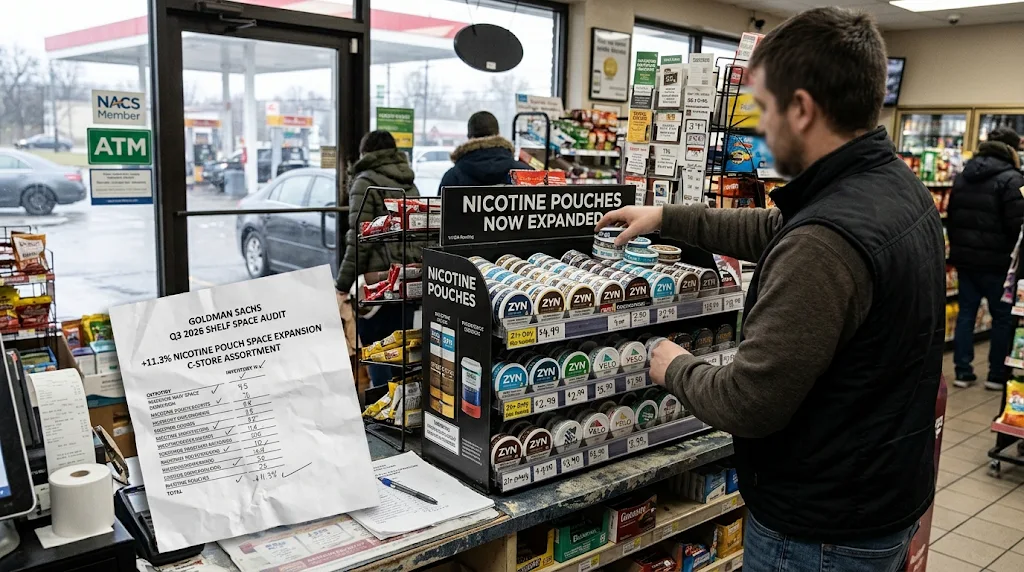
Goldman Sachs' third-quarter 2026 Nicotine Nuggets survey found that U.S. tobacco and nicotine retailers expect nicotine pouch shelf space to increase by 11.3%, the largest projected gain among major nicotine product categories. Retailers and wholesalers participating in the survey represent approximately 40,000 U.S. retail locations. Respondents reported stronger third-quarter growth for ZYN and VELO, while on! growth was more moderate. Approximately 80% said deep-discount cigarettes gained market share. In an earlier interview with 2Firsts, the National Association of Convenience Stores (NACS) reported that convenience stores accounted for 92.9% of U.S. other tobacco product sales in 2025. Meanwhile, regional convenience store chains are reallocating nicotine pouch displays and managing vape assortments amid FDA authorization requirements and varying state regulations.
Market
Nov.23
Reynolds Showcases Vuse Pro Flavors and VELO Nicotine Pouches at NACS Show 2026
Reynolds American, a BAT subsidiary, showcased four Vuse Pro flavored e-cigarette pods and its VELO nicotine pouch portfolio at NACS Show 2026. Booth staff confirmed to 2Firsts that the Vuse Pro flavors are sold in the U.S., although they have not received FDA marketing authorization. BAT outlined plans to expand Vuse retail distribution and reported that VELO held a 30.5% year-to-date volume share of the U.S. modern oral nicotine category through August 2026. The booth also featured the newly launched VELO MAX range and merchandising displays combining cigarettes, vaping products and oral nicotine brands.
EXPO
Oct.09
Wisconsin Vape Directory One Year On: Retailer Reports Four Store Closures and 70% Staff Cuts
Wisconsin's electronic vaping device directory has been fully enforced for more than a year, and local vape retailers say the reduced range of eligible products has contributed to declining sales, store closures and layoffs. Johnny Vapes owner Ben Hall said he has closed four of seven locations and cut about 70% of his staff. State law bars the sale of vaping devices not listed on the Wisconsin Department of Revenue directory and allows penalties of $1,000 per day for each unlisted device sold or offered for sale. In April 2026, the U.S. Court of Appeals for the Seventh Circuit allowed enforcement of the law to continue.
Regulations
Oct.10
South Korea's Synthetic Nicotine Tax Take Estimated at Just 1.3% of Forecast as Imports Plunge Nearly 97%
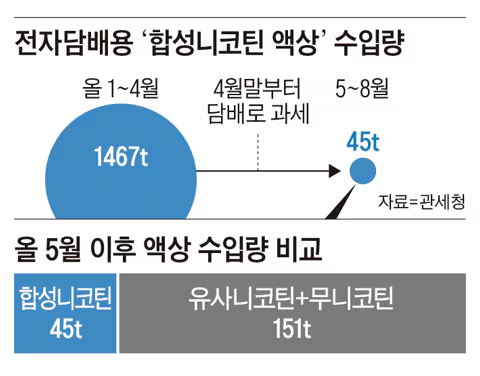
After synthetic nicotine was placed under tobacco regulation on April 24, 2026, South Korea’s tax collections from synthetic-nicotine vaping products fell far short of government projections. The Chosun Ilbo reported on November 18 that Ministry of Health and Welfare data showed national health promotion charges on synthetic-nicotine liquid e-cigarettes totaled 765 million won from April 24 through September. Using statutory rates, the newspaper estimated combined major taxes and charges at about 2.622 billion won—on a monthly basis roughly 1.3% of an earlier forecast after temporary tax reductions. Customs data showed synthetic-nicotine imports dropped from about 1,467 metric tons in January–April to 45 metric tons in May–August, a nearly 97% decline. Imports of nicotine-analog and nicotine-free liquids totaled 151 metric tons in May–August, exceeding synthetic-nicotine imports in the same period, though both categories were also below January–April volumes.
Regulations
Nov.19
Russia Expands Temporary Administration of JTI Assets in Second Round: From Four to All Seven Russian Entities, With Approximately $9.5 Billion in Related Assets
Japan Tobacco Inc. (JT) confirmed on November 9, 2026, that all seven of its Russian entities had been placed under temporary administration after a second presidential decree added three companies to the four designated a day earlier. The additional entities are associated with importing, management, holdings and the former supply of Ploom heated-tobacco devices. JT disclosed approximately ¥1.5 trillion in Russian business-related assets as of September 30, including ¥360 billion in cash and deposits, and approximately ¥200 billion in liabilities. Under its revised FY2026 forecast, Russia accounts for about 25% of adjusted operating profit. JT said operations in Russia were continuing, while the financial impact remained under assessment.
company
Nov.09
North Carolina Tightens Vape Product Directory Enforcement, Expands State and Local Powers as Violators Face Fines, Product Seizures and License Suspension or Revocation
North Carolina has expanded enforcement of its vapor product directory rules, authorizing more state and local law enforcement participation and establishing a task force led by the State Bureau of Investigation. The legislation requires at least one unannounced compliance inspection annually for retailers, distributors and wholesalers handling covered products. Penalties effective October 1, 2026, include civil fines of $500–$750 for a first violation and $1,000–$1,500 for repeated violations within 12 months, along with potential license suspension or revocation. Manufacturers may face penalties of $10,000 per unlisted product. The measures strengthen the product directory system established in 2024.
Regulations
Oct.28