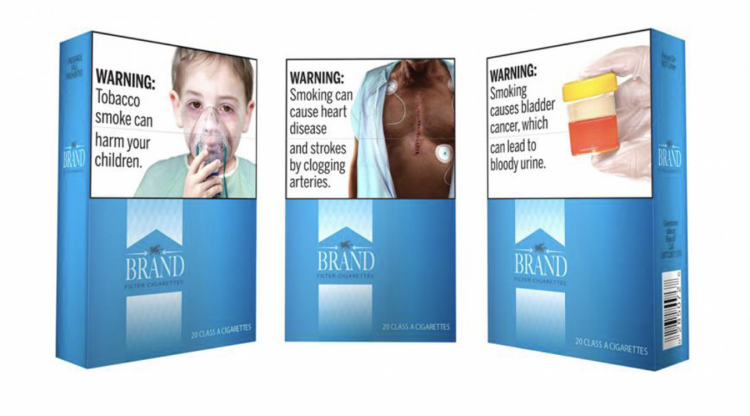
According to reports, a federal judge in the United States has cited the First Amendment right to prevent the Food and Drug Administration (FDA) from enforcing a regulation that would require tobacco manufacturers to print graphic warning labels on their products.
In 2009, the Family Smoking Prevention and Tobacco Control Act directed the FDA to create graphic health warnings, but the first attempt was blocked due to a lack of convincing evidence that these warnings would reduce smoking.
In March 2020, the FDA released a final regulation requiring warning labels on the top half of both the front and back of cigarette packaging, as well as at least 20% of the space on the top of cigarette advertisements.
In April 2020, tobacco companies, including Reynolds American, Imperial Tobacco, and Liggett Group, challenged the First Amendment. The regulation was originally set to take effect in November 2023 but has been overturned by courts multiple times before.
On December 7th, US District Judge J. Campbell Barker issued a lengthy opinion in which he revoked regulations from the FDA that required certain label statements and graphic images designed to increase public awareness of the health hazards of smoking. The judge found that these requirements were tailored to benefit the FDA.
The government has not indicated that mandatory large graphic warning labels are necessary, given other options," said the judge, adding that the government could invest more effort into public awareness campaigns.
In a joint statement released by the American Academy of Pediatrics, the organizations including the American Cancer Society, the American Cancer Society Cancer Action Network, the American Heart Association, the American Lung Association, the Campaign for Tobacco-Free Kids, and Truth Initiative criticized a federal judge's decision to block the Food and Drug Administration's mandate to use graphic warning labels on cigarette packages. The statement argues that the judge's ruling is legally incorrect and goes against decades of precedent, and it poses a threat to public health.
These institutions stated, "We urge the Department of Justice to appeal this decision and we believe that the FDA's warning will ultimately be supported by the higher courts.
The health organization also pointed out that the United States lags behind other countries in tobacco control policies. Prior to the passage of the Tobacco Control Act by Congress in 2009, only 18 countries/regions required graphic warnings on tobacco products. Today, over 120 countries require them.
2FIRSTS will continue to report on this topic. Further updates will be available on the "2FIRSTS APP". Scan the QR code below to download the app.
Disclaimer
This article is provided solely for professional research, industry discussion, and informational purposes. Any references to brands, companies, products, technologies, or policies are made for factual reporting and analytical purposes only, and do not constitute endorsement, recommendation, promotion, or advertising by 2Firsts.
Nicotine-containing products, including but not limited to cigarettes, e-cigarettes, heated tobacco products, and nicotine pouches, carry significant health risks. Readers are responsible for complying with all applicable laws and regulations in their respective jurisdictions, including age restrictions and access limitations.
The information contained in this article should not be regarded as investment, legal, medical, regulatory, or commercial advice. While 2Firsts strives to ensure the accuracy and reliability of its content, it does not assume liability for any direct or indirect loss arising from errors, omissions, inaccuracies, or reliance on the information contained herein.
This article is not intended for individuals below the legal age for accessing tobacco or nicotine-related information in their jurisdiction.
Copyright Notice
This article is either original content produced by 2Firsts or content reproduced, translated, summarized, or adapted from third-party sources with attribution where applicable. The intellectual property rights of the original content remain with 2Firsts or the respective original rights holders.
No individual or organization may copy, reproduce, distribute, republish, modify, translate, or otherwise use this content without prior authorization. Any unauthorized use may result in legal action.
For copyright-related inquiries, corrections, or removal requests, please contact: info@2firsts.com.
AI-Assisted Translation and Editing Notice
Portions of this article may have been translated, edited, or reviewed with the assistance of artificial intelligence tools to improve efficiency and readability. Due to the limitations of AI-assisted translation and editing, discrepancies, omissions, or inaccuracies may exist when compared with the original source.
Where applicable, readers are advised to refer to the original source for the most complete and accurate information. If you identify any errors or believe that any content infringes upon your rights, please contact us at info@2firsts.com, and we will review and address the matter promptly.