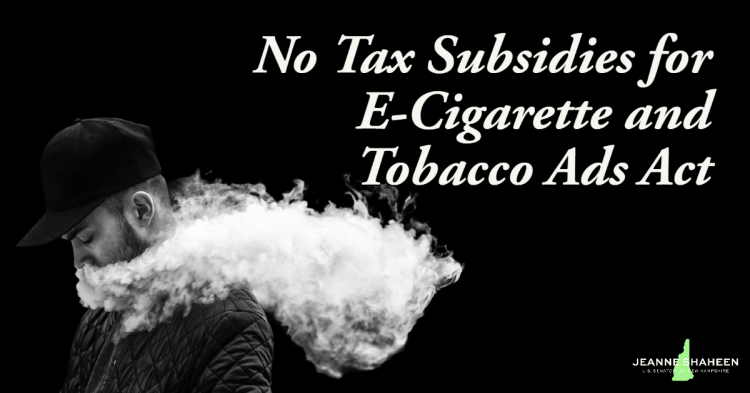
On February 16th, Senators Jeanne Shaheen and Richard Blumenthal reintroduced the "No Tax Subsidies for E-Cigarette and Tobacco Ads Act" in Congress. The bill aims to crack down on e-cigarette companies and close a tax loophole that currently allows manufacturers to receive federal tax breaks on advertising expenses for e-cigarette and tobacco products.
In November 2022, federal data released by the US Food and Drug Administration (FDA) and the Centers for Disease Control and Prevention (CDC) revealed that over 3 million middle and high school students had used tobacco products in the past 30 days. The use of electronic cigarettes by teenagers has risen by 1800% from 2011 to 2019. More than 30% of teenagers who start using electronic cigarettes switch to traditional tobacco products within six months.
Currently, more than 25% of teenage e-cigarette users use their e-cigarettes every day. More than 85% of users prefer fruit flavors. Among students surveyed, 73.5% reported seeing e-cigarette content on social media.
Electronic cigarette and big tobacco companies must be held accountable for their advertising targeting young people. These dangerous products are fueling a public health crisis – especially among teenagers," said Shaheen. "Taxpayers should not foot the bill for these harmful marketing practices. That's why I am reintroducing this critical legislation, which would close a tax loophole that allows companies to write off their advertising costs and require responsibility from electronic cigarette companies.
The tax breaks for the tobacco and e-cigarette giants allowed the industry to profit from their manipulative marketing tactics. Our legislation has put an end to these loopholes, in order to protect children and other consumers from being lured into lifelong addiction," said Blumenthal. "I am proud to have worked alongside Senator Shaheen to prevent big tobacco companies from enticing the next generation.
According to federal law, television and radio advertisements for traditional tobacco products have been prohibited, and certain other forms of tobacco advertising are also restricted by the 1998 Tobacco Master Settlement Agreement. However, these restrictions do not apply to electronic cigarettes. While some television media have begun to pull electronic cigarette advertisements during broadcasts in response to the ongoing youth vaping crisis, other media are still airing these ads. To ensure equality between electronic cigarettes and traditional tobacco, the Shaheen and Blumenthal bill also prohibits tax breaks for advertising expenses related to cigarette rolling tobacco, cigars, snuff, chewing tobacco, pipe tobacco, and homemade cigarettes.
Senators Brown (D-OH), Reed (D-RI), Durbin (D-IL), and Merkley (D-OR) have also joined the ranks of sponsors for this reintroduced bill.
The full text of the legislation can be found here.
Disclaimer
This article is provided solely for professional research, industry discussion, and informational purposes. Any references to brands, companies, products, technologies, or policies are made for factual reporting and analytical purposes only, and do not constitute endorsement, recommendation, promotion, or advertising by 2Firsts.
Nicotine-containing products, including but not limited to cigarettes, e-cigarettes, heated tobacco products, and nicotine pouches, carry significant health risks. Readers are responsible for complying with all applicable laws and regulations in their respective jurisdictions, including age restrictions and access limitations.
The information contained in this article should not be regarded as investment, legal, medical, regulatory, or commercial advice. While 2Firsts strives to ensure the accuracy and reliability of its content, it does not assume liability for any direct or indirect loss arising from errors, omissions, inaccuracies, or reliance on the information contained herein.
This article is not intended for individuals below the legal age for accessing tobacco or nicotine-related information in their jurisdiction.
Copyright Notice
This article is either original content produced by 2Firsts or content reproduced, translated, summarized, or adapted from third-party sources with attribution where applicable. The intellectual property rights of the original content remain with 2Firsts or the respective original rights holders.
No individual or organization may copy, reproduce, distribute, republish, modify, translate, or otherwise use this content without prior authorization. Any unauthorized use may result in legal action.
For copyright-related inquiries, corrections, or removal requests, please contact: info@2firsts.com.
AI-Assisted Translation and Editing Notice
Portions of this article may have been translated, edited, or reviewed with the assistance of artificial intelligence tools to improve efficiency and readability. Due to the limitations of AI-assisted translation and editing, discrepancies, omissions, or inaccuracies may exist when compared with the original source.
Where applicable, readers are advised to refer to the original source for the most complete and accurate information. If you identify any errors or believe that any content infringes upon your rights, please contact us at info@2firsts.com, and we will review and address the matter promptly.