Using Nicotine-Free E-Cigarettes for Smoking Cessation

Nov.28.2022
Using Nicotine-Free E-Cigarettes for Smoking Cessation
A year-long study found that nicotine-free e-cigarettes are more effective for quitting smoking than nicotine delivery systems.

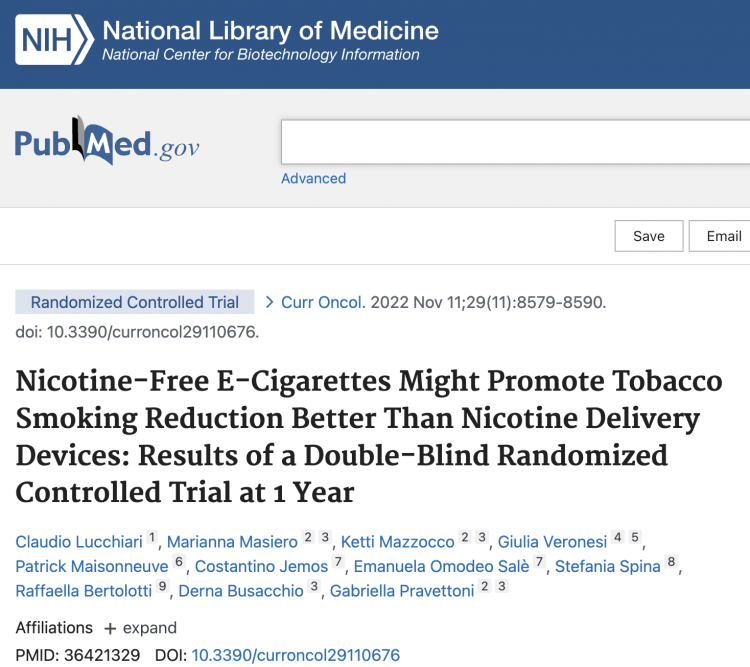
A study published in the National Library of Medicine in the United States found that the use of nicotine-free electronic cigarettes is more effective in promoting smoking cessation than nicotine delivery systems, based on a one-year double-blind randomized trial. The abstract of the paper is compiled by 2FIRSTS below.


The aim of this study was to determine whether using electronic cigarettes to help quit smoking is beneficial for improving the lung health of chronic smokers. The effectiveness of electronic cigarette support in successful smoking cessation attempts was also studied. A total of 210 smokers (78 females) participated in an early lung cancer screening program and were divided into three groups: nicotine electronic cigarette plus support, non-nicotine electronic cigarette plus support, and support only. The results showed that participants in the nicotine electronic cigarette group significantly and rapidly reduced their daily smoking intake, but they relapsed more frequently than the other two groups. Conversely, participants in the other two groups had similar daily consumption levels at both assessment points. Among the participants who quit smoking, only 12 reported coughing, while 48% of current smokers had lung symptoms. Our study suggests that in the long run, using non-nicotine liquids may be beneficial for reducing smoking and may be considered a good option in clinical settings.


Disclaimer

This article is provided solely for professional research, industry discussion, and informational purposes. Any references to brands, companies, products, technologies, or policies are made for factual reporting and analytical purposes only, and do not constitute endorsement, recommendation, promotion, or advertising by 2Firsts.

Nicotine-containing products, including but not limited to cigarettes, e-cigarettes, heated tobacco products, and nicotine pouches, carry significant health risks. Readers are responsible for complying with all applicable laws and regulations in their respective jurisdictions, including age restrictions and access limitations.

The information contained in this article should not be regarded as investment, legal, medical, regulatory, or commercial advice. While 2Firsts strives to ensure the accuracy and reliability of its content, it does not assume liability for any direct or indirect loss arising from errors, omissions, inaccuracies, or reliance on the information contained herein.

This article is not intended for individuals below the legal age for accessing tobacco or nicotine-related information in their jurisdiction.


Copyright Notice

This article is either original content produced by 2Firsts or content reproduced, translated, summarized, or adapted from third-party sources with attribution where applicable. The intellectual property rights of the original content remain with 2Firsts or the respective original rights holders.

No individual or organization may copy, reproduce, distribute, republish, modify, translate, or otherwise use this content without prior authorization. Any unauthorized use may result in legal action.

For copyright-related inquiries, corrections, or removal requests, please contact: info@2firsts.com.


AI-Assisted Translation and Editing Notice

Portions of this article may have been translated, edited, or reviewed with the assistance of artificial intelligence tools to improve efficiency and readability. Due to the limitations of AI-assisted translation and editing, discrepancies, omissions, or inaccuracies may exist when compared with the original source.

Where applicable, readers are advised to refer to the original source for the most complete and accurate information. If you identify any errors or believe that any content infringes upon your rights, please contact us at info@2firsts.com, and we will review and address the matter promptly.


Special Report|AIR H1 Revenue Rises 3.7% as Shisha Volumes Fall 9%, Testing Its Shift Beyond Traditional Hookah
AIR’s first half-year results as a listed company offer a new test of how far a traditional hookah business can transform. H1 2026 revenue rose 3.7%, even as Flavored Shisha Molasses shipments fell 9%, with pricing and mix supporting growth. Traditional shisha still generates almost all revenue, while OOKA, Crown Switch, Greentank and U.S. regulatory spending point to accelerating diversification. The next test is whether those investments can become a second business of meaningful scale and profitability.
Capital Markets
Aug.21
DOJ Trade Fraud Task Force Tops $1 Billion in Cases, Putting Vape Supply Chains at Risk of Fraud Enforcement
According to the U.S. Department of Justice (DOJ), Fox News and other reports, the DOJ’s Trade Fraud Task Force (TFTF) has been linked to more than $1 billion in recoveries, penalties, forfeitures and publicly charged losses in less than one year. The task force focuses on trade fraud issues including country-of-origin fraud, illegal transshipment, false declarations and tariff evasion. While vape products are not the main source of the $1 billion figure, the industry’s reliance on global manufacturing and cross-border supply chains places it within broader U.S. trade enforcement scrutiny. The development suggests that U.S. oversight of cross-border vape products may increasingly extend beyond product authorization into import compliance, supply-chain transparency and corporate accountability.
Jul.23
Alaska Warns 1,500 Tobacco Retailers Over Unauthorized Vapes and Nicotine Pouches
Alaska Attorney General Stephen J. Cox has sent notices to more than 1,500 tobacco retailers and distributors warning them against selling vape and nicotine pouch products that lack authorization from the U.S. Food and Drug Administration (FDA). According to the Alaska Department of Law, businesses were advised to verify products against FDA authorization databases and avoid selling unauthorized nicotine products. The action highlights how state-level enforcement is increasingly extending federal product authorization requirements to retail channels.
Jul.24
UK Reform Party Proposes Cap of 1,000 Vape Shops Under Plan to Tighten Retail Controls
The UK Reform Party has proposed limiting the number of dedicated vape shops in the country to around 1,000 as part of a plan to tighten oversight of vape retail channels. The proposal was put forward by Reform UK deputy leader and MP Lee Anderson. The plan remains a political proposal and has not become UK government policy, with no detailed legislation, implementation timeline or allocation rules announced.
Aug.10
WIRED Investigation: Chinese-Made Vapes Turn to 6-Methyl-Nicotine and Other Analogs, Challenging U.S. Regulation
U.S. technology and investigative publication WIRED has examined how nicotine analogs are emerging as a new challenge for the country’s vape regulatory framework. The article argues that after the U.S. expanded federal oversight of nicotine products in 2022, some manufacturers began using nicotine-like compounds such as 6-methyl-nicotine that may fall outside existing definitions. Researchers cited by WIRED said some nicotine analogs could be more potent than traditional nicotine, although human health impacts remain unclear. U.S. policymakers are considering broader definitions of nicotine to bring these compounds under federal oversight.
Jul.27
CCPIT Says Trade Friction Index for China-Related Electronics Sector Remains High, With Vape Products Among Areas of Focus
China Council for the Promotion of International Trade (CCPIT) held its July regular press conference on July 31, 2026, releasing the May 2026 Global Economic and Trade Friction Index. CCPIT spokesperson Yang Fan said the global trade friction index stood at 95 in May, remaining at a medium-to-high level. By industry, the electronics sector recorded the highest trade friction index among 13 monitored industries. In China-related trade frictions, the index stood at 93, with electronics products including drones, chips and vape products among areas where friction remained elevated.
Aug.03