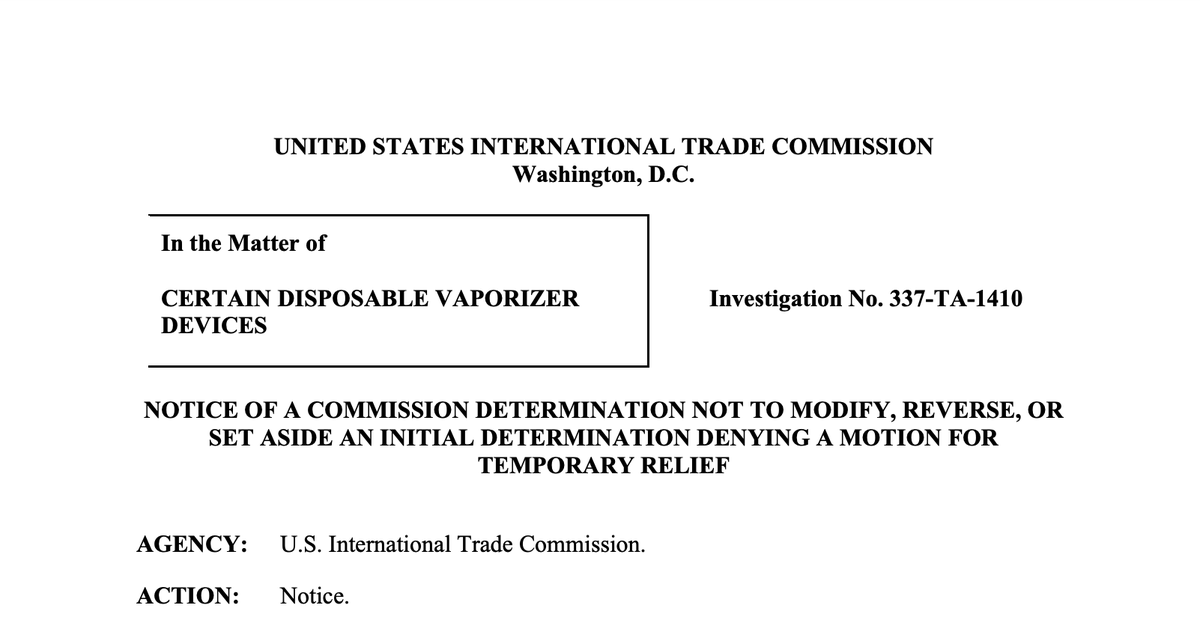
On December 18, the United States International Trade Commission (USITC) announced that it had decided not to modify, rescind, or overturn the decision of the presiding Administrative Law Judge (ALJ) concerning the preliminary determination denying RAI Strategic Holdings, Inc. and its affiliated companies' request for temporary relief (known as "ID," or Order No. 28). This decision means that the temporary exclusion order and cease and desist order sought by RAI regarding the import and sale of certain disposable e-cigarette devices and their components were not approved.
The investigation was filed by the British-American tobacco subsidiary Reynolds Tobacco on July 22, 2024, alleging that the importation and sale of certain disposable e-cigarette devices and components by 35 companies violated its US Patent No. 11,925,202. The companies under investigation include several from China, Hong Kong, and the United States.
Reynolds Tobacco has filed a complaint and simultaneously applied for a temporary restraining order and injunction in an attempt to prevent these products from entering or continuing to be sold in the US market during the investigation.
The U.S. International Trade Commission has accepted the case and assigned an administrative law judge to conduct the investigation. However, due to the complexity of the case, the commission deemed the interim relief program as a "complicated" matter on July 29, 2024. Some defendant companies such as Kimsun and Bidi Vapor have ended the investigation by reaching a consent decree, but several defendants have not appeared in response to the lawsuit.
On November 19, 2024, an administrative judge issued a temporary restraining order ("TEO"), denying Reynolds Tobacco's request for temporary relief. The ruling stated:
The claims of patent infringement lack a likelihood of success.
There is a significant dispute over the validity of the patent.
The plaintiff failed to prove that not seeking redress would result in irreparable harm.
Renault subsequently submitted a comment document, but stated that they will not seek a reconsideration of the ruling by the commission.
We welcome news tips, article submissions, interview requests, or comments on this piece.
Please contact us at info@2firsts.com, or reach out to Alan Zhao, CEO of 2Firsts, on LinkedIn
Notice
1. This article is intended solely for professional research purposes related to industry, technology, and policy. Any references to brands or products are made purely for objective description and do not constitute any form of endorsement, recommendation, or promotion by 2Firsts.
2. The use of nicotine-containing products — including, but not limited to, cigarettes, e-cigarettes, nicotine pouchand heated tobacco products — carries significant health risks. Users are responsible for complying with all applicable laws and regulations in their respective jurisdictions.
3. This article is not intended to serve as the basis for any investment decisions or financial advice. 2Firsts assumes no direct or indirect liability for any inaccuracies or errors in the content.
4. Access to this article is strictly prohibited for individuals below the legal age in their jurisdiction.
Copyright
This article is either an original work created by 2Firsts or a reproduction from third-party sources with proper attribution. All copyrights and usage rights belong to 2Firsts or the original content provider. Unauthorized reproduction, distribution, or any other form of unauthorized use by any individual or organization is strictly prohibited. Violators will be held legally accountable.
For copyright-related inquiries, please contact: info@2firsts.com
AI Assistance Disclaimer
This article may have been enhanced using AI tools to improve translation and editorial efficiency. However, due to technical limitations, inaccuracies may occur. Readers are encouraged to refer to the cited sources for the most accurate information.
We welcome any corrections or feedback. Please contact us at: info@2firsts.com