ITC terminates investigation on Kimsun in e-cigarette dispute

Sep.25.2024
ITC terminates investigation on Kimsun in e-cigarette dispute
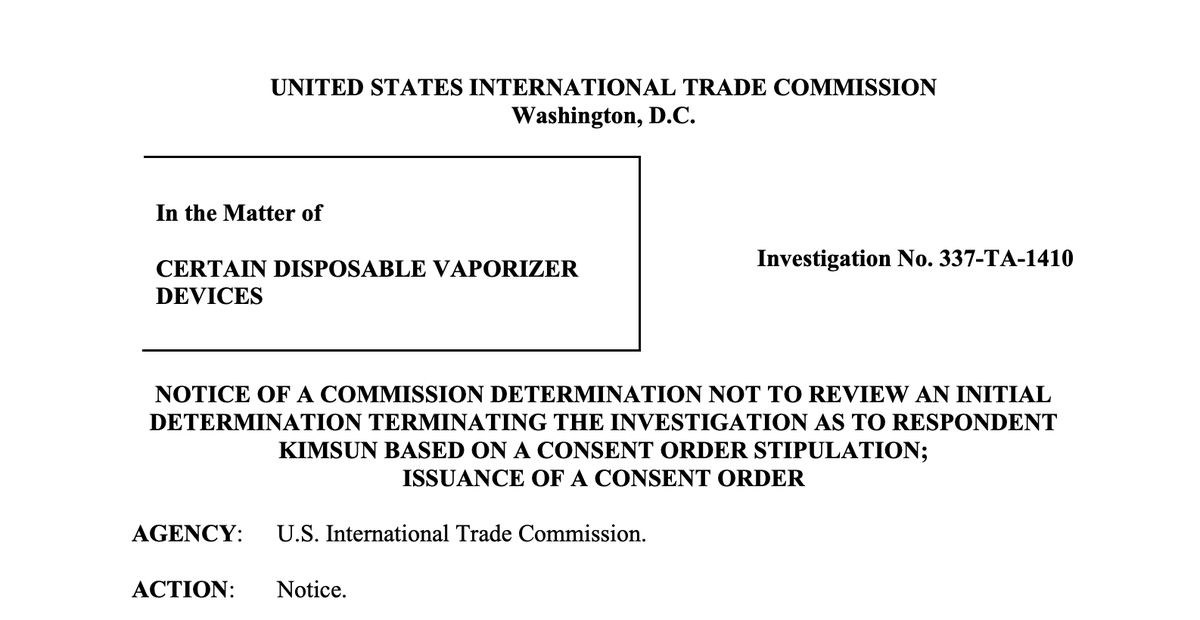
ITC terminates investigation on disposable e-cigarette devices, issuing settlement order to Kimsun in 337 case.

On September 23, according to the latest announcement by the U.S. International Trade Commission (ITC), in the 337 investigation case regarding certain disposable e-cigarette devices, the commission decided not to review the initial determination of the Administrative Law Judge (ALJ). This means that based on a mutually agreed settlement agreement, the investigation into Kimsun Technology (HuiZhou) Co., Ltd. has been terminated.


The investigation case number is 337-TA-1410, which began on July 22, 2024, brought by the plaintiffs RAI Strategic Holdings, Inc., R.J. Reynolds Vapor Company, R.J. Reynolds Tobacco Company, RAI Services Company, collectively known as the plaintiffs. They accused 35 companies, including Kimsun, of violating Section 337 of the Tariff Act of 1930. The plaintiffs claim that these companies have imported, sold, and/or sold after importation disposable e-cigarette devices and their components in the United States, infringing on their patents.


On August 16, 2024, Kimsun applied to terminate the investigation against it based on a consent order. On August 22, the Office of Unfair Import Investigations (OUII) supported the motion, with no opposition from other parties. On August 28, the Administrative Law Judge (ALJ) issued a preliminary ruling to terminate the investigation against Kimsun, stating that the consent order complied with ITC rules 210.21(c)(3) and (4), and that the termination of the investigation would not be against the public interest.


ITC decided not to review the ruling in the vote on September 23 and issued a consent order to Kimsun. This marks the end of the legal dispute for Kimsun in the 337 investigation case.


We welcome news tips, article submissions, interview requests, or comments on this piece.

Please contact us at info@2firsts.com, or reach out to Alan Zhao, CEO of 2Firsts, on LinkedIn


Notice

1.  This article is intended solely for professional research purposes related to industry, technology, and policy. Any references to brands or products are made purely for objective description and do not constitute any form of endorsement, recommendation, or promotion by 2Firsts.

2.  The use of nicotine-containing products — including, but not limited to, cigarettes, e-cigarettes, nicotine pouchand heated tobacco products — carries significant health risks. Users are responsible for complying with all applicable laws and regulations in their respective jurisdictions.

3.  This article is not intended to serve as the basis for any investment decisions or financial advice. 2Firsts assumes no direct or indirect liability for any inaccuracies or errors in the content.

4.  Access to this article is strictly prohibited for individuals below the legal age in their jurisdiction.


Copyright


This article is either an original work created by 2Firsts or a reproduction from third-party sources with proper attribution. All copyrights and usage rights belong to 2Firsts or the original content provider. Unauthorized reproduction, distribution, or any other form of unauthorized use by any individual or organization is strictly prohibited. Violators will be held legally accountable.

For copyright-related inquiries, please contact: info@2firsts.com


AI Assistance Disclaimer


This article may have been enhanced using AI tools to improve translation and editorial efficiency. However, due to technical limitations, inaccuracies may occur. Readers are encouraged to refer to the cited sources for the most accurate information.

We welcome any corrections or feedback. Please contact us at: info@2firsts.com

West Virginia House passes “Vape Safety Act of 2026,” creating licensing and product directory requirements
West Virginia’s House of Delegates passed the Vape Safety Act of 2026, a proposal to tighten oversight of vape and smoke shops through licensing, fees and enforcement. The bill would establish a state directory requiring vape products sold in West Virginia to have FDA marketing authorization or a pending application under FDA review to be listed, and only directory-listed products could be sold starting Sept. 1, 2026 if enacted.
Feb.28 by 2FIRSTS.ai
South Korea to regulate synthetic-nicotine e-liquids as tobacco from April 24
South Korea’s Health Ministry says amendments to the Tobacco Business Act will take effect on April 24, bringing synthetic-nicotine e-liquid vapes under the legal definition of tobacco. The shift extends cigarette-style rules to these products, including mandatory graphic warnings, sharply limited advertising channels, stricter vending-machine placement requirements, and a ban on use in smoke-free areas, with enforcement checks slated from late April.
Feb.03 by 2FIRSTS.ai
Philip Morris and BAT’s Nicoventures Win EPO Appeal to Revoke VMR Vape Patent
The EPO Technical Board of Appeal 3.2.02 (T 1319/24) revoked VMR Products LLC’s EP3613453 “VAPORIZER” patent after finding that a 2012 YouTube video of the Innokin iTaste VV (D3) disclosed the claimed electrical contact arrangement. Opponents Nicoventures Trading Ltd (BAT subsidiary) and Philip Morris Products S.A. prevailed.
BATPMI
Feb.17
BAT’s Product Strategy Reset: A Structural Analysis of Its Post-FY2025 Competitive Architecture
Drawing on BAT’s FY2025 results and earnings call, 2Firsts finds the company shifting from category expansion to competitive entrenchment across Vapour, Modern Oral, Heated Products and Combustibles. The strategy centers on connected devices, geographic customization and portfolio tiering. While structurally coherent, financial returns depend on consistent regulatory enforcement against illicit competitors, making policy execution a key variable for 2026 performance.
Feb.12
Special Report | Middle East Military Conflict Disrupts Global Air Corridors: Europe-Bound Vape Logistics Defy Seasonal Price Declines, Fuel Cost Risks Emerge
Escalating tensions involving Iran are disrupting air transit routes heavily used for China’s vape exports to Europe, preventing the usual post–Lunar New Year freight rate decline. While Europe-bound capacity reliant on Middle East hubs faces pressure, shipments to the United States remain largely unaffected for now. However, potential jet fuel price increases could broaden cost pressures globally.
Special Report
Mar.02
Study: Links between internalizing mental health symptoms and nicotine/tobacco use vary by gender identity among U.S. adolescents
A study using 2020–2023 U.S. data from the ITC Youth Tobacco and Vaping Survey (ages 16–19) reports that both nicotine/tobacco use and internalizing mental health (IMH) symptoms vary across disaggregated gender identities, and that gender identity moderates the relationship between IMH symptoms and product use.
Feb.27 by 2FIRSTS.ai