Key Points:
·The Vape-Free Kids organization is calling for the government to remove control over tobacco and e-cigarette affairs.
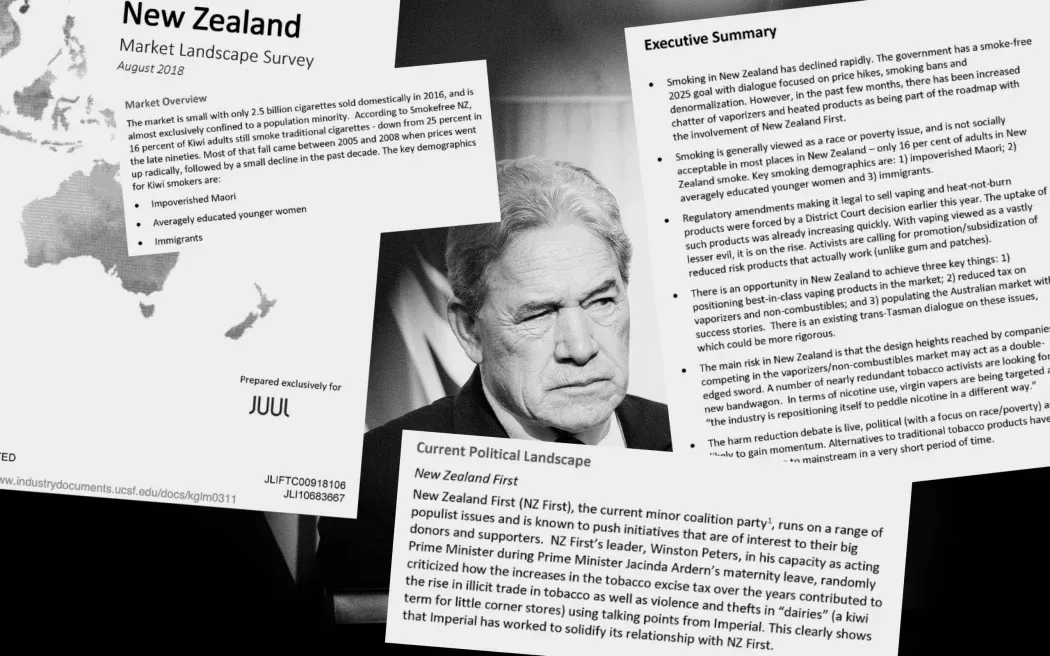
·Documents released by RNZ reveal a close relationship between Philip Morris International (PMI) and the New Zealand First party.
·PMI has proposed legislation to the New Zealand First party in an attempt to secure regulatory advantages for heated tobacco products (HTPs).
·New Zealand First party member Casey Costello has advocated for a halving of the consumption tax on HTPs, benefiting PMI.
·New Zealand First party leader Winston Peters claims that their interactions with the tobacco industry are lawful.
【2Firsts News Flash】According to a report by Radio New Zealand on July 23, an advocacy group aiming to keep children away from nicotine is calling for the New Zealand First Party to be stripped of its authority over tobacco and e-cigarette affairs.
This call comes from Vape-Free Kids organization, after Radio New Zealand (RNZ) released documents claiming a close relationship between tobacco giant Philip Morris International (PMI) and the New Zealand First Party.
“A political party with significant influence in the government appears to have a strong alliance with the tobacco industry, posing a risk to the health of New Zealanders.”
Cheryl Robinson, co-founder of Vape-Free Kids organization, said.
These documents were released as part of a lawsuit against the US e-cigarette company JUUL, alleging that Philip Morris International (PMI) presented a legislative proposal to the New Zealand ACT Party as part of their lobbying efforts for their heated tobacco products (HTPs).
The document also alleges that personnel from Philip Morris International (PMI) contacted the New Zealand First Party in an attempt to secure regulatory advantages for IQOS, a heated tobacco product that holds a monopoly in the New Zealand market.
The Bower Group Asia, which previously developed a launch plan for JUUL in New Zealand, claims that New Zealand First Party leader Winston Peters has connections with PMI.
“Any regulation he advocates for could be highly beneficial to the industry, heavily skewed towards commercial interests in that sector.”
These documents - most dated from 2018 and 2019 - provide a new perspective on the controversial policy changes led by the New Zealand First Party in the current coalition government, as well as the party's relationship with the nicotine industry.
In 2024, New Zealand First Party MP and Deputy Minister of Health Casey Costello will halve the consumption tax on HTPs, potentially resulting in a loss of 200 million New Zealand dollars (approximately 100 million USD). The Ministry of Finance has stated that this move primarily benefits Philip Morris International (PMI), the sole importer of HTPs in the country.
Despite health officials telling her that there is no strong evidence to suggest that HTPs are effective as a smoking cessation tool, or that they are much safer than cigarettes, Costello still took this course of action.
Philip Morris International (PMI) has appointed two individuals who previously held senior positions in the New Zealand First Party to senior corporate communications roles.
David Broome served as the Chief of Staff for New Zealand First Party from 2014 to 2017, and currently works as the External Affairs Manager for Philip Morris International (PMI).
Apilana Dawson, who served as the Operations and Research Director for Winston Peters' office from 2013 to 2017, leading the party's election campaigns in 2014 and 2017, has been appointed as the Director of External Affairs for the company.
The Smokefree Kids organization stated that it is time for Prime Minister Christopher Luxon to take control of tobacco and e-cigarette affairs away from the New Zealand First Party.
“He must intervene, at the very least to redistribute this authority, to show that New Zealand's public health policies are not up for sale.”
Robinson said.
But Luxon told reporters on his way to Parliament that Costello is an "excellent minister" and he is "very proud" of her record.
Radio New Zealand presented Peters with a detailed list of questions, but he did not answer any of them. Instead, he took to social media to express his pride in the New Zealand First Party's record on tobacco control.
“Since the introduction of the smoke-free policy by the New Zealand Priority Party in 2020, the smoking rate has dropped sharply, and now we are one of the two countries with the lowest smoking rates in the world. The smoke-free legislation we have implemented is proving to be effective.”
He did not respond to the allegations that the New Zealand First party received materials from Philip Morris International (PMI), but his social media posts stated that contact with the tobacco industry is legal.
As a signatory to the World Health Organization's Framework Convention on Tobacco Control (FCTC), New Zealand pledges to "protect policies from the influence of commercial and other vested interests of the tobacco industry.
The FCTC stated that,
“There is a fundamental, irreconcilable conflict between the interests of the tobacco industry and public health policy.”
The Ministry of Health stated that the FCTC requires signatories to "maintain full transparency in their interactions with the tobacco industry." Since 2011, it has been keeping records of meetings with tobacco lobbyists.
Melissa-Jade Gregan, an honorary research fellow at the University of Auckland whose doctoral thesis explored how the alcohol, food, gambling, and tobacco industries influence politics, stated that New Zealand's lobbying laws are too lenient.
Gregan extensively searched the JUUL documents housed in the Truth Tobacco Industry Documents archive created in 2002 at the University of California library in San Francisco.
The archive is still being updated and contains nearly 19 million documents, including 3.8 million documents related to JUUL.
“Through these documents, what we see is not a conspiracy, but rather how these industries operate in New Zealand. The tobacco and e-cigarette industry, alcohol, junk food - they have developed a complex, effective method of political influence, taking full advantage of our complete lack of lobbying regulations.”
She said.
Greaghan said that the reputation of New Zealand as an open and transparent government is largely a "myth".
“We have a political system where industries that cause harm to health systematically and covertly interact with decision-makers.”
The Labour Party's health spokesperson Ayesha Verrall has stated that the recent exposé by Radio New Zealand highlights why her member's bill - which aims to severely restrict the tobacco industry's influence on the government - is necessary.
“Tobacco companies have a long history globally of influencing and undermining public health policies to better suit their bottom line, and evidence of this happening in New Zealand is seen here.”
The key point of the report is that countries should avoid overly cautious approaches and direct bans, such as the requirement for a prescription to use nicotine e-cigarette products in Australia.
Essentially, the argument is not that new products should not be regulated at all, but that risks, whether direct or indirect, should be evaluated in a more balanced manner.
We welcome news tips, article submissions, interview requests, or comments on this piece.
Please contact us at info@2firsts.com, or reach out to Alan Zhao, CEO of 2Firsts, on LinkedIn
Notice
1. This article is intended solely for professional research purposes related to industry, technology, and policy. Any references to brands or products are made purely for objective description and do not constitute any form of endorsement, recommendation, or promotion by 2Firsts.
2. The use of nicotine-containing products — including, but not limited to, cigarettes, e-cigarettes, nicotine pouchand heated tobacco products — carries significant health risks. Users are responsible for complying with all applicable laws and regulations in their respective jurisdictions.
3. This article is not intended to serve as the basis for any investment decisions or financial advice. 2Firsts assumes no direct or indirect liability for any inaccuracies or errors in the content.
4. Access to this article is strictly prohibited for individuals below the legal age in their jurisdiction.
Copyright
This article is either an original work created by 2Firsts or a reproduction from third-party sources with proper attribution. All copyrights and usage rights belong to 2Firsts or the original content provider. Unauthorized reproduction, distribution, or any other form of unauthorized use by any individual or organization is strictly prohibited. Violators will be held legally accountable.
For copyright-related inquiries, please contact: info@2firsts.com
AI Assistance Disclaimer
This article may have been enhanced using AI tools to improve translation and editorial efficiency. However, due to technical limitations, inaccuracies may occur. Readers are encouraged to refer to the cited sources for the most accurate information.
We welcome any corrections or feedback. Please contact us at: info@2firsts.com