Vape Loft Sues VPR Over 'Elf' Trademark

Jun.09.2023
Vape Loft Sues VPR Over 'Elf' Trademark
Vape Loft sues VPR to cancel "Elf" trademark, claiming VPR does not have the right to it.

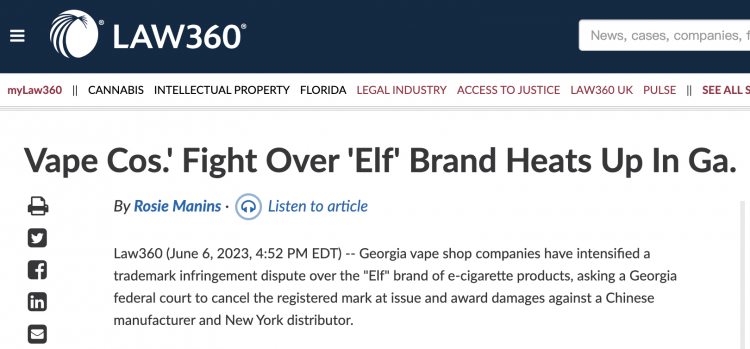
Recently, according to LAW360, Vape Loft, an electronic cigarette retailer in the state of Georgia, has filed a lawsuit in federal court seeking to revoke the "ELF" trademark of American electronic cigarette company VPR, claiming that VPR should not hold the trademark rights.


According to reports, VPR has accused Vape Loft of selling electronic cigarettes under the name "ELFBAR" that are too similar to VPR's own Elf-branded products, thus infringing on the Elf trademark. VPR claims to have been using the trademark since November 2017 and received federal registration for it in June 2018, which covers electronic cigarette lighters, electronic cigarettes, and non-smokeable cigarette vaporization tubes.


VPR has filed a lawsuit against Vape Loft for trademark infringement and unfair competition under the Lanham Act and Georgia state law. VPR is seeking unspecified damages and an injunction to prevent Vape Loft from further using the Elf brand in its electronic cigarette products.


Vape Loft has stated that VPR did not conform to the requirements of the Family Smoking Prevention and Tobacco Control Act and related regulations when applying for or obtaining pre-market approval (PMTA) from the US Food and Drug Administration (FDA). Vape Loft claims that VPR did not create the Elf brand associated with its electronic cigarette products, nor did it have the right to register the trademark when applying for it.


Vape Loft denies any wrongdoing and argues that VPR cannot determine if the Elf trademark has priority over those held by Vape Loft.


Vape Loft also stated that they have over $30,000 worth of disposable products in their inventory, manufactured by Shenzhen Aiqijie or its licensees and distributed by Demand Vape. They claim that these products are very popular among their customers and generate a monthly revenue of $50,000.


VPR informed Law360 that the defense and accusations of Vape Loft were not new to them, as these accusations were previously filed by Demand Vape in a Florida court and were already dismissed by the court.


VPR reports that the Florida court has temporarily suspended the injunction during the appeals period.


Reference:


The legal battle between two vape companies over the use of the brand name "Elf" is intensifying in Georgia.


Disclaimer

This article is provided solely for professional research, industry discussion, and informational purposes. Any references to brands, companies, products, technologies, or policies are made for factual reporting and analytical purposes only, and do not constitute endorsement, recommendation, promotion, or advertising by 2Firsts.

Nicotine-containing products, including but not limited to cigarettes, e-cigarettes, heated tobacco products, and nicotine pouches, carry significant health risks. Readers are responsible for complying with all applicable laws and regulations in their respective jurisdictions, including age restrictions and access limitations.

The information contained in this article should not be regarded as investment, legal, medical, regulatory, or commercial advice. While 2Firsts strives to ensure the accuracy and reliability of its content, it does not assume liability for any direct or indirect loss arising from errors, omissions, inaccuracies, or reliance on the information contained herein.

This article is not intended for individuals below the legal age for accessing tobacco or nicotine-related information in their jurisdiction.


Copyright Notice

This article is either original content produced by 2Firsts or content reproduced, translated, summarized, or adapted from third-party sources with attribution where applicable. The intellectual property rights of the original content remain with 2Firsts or the respective original rights holders.

No individual or organization may copy, reproduce, distribute, republish, modify, translate, or otherwise use this content without prior authorization. Any unauthorized use may result in legal action.

For copyright-related inquiries, corrections, or removal requests, please contact: info@2firsts.com.


AI-Assisted Translation and Editing Notice

Portions of this article may have been translated, edited, or reviewed with the assistance of artificial intelligence tools to improve efficiency and readability. Due to the limitations of AI-assisted translation and editing, discrepancies, omissions, or inaccuracies may exist when compared with the original source.

Where applicable, readers are advised to refer to the original source for the most complete and accurate information. If you identify any errors or believe that any content infringes upon your rights, please contact us at info@2firsts.com, and we will review and address the matter promptly.


Hunan China Tobacco Industry files heated tobacco device patent featuring adult-user identification through pressure sensing
China-based Hunan China Tobacco Industry Co., Ltd. and Shenzhen Baisha Technology Co., Ltd. have filed a patent application covering an adult-user identification mechanism for heated tobacco devices. The patent proposes using flexible pressure sensors installed in the device grip area to collect pressure distribution patterns generated when users hold the device. The system evaluates factors including effective contact area, grip shape and contact duration, and combines roller movement detection to determine whether unlocking conditions are met. The filing reflects exploration of device-level user recognition and smarter interaction technologies for heated tobacco products (HTPs).
Aug.05
Arizona Turns to a 50% Retail Vape Tax as Tobacco Tax Revenue Falls 47% From 2008
Arizona's First Things First is pushing for an excise tax equal to 50% of the retail price of vaping products, estimating that the measure could generate about $100 million annually. The agency says its tobacco-tax revenue has fallen 47% from 2008 levels. Arizona has attempted to broaden its nicotine tax base in each of the past two years: a 2025 bill proposed a 50% wholesale-price tax, while a 2026 measure shifted to a 50% retail-price tax covering alternative nicotine products and vapor products. Separately, the state enacted HB 4001 this year to establish a new licensing and sales framework for alternative nicotine products.
Sep.21
FDA Authorizes JUUL2, Cites Adult Switching Amid Efforts to Speed PMTA Reviews
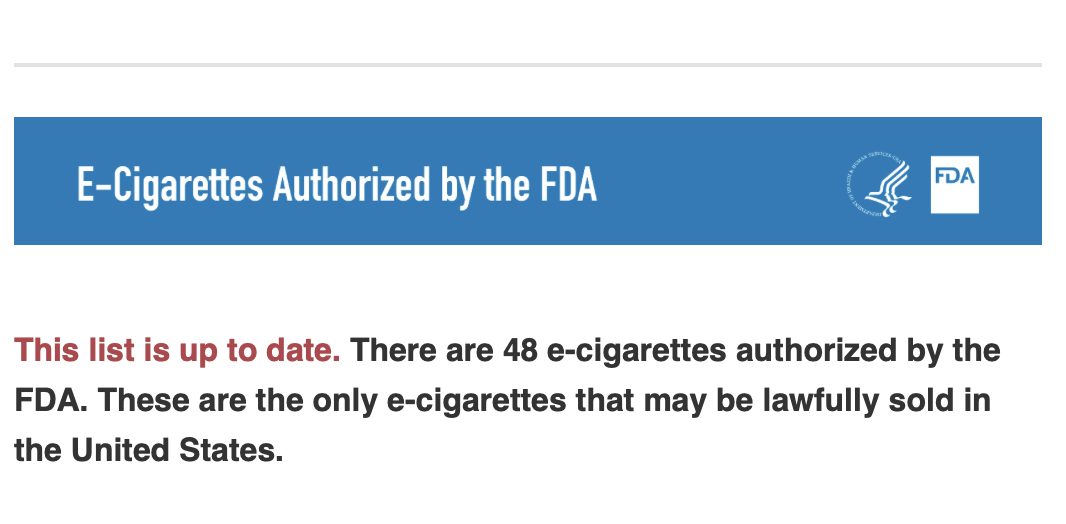
The FDA authorized the JUUL2 device and tobacco- and menthol-flavored pods on Aug. 28, bringing the number of authorized e-cigarette products to 48. The agency highlighted complete switching among adult smokers, with six-week switching rates reaching 28.4%–49.3% for the menthol pod. The decision comes as FDA works to speed PMTA reviews, reduce application backlogs and expand authorized e-cigarette and nicotine-pouch products while maintaining enforcement priorities for unauthorized products.
Regulations
Aug.29
STIIIZY Redesign Fails to Escape PAX Labs Patent Import Ban as Section 337 Case Also Involves China ALD
U.S. Customs and Border Protection ruled that STIIIZY had not shown that the redesigned cannabis-vape products covered by its latest request fall outside an ITC limited exclusion order tied to PAX Labs patents. CBP accepted some of STIIIZY’s claim-construction and non-infringement arguments, but the company did not address two additional claims in the same patent. Earlier STIIIZY redesigned cartridges and certain associated components imported with them had received separate CBP clearance.
Sep.16
As FDA Reshapes PMTA Reviews and ENDS Enforcement Priorities, CTP Acting Director Bret Koplow to Keynote NATO Event for a Retail Network of 66,000-Plus Stores
Bret Koplow, acting director of the U.S. Food and Drug Administration's Center for Tobacco Products, will deliver a keynote and participate in a fireside chat at the National Association of Tobacco Outlets' Sept. 29-30 conference in Washington. His appearance comes months after the FDA moved to accelerate PMTA reviews and introduced a more differentiated enforcement policy for certain unauthorized ENDS and oral nicotine pouch products. The agency also plans a public list identifying manufacturers and products it does not currently intend to prioritize for enforcement under the May guidance. NATO says its membership includes more than 66,000 retail stores, making product-status transparency and enforcement boundaries directly relevant to the retail sector.
Aug.14
From Nicotine Salts to Cocrystals: China’s Shenzhen Huabao institute explores a more stable form for sustained nicotine release
China-based Shenzhen Huabao Collaborative Innovation Technology Research Institute Co., Ltd. has filed a patent application for a nicotine-ascorbic acid cocrystal, exploring a new solid-state form of nicotine. The patent proposes applications across e-liquids, heated tobacco sticks, oral tobacco, chewing tobacco and snuff. In nicotine pouch tests disclosed in the filing, cocrystal formulations showed less than a 6% decline in nicotine content after three months of accelerated storage and a release profile combining early-stage release with sustained delivery over 60 minutes. The filing reflects exploration of nicotine forms beyond conventional nicotine base and nicotine salts.
Aug.13