West Virginia Residents Search for Vapes the Most: Study

Sep.20.2022
West Virginia Residents Search for Vapes the Most: Study
West Virginia residents are searching for e-cigarettes at an increased frequency, according to recent Google Trends data.

According to a recent study utilizing Google Trends data, residents of West Virginia are conducting a high volume of searches for electronic cigarettes.


According to ProVape research, West Virginia has the highest number of searches for keywords related to vaping among its population. These search terms include "vape shop," "vape," "vaping," and "vapes," among others. West Virginia searched for the terms "vape" and "vaping" more than any other state.


Each state has a ranking score ranging from 6 to 117, with lower scores indicating a greater affinity for e-cigarettes. While the exact methodology for assigning scores has not been disclosed, West Virginia has received the lowest score to date with a score of 6. The state in second place received a score of 23. The ranking indicates that West Virginia is significantly ahead of its competitors in terms of e-cigarette usage.


According to the ranking, closely following is the states of Wyoming, Kentucky, and Hawaii. The states least enamored with electronic cigarettes are California, New York, and Maryland.


It's important to note that the Google Trends data doesn't necessarily indicate how many people in West Virginia are using e-cigarettes, but rather how many people are searching for information related to them. While these numbers themselves are not affected, it should also be noted that the study was conducted by an e-cigarette retailer which included pro-nicotine statements in their published materials.


Over the past few years, there has been ongoing controversy regarding whether e-cigarettes are a good alternative to smoking. In the past month, e-cigarette manufacturer Juul has agreed to pay a $440 million settlement for marketing its high-nicotine e-cigarette products, which have long been accused of fueling the nationwide surge in teen e-cigarette use.


Statement:


This article is compiled from third-party information and is intended for industry communication and learning purposes only.


This article does not represent the views of 2FIRSTS, and 2FIRSTS cannot confirm the authenticity or accuracy of the article content. The translation of this article is only intended for communication and research within the industry.


Due to limitations in the level of translation, the compiled article may not express the original text accurately. Please refer to the original text for accuracy.


2FIRSTS maintains complete alignment with the Chinese government on any domestic, Hong Kong, Macau, Taiwan, and foreign-related statements and positions.


The copyright of the compiled information belongs to the original media and author. If there is any infringement, please contact us for removal.


Disclaimer

This article is provided solely for professional research, industry discussion, and informational purposes. Any references to brands, companies, products, technologies, or policies are made for factual reporting and analytical purposes only, and do not constitute endorsement, recommendation, promotion, or advertising by 2Firsts.

Nicotine-containing products, including but not limited to cigarettes, e-cigarettes, heated tobacco products, and nicotine pouches, carry significant health risks. Readers are responsible for complying with all applicable laws and regulations in their respective jurisdictions, including age restrictions and access limitations.

The information contained in this article should not be regarded as investment, legal, medical, regulatory, or commercial advice. While 2Firsts strives to ensure the accuracy and reliability of its content, it does not assume liability for any direct or indirect loss arising from errors, omissions, inaccuracies, or reliance on the information contained herein.

This article is not intended for individuals below the legal age for accessing tobacco or nicotine-related information in their jurisdiction.


Copyright Notice

This article is either original content produced by 2Firsts or content reproduced, translated, summarized, or adapted from third-party sources with attribution where applicable. The intellectual property rights of the original content remain with 2Firsts or the respective original rights holders.

No individual or organization may copy, reproduce, distribute, republish, modify, translate, or otherwise use this content without prior authorization. Any unauthorized use may result in legal action.

For copyright-related inquiries, corrections, or removal requests, please contact: info@2firsts.com.


AI-Assisted Translation and Editing Notice

Portions of this article may have been translated, edited, or reviewed with the assistance of artificial intelligence tools to improve efficiency and readability. Due to the limitations of AI-assisted translation and editing, discrepancies, omissions, or inaccuracies may exist when compared with the original source.

Where applicable, readers are advised to refer to the original source for the most complete and accurate information. If you identify any errors or believe that any content infringes upon your rights, please contact us at info@2firsts.com, and we will review and address the matter promptly.


How Large Is France’s Off-Channel Tobacco Market? Logista Says It Has Become Structural, While the Official Estimate Is 17.7% and Some Industry Studies Put It Above 50%
Logista France says tobacco consumption outside France’s official tobacconist network has become a large and structural market phenomenon, but official and industry estimates differ sharply. France’s TAFE study estimates that 17.7% of tobacco consumption escaped domestic taxation in 2023, with most of that volume attributed to cross-border purchasing rather than street sales. Some industry studies use broader off-channel definitions and put the figure above 50%. Meanwhile, French Customs seized 547.94 tonnes of tobacco in 2025, up 12%, showing continued pressure from illicit trade.
Sep.04
2Firsts First Look|China to End VAT Export Rebates on Vape Devices and Nicotine in April 2027, Following Earlier Removal for HTP Devices and Nicotine Vapes
China's Ministry of Finance and State Taxation Administration announced on October 12, 2026, that value-added tax (VAT) export rebates for vape devices, nicotine and its salts, and certain non-combustible inhalation products will be eliminated from April 1, 2027. The measure adds four tobacco- and nicotine-related customs codes, including 8543400010, which covers vape devices and qualifying empty pods. China previously eliminated rebates for nicotine-containing vaping products and devices under code 8543400090 in April 2026. According to industry classification information held by 2Firsts, the latter currently corresponds to heated tobacco devices. Export excise tax refund and exemption arrangements will remain unchanged.
Special Report
Oct.12
Kumulus Vape2026 H1 Revenue Falls 8.3% but Profit Rises 24% as B2B Weakens and Consumer Channels Grow
French vaping company Kumulus Vape reported first-half 2026 revenue of €25.5 million, down 8.3% year over year, as its core B2B distribution business fell 11% to €21.6 million. B2C and store-network revenue rose 5.6% and 17.8%, respectively. Commercial margin increased to 26.3% from 21.7%, while net profit rose 24.1% to €0.8 million. The company attributed the profitability improvement to catalog optimization, logistics restructuring and the ramp-up of Labster, its in-house production unit for proprietary brands.
Market
Sep.17 by 2Firsts Perspectives
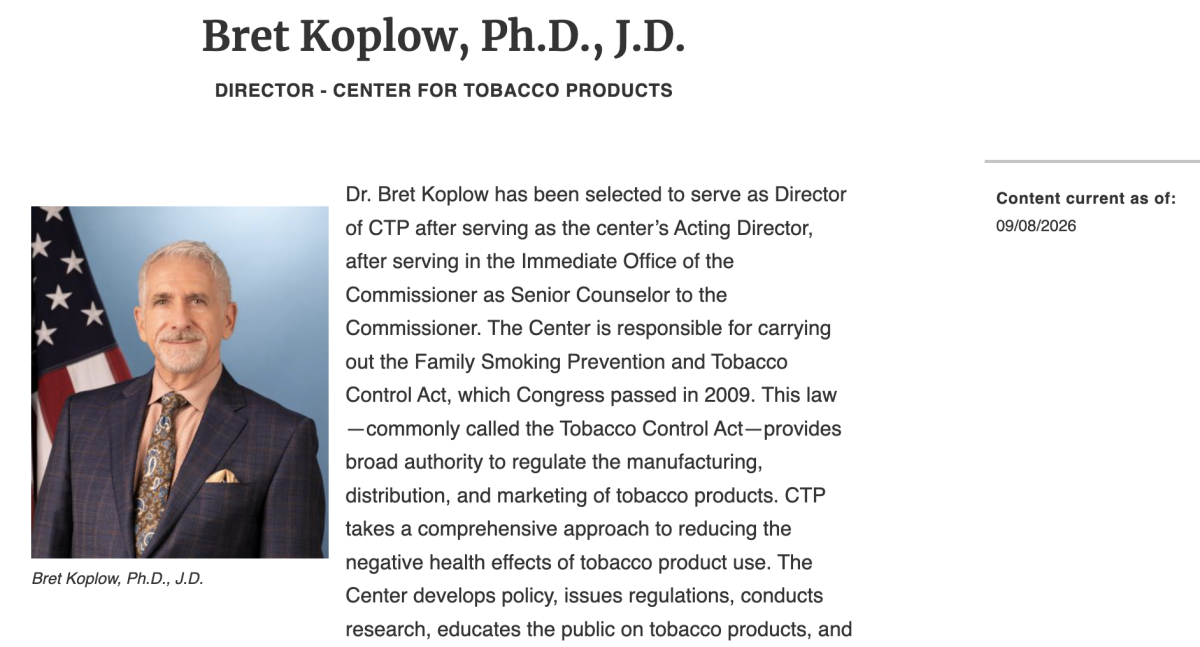
Bret Koplow Takes Permanent Charge of FDA Tobacco Center After Pushing Faster PMTA Reviews, as HHS Emphasizes Innovation and Access to Lower-Risk Alternatives
The U.S. Department of Health and Human Services has named Bret Koplow permanent director of the FDA’s Center for Tobacco Products, ending his period as acting chief. Koplow has spent years working on tobacco regulation, law and policy inside the FDA and, while serving as acting director, pushed for faster PMTA reviews and nicotine pouch review pilots. HHS also said CTP will prioritize innovation and access to less harmful alternatives for adult smokers while continuing efforts to protect youth.
Sep.09
Global Nicotine-Pouch E-Commerce Group Haypp Shuts Sweden’s Snusnetto Over Age Verification as Identity Checks Become Industry Infrastructure for New Nicotine Products
Sweden's Supreme Administrative Court has declined to hear an appeal over age verification for tobacco and nicotine products collected from parcel lockers, leaving in place a lower-court ruling that geo-located BankID verification is insufficient to securely verify the actual recipient. Haypp Group has stopped tobacco and nicotine sales through Snusnetto and is deploying a new system across its other Swedish e-commerce sites to verify the age of the person who actually opens the locker and receives the shipment. The change comes as age verification across next-generation nicotine products expands from purchase checks into retail, delivery and, for some e-cigarettes, device access itself.
Regulations
Oct.20
NAS 2026 | Cliff Douglas: Risk Continuum Should Play a Central Role in Tobacco Policy
Cliff Douglas, a veteran U.S. tobacco-control and public health policy figure, told NAS 2026 that the “continuum of risk” should play a central role in tobacco policy. He called for clearer market pathways, stronger risk communication, differentiated regulation and enforcement, and said possible FDA reforms to PMTA reviews could be a “welcome correction” if they create a more efficient, predictable route for scientifically substantiated lower-risk products. Read 2Firsts’ on-site coverage.
Sep.26