Key Points
· Independent brands face the toughest enforcement pressure.
Recent federal raids have disproportionately affected U.S.-made vape companies with pending PMTA applications, including Naked 100, 5 Pawns, and Air Factory.
· Only 39 products have FDA marketing authorization.
Nearly all are owned by Big Tobacco, leaving small and independent brands in regulatory limbo.
· Innovation is driving market growth.
New “non-nicotine blends” such as Nixodine and Metatine are gaining traction, offering a nicotine-like experience without nicotine content.
· Compliance has become the currency of market access.
Distributors now act as “gatekeepers,” only accepting brands that can provide full PMTA and testing documentation.
· For Chinese manufacturers, compliance comes first.
Boughner advises: “Lead with compliance, not price”—emphasizing transparency, traceability, and partnerships with U.S.-based teams.
2Firsts, October 21, 2025-- Since the second half of 2024, the U.S. Food and Drug Administration (FDA) has intensified enforcement actions against unauthorized e-cigarette products.
Lawmakers, federal and state officials, and major international tobacco companies have all joined the debate—calling not only for tougher crackdowns on illegal vapes but also for improvements to the PMTA (Premarket Tobacco Application) review process.
These combined forces are fundamentally reshaping the structure and dynamics of the U.S. vaping market.
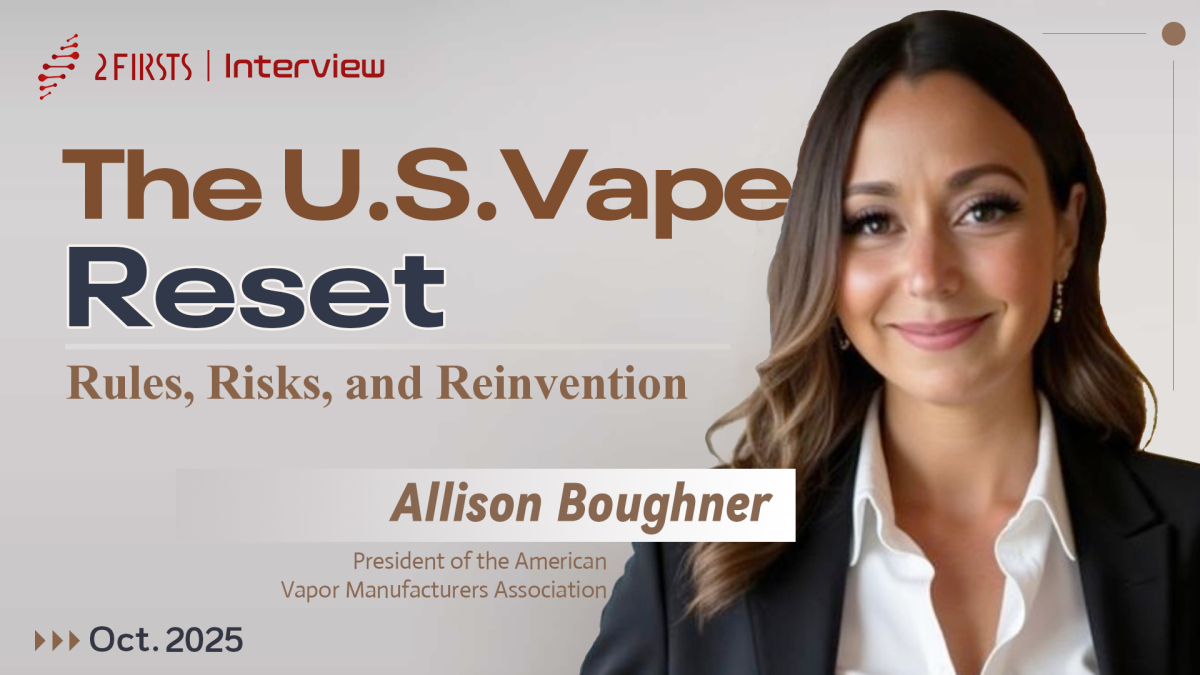
To understand how the industry is evolving under this “regulatory storm,” 2Firsts interviewed Allison Boughner, President of the American Vapor Manufacturers Association (AVM) and a long-time advocate for tobacco harm reduction.
2Firsts spoke with Boughner about multiple aspects of the U.S. market—including brands, products, distribution, compliance, and manufacturing.
Boughner noted that over the past year, the U.S. vaping industry has undergone unprecedented turbulence.
From stricter enforcement and distribution reshuffles to the growing localization of manufacturing, the entire sector is in the midst of profound transformation.
“Compliance has become the key threshold for survival, while innovation-driven brands are finding ways to grow in the gaps,” she said.
According to Boughner, the U.S. market is shifting from disorderly expansion toward a compliance-first phase, as distributors and retailers redefine their roles. Meanwhile, domestic manufacturing and nicotine-alternative products are emerging as new growth drivers.
Independent Brands Hit Hardest by Enforcement
“The hardest hit,” Boughner said, “have been independent U.S. brands—companies that tried to play by the rules and filed their PMTAs.”
“Many of them woke up to find their inventory seized or blocked from state registries,” she added. “They’ve been transparent and compliant from day one, yet suddenly pushed into a gray zone of uncertainty.”
In her September 15, 2025 blog post on Mi-Pod Wholesale, titled “FDA Spins China Narrative as It Seizes U.S.-Made Vapes with Pending Applications,” Boughner wrote that recent joint enforcement actions led by the U.S. Department of Justice (DOJ) and former Florida Attorney General Pam Bondi exemplify this trend.
According to her article, federal authorities seized approximately 4.7 million e-cigarette devices valued at $86.5 million at the Port of Chicago—marking the largest such confiscation in U.S. history. Officials claimed the shipments originated from China, but the reality, she noted, was the opposite: about 90 percent of the seized products were U.S.-made open-system e-liquids, primarily from California-based companies with pending PMTA applications, including Naked 100, 5 Pawns, Air Factory, Cuttwood, and Coastal Clouds.
“These were not rogue manufacturers,” Boughner wrote. “They followed the FDA’s application process but, after waiting three to five years without decisions, they found their compliant inventory confiscated—proving that compliance alone is no safeguard.”
At the same time, state registries have been tightening entry requirements. Some states now allow only PMTA-MGO’d products to be sold—of which there are just 39 nationwide, all owned by Big Tobacco except JUUL.
Innovation-Driven Brands Are Rising
Despite tougher regulation, Boughner believes the market remains dynamic.
“The fastest growth is coming from innovation-driven companies—especially those using non-nicotine blends like Nixodine or Metatine,” she said.
The “non-nicotine blends” mentioned by Boughner—such as Nixodine and Metatine—represent nicotine-alternative technologies that have recently emerged in the U.S. market.
According to the Public Health Law Center (2024), Nixodine is described as a compound derived from vitamin B3 (nicotinamide) designed to mimic some of nicotine’s physiological effects without containing tobacco or nicotine.
Metatine (also known as 6-methyl nicotine) was reported by The Lancet (2024) as a new synthetic nicotine analogue, structurally similar but chemically distinct from nicotine, and has already appeared in some disposable vape products.
Boughner cited Fifty Bar and Lost Mary as examples of this rising segment.

“These brands are gaining traction because they offer the same satisfaction and performance without the stigma or restrictions tied to nicotine,” she said.
These companies also feature sleek designs, high-consistency coils, adult branding, and adult-forward flavor profiles, helping them stand out in a highly competitive market.
Distribution Landscape Reshaped: Compliance-Focused Distributors on the Rise
Enforcement has brought significant disruption to the distribution network.
“Many distributors lost entire warehouses of product overnight,” Boughner said. “Retailers are confused and scared—they don’t know what’s legal or what’s next.”
Those who acted quickly to implement compliance systems have turned challenge into opportunity.
“They require PMTA acceptance letters, batch records, and clean labeling, earning retailers’ trust and gaining market share,” she explained.
Most industry stakeholders agree that enforcement is necessary, but they want it to be fair, consistent, and science-based.
Boughner pointed out that small U.S. businesses often become the main targets, while counterfeit imports face far less scrutiny—an imbalance that has stirred frustration across the sector.
U.S. Manufacturing Grows, but China Remains Indispensable
Boughner observed that U.S.-based production is gaining momentum.
“E-liquid producers are expanding capacity, and some disposable brands are now doing final fill or packaging in the U.S. to avoid import barriers and strengthen quality control,” she said.
However, challenges remain—particularly dependence on Chinese components.
“The batteries, chips, and coils are still mostly made in China,” she said.
While the U.S. is unlikely to replace China in hardware manufacturing in the short term, its share of e-liquid, filling, packaging, and alt-nic products is steadily increasing.
Compliance Becomes the Currency of Market Access
“In today’s market, compliance is not just a regulatory requirement—it’s a business necessity,” Boughner said.
“Distributors have become the gatekeepers. They won’t even take on a brand unless it can show PMTA acceptance letters, certificates of analysis, and full label transparency.”
Distributors are also training retailers, updating signage, and reinforcing age verification.
“Compliance and market access are basically the same thing now,” Boughner said. “The brands that treat compliance as a core strategy, not an afterthought, are the ones surviving and expanding.”
Advice for Chinese Manufacturers: Lead with Compliance and Build Trust
When asked about advice for Chinese vape companies entering the U.S. market, Boughner emphasized: “Lead with compliance, not price.”
“Come with documentation, adult branding, and traceability,” she advised, “and invest in U.S. partnerships for filling, distribution, and marketing.”
“The U.S. market rewards transparency and responsibility,” Boughner said. “If you can prove you’re here to build trust—and not just push volume—retailers will open their doors to you.”
For ongoing coverage of developments in the U.S. vaping market, stay tuned to 2Firsts.
Read more: