Arizona Moves to Tighten Vape Supply-Chain Enforcement, Targeting Illicit Products

Jan.30
Arizona Moves to Tighten Vape Supply-Chain Enforcement, Targeting Illicit Products
Arizona state Sen. Shawnna Bolick introduced SB 1397 to curb illicit vapes by tracing product origins, intercepting illegal shipments, and cracking down on retailers that violate state law. The proposal would require manufacturers to hold a state license to sell in Arizona, with fines up to $10,000 for unlicensed sales.

Key Points


• SB 1397 is framed as an anti-smuggling measure aimed at illicit vapes and transnational supply networks

• The bill would strengthen state authority to trace origins, seize illegal shipments, and shut down violative retailers

• Interstate wholesalers would need to provide documentation to the Arizona Department of Revenue, or face seizure/destruction of products

• Manufacturers would need a state license; unlicensed sales could trigger fines up to $10,000

• Design limits would bar products resembling cartoons/toys/video games/smartphones; vapes would be prohibited on school property and events

• The report references broader federal seizures and a 2024 study suggesting a large share of the U.S. vape market may be illicit


2Firsts, Jan. 30, 2026


According to The Center Square, Arizona state Sen. Shawnna Bolick introduced Senate Bill 1397, describing it as an “anti-smuggling” measure aimed at illicit vaping products. Bolick said transnational organizations are involved in bringing illegal vapes into the United States, with links spanning Mexico, China and Russia. She added that illicit vapes are being smuggled through ports of entry, and claimed that nearly all of these products come from China and are labeled “not for sale in China.”


SB 1397 would authorize state agencies to trace the origin of vape products, intercept illegal shipments, and take action against retailers that violate Arizona law. 


The proposal would require interstate vape wholesalers to present proper documentation to the Arizona Department of Revenue; failure to do so could result in products being confiscated and destroyed. It would also require vape manufacturers to obtain a state license to sell in Arizona, with penalties of up to $10,000 for unlicensed manufacturers caught selling in the state.


The bill also targets youth appeal and access. It would prevent vape products from resembling cartoons, toys, video games, or smartphones, and would prohibit vape products on school grounds, school buses, and at school events. 


Bolick said the intent is not to eliminate all vape products, but to close loopholes that allow illegal products—often marketed toward youth—to spread through increasingly sophisticated channels.


The report cites support from Border Security Alliance Vice President Justin Harris, who said Arizona law enforcement needs the ability to “close the vape loophole” and stop the smuggling of illegal Chinese vape products into America. 


It also references a 2024 study indicating a large share of the U.S. vape market may be illicit, alongside recent federal seizures of illegal vape products across multiple states, including Arizona.


Image source: CDC / Unsplash


We welcome news tips, article submissions, interview requests, or comments on this piece.

Please contact us at info@2firsts.com, or reach out to Alan Zhao, CEO of 2Firsts, on LinkedIn


Notice

1.  This article is intended solely for professional research purposes related to industry, technology, and policy. Any references to brands or products are made purely for objective description and do not constitute any form of endorsement, recommendation, or promotion by 2Firsts.

2.  The use of nicotine-containing products — including, but not limited to, cigarettes, e-cigarettes, nicotine pouchand heated tobacco products — carries significant health risks. Users are responsible for complying with all applicable laws and regulations in their respective jurisdictions.

3.  This article is not intended to serve as the basis for any investment decisions or financial advice. 2Firsts assumes no direct or indirect liability for any inaccuracies or errors in the content.

4.  Access to this article is strictly prohibited for individuals below the legal age in their jurisdiction.


Copyright


This article is either an original work created by 2Firsts or a reproduction from third-party sources with proper attribution. All copyrights and usage rights belong to 2Firsts or the original content provider. Unauthorized reproduction, distribution, or any other form of unauthorized use by any individual or organization is strictly prohibited. Violators will be held legally accountable.

For copyright-related inquiries, please contact: info@2firsts.com


AI Assistance Disclaimer


This article may have been enhanced using AI tools to improve translation and editorial efficiency. However, due to technical limitations, inaccuracies may occur. Readers are encouraged to refer to the cited sources for the most accurate information.

We welcome any corrections or feedback. Please contact us at: info@2firsts.com

Japan Survey Finds 49.5% Would Cut Tobacco Use if Prices Rise, 64.6% Show Interest in Nicotine-Free Alternatives
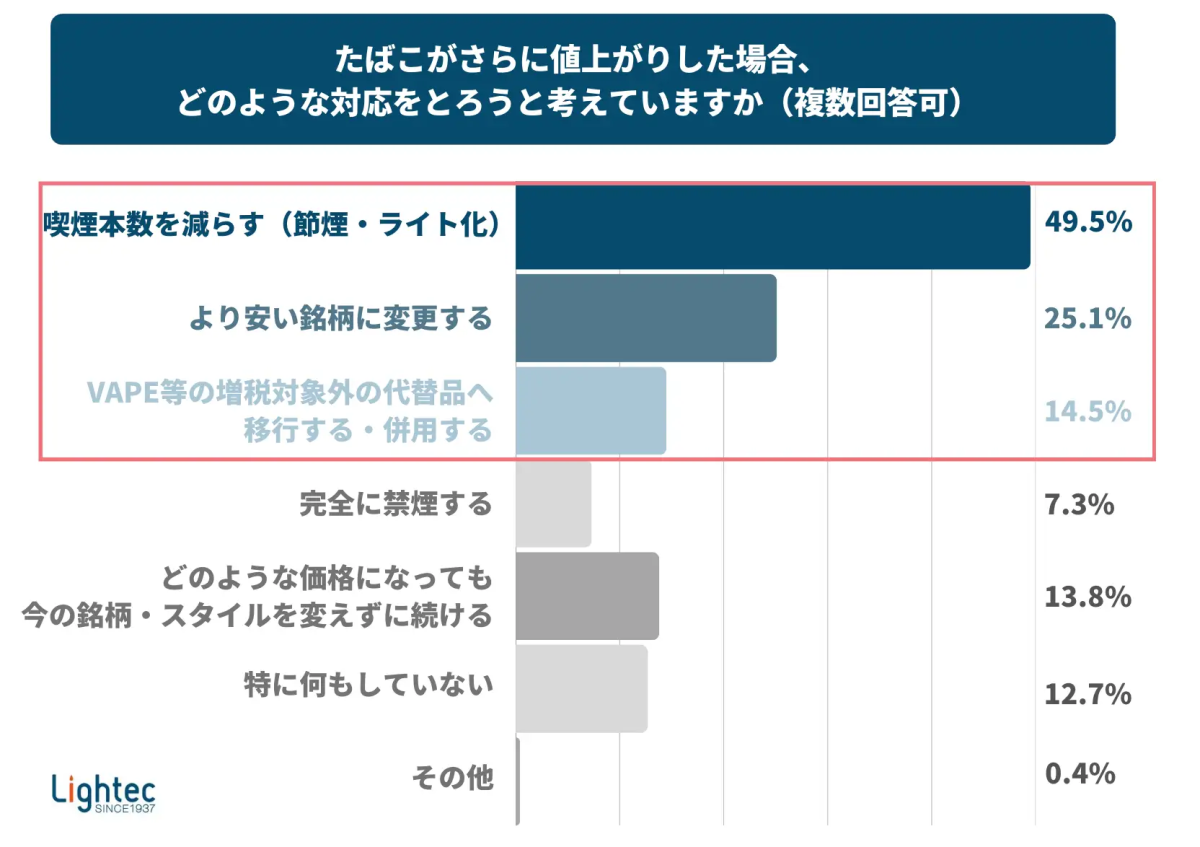
A September online survey commissioned by Japanese smoking-accessories company Lightec found that 49.5% of respondents would consider reducing tobacco use if prices rose further, while 25.1% would consider switching to cheaper brands and 14.5% would consider using or combining alternatives such as vapes and nicotine-free herbal sticks. Another 64.6% expressed some level of interest in such alternatives. The survey covered 1,088 respondents aged 20 to 70 and was conducted by a company that sells NICOLESS nicotine-free vaping and herbal-stick products, meaning its findings should not be treated as representative of Japan's smoking population.
DATA
Oct.12
JUUL Purchasers Ask Ninth Circuit to Preserve Antitrust Classes in Case Over Altria’s $12.8 Billion Investment
Private antitrust litigation stemming from Altria's 2018 $12.8 billion investment for a 35% economic interest in JUUL is advancing before the U.S. Court of Appeals for the Ninth Circuit. Direct purchasers, indirect purchasers and indirect resellers of JUUL products filed answering briefs this week seeking to preserve class certifications granted by a California federal court in February. Altria and JUUL argue that individual consumers and large distributors differ too much in purchasing terms to remain in a single direct-purchaser class, while a separate dispute concerns whether California antitrust law can apply to indirect purchasers across 27 jurisdictions. A September trial has been put on hold during the appeal.
Sep.23
Product | SnowPlus Launches Nicotine-Free DASH in South Korea, Localising an Established Disposable Platform
SnowPlus has introduced a nicotine-free version of DASH in South Korea, adapting an existing overseas disposable platform for the local market. The Korean version retains the series’ flat duckbill-style mouthpiece, ceramic heating architecture and disposable form factor while reducing nicotine content to 0%. By comparison, the overseas DASH 4000 platform typically features 7.5ml of prefilled e-liquid, up to 4,000 puffs and a 530mAh rechargeable battery, with nicotine-containing variants available in some markets. The product update centers on formulation localisation rather than a new hardware generation.
Aug.31
Product | KIWI Launches Spark 2 and Spark 2 Pro in Germany, Two Hardware Tiers Share Backward-Compatible 2ml Pods
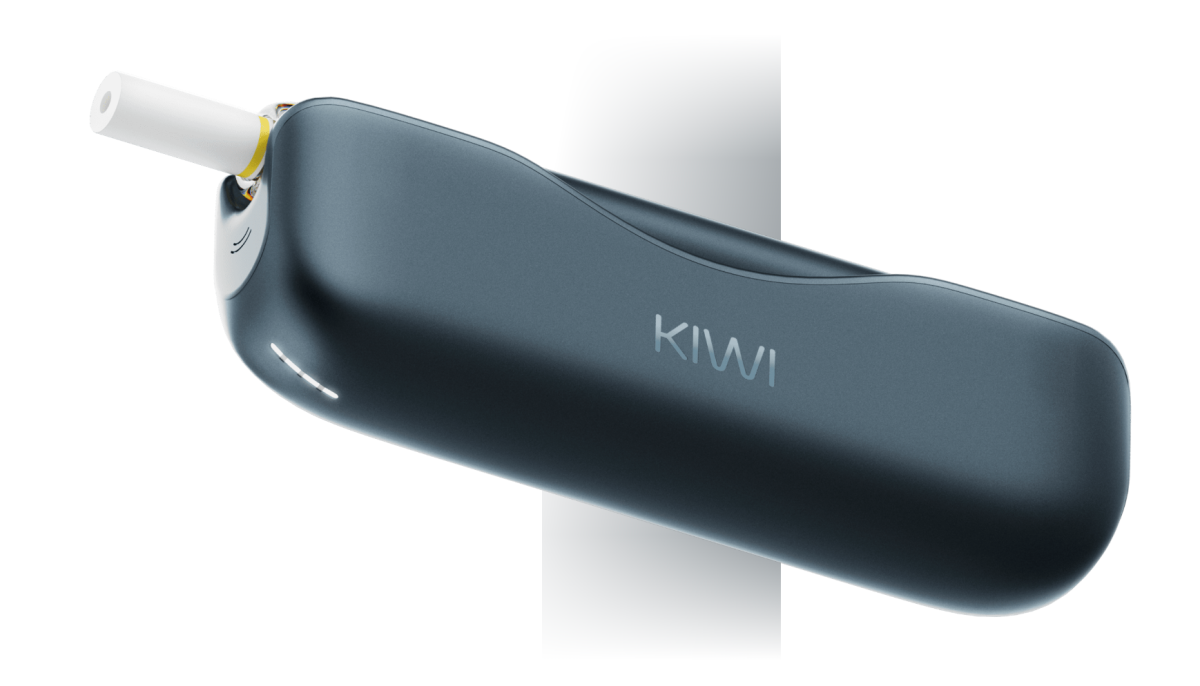
KIWI has launched the Spark 2 and Spark 2 Pro refillable pod systems in Germany at official prices of €18 and €29, respectively. Spark 2 uses an 800mAh removable lithium-ion battery in a pen-style body, while Spark 2 Pro features a 1,400mAh removable battery, a box-shaped design and vibration feedback every 20 puffs. Both devices use the same 2ml Spark V2 pods in 0.8Ω and 1.2Ω versions, with AirSync airflow adjustment and a choice between Cotton Tips and conventional Drip Tips. The new pods also remain compatible with the original KIWI Spark.
News
Sep.29 by 2Firsts Perspectives
Arizona Turns to a 50% Retail Vape Tax as Tobacco Tax Revenue Falls 47% From 2008
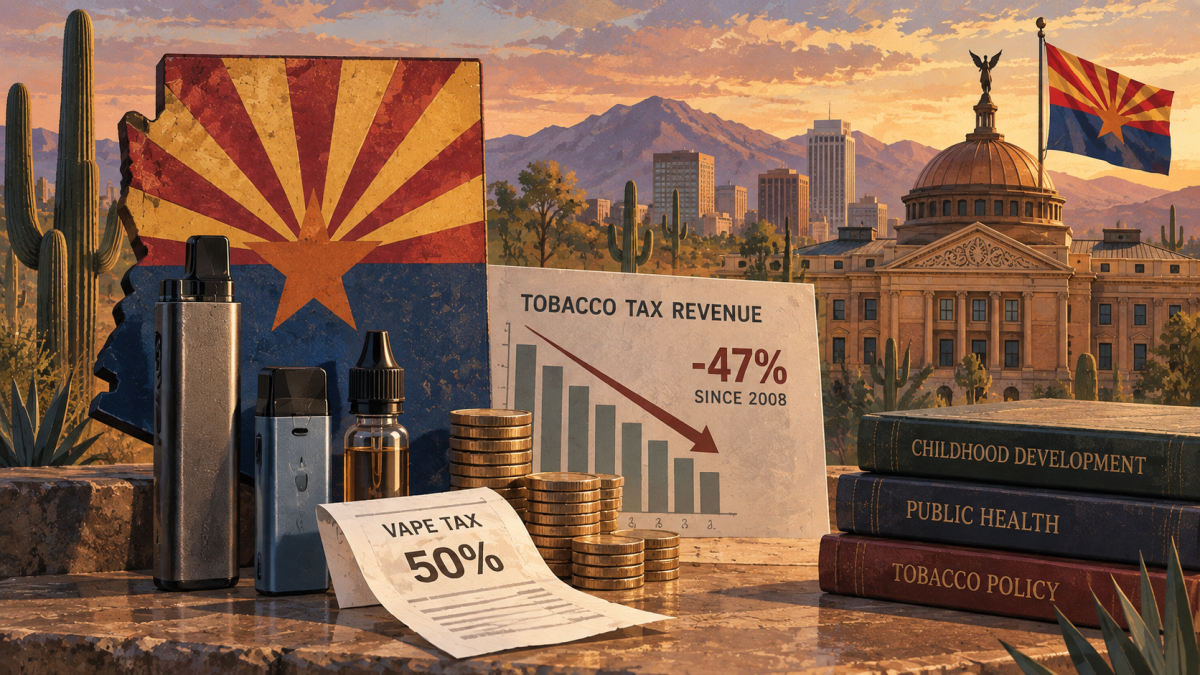
Arizona's First Things First is pushing for an excise tax equal to 50% of the retail price of vaping products, estimating that the measure could generate about $100 million annually. The agency says its tobacco-tax revenue has fallen 47% from 2008 levels. Arizona has attempted to broaden its nicotine tax base in each of the past two years: a 2025 bill proposed a 50% wholesale-price tax, while a 2026 measure shifted to a 50% retail-price tax covering alternative nicotine products and vapor products. Separately, the state enacted HB 4001 this year to establish a new licensing and sales framework for alternative nicotine products.
Sep.21
Australia Adds 6-Methylnicotine to Schedule 9 Prohibited Substances, Effective October 1
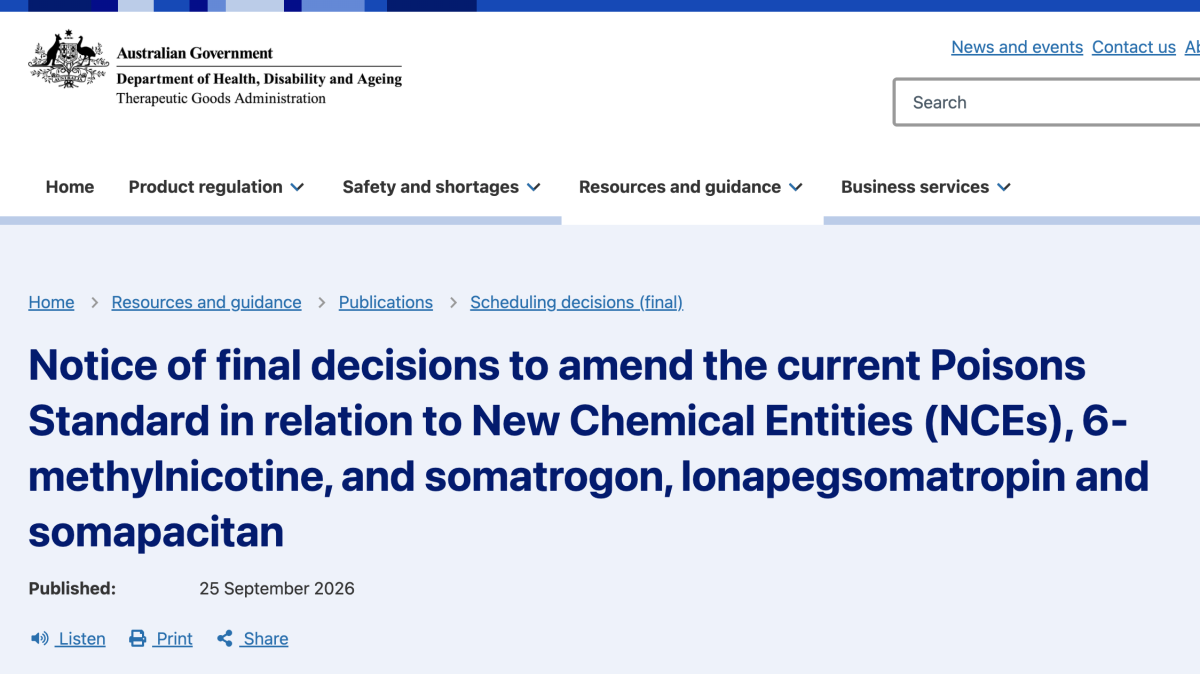
Australia's Therapeutic Goods Administration published a final decision on September 25 to classify 6-methylnicotine as a Schedule 9 prohibited substance under the Poisons Standard, effective October 1, 2026. TGA said the chemical has been reported in e-cigarette liquids sold in Australia and marketed as nicotine-free or nicotine alternatives, while evidence also indicates its use in preparations such as oral pouches. The government originally proposed a Schedule 7 classification but ultimately adopted the stricter Schedule 9 designation, citing acute toxicity, dependence risk, use in unapproved consumer products and misleading marketing.
News
Sep.29 by 2Firsts Perspectives