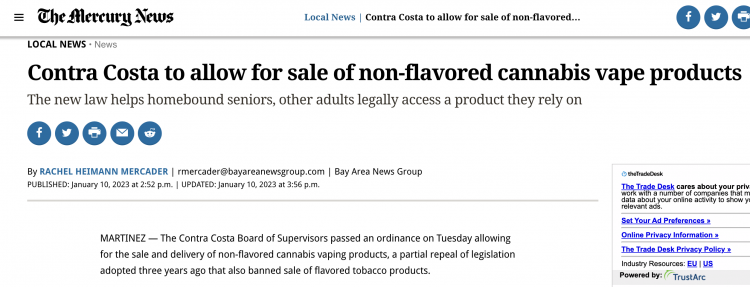
On Tuesday, Contra Costa County Board of Supervisors in California approved an ordinance allowing the sale and delivery of flavorless cannabis e-cigarette products and repealed a portion of legislation passed three years ago that also banned the sale of flavored tobacco products.
A new law has been introduced with the goal of ensuring that older adults and other adults, especially those who rely on marijuana for medical reasons, have access to marijuana vaping products. The regulation was proposed by supervisor Diane Burgis and allows licensed marijuana retailers in non-permitted areas to sell and deliver products.
The regulation was passed with a vote of 3-2, with federal supervisors Glover and Candace Anderson casting dissenting votes.
During the first reading of the bill on December 6, 2022, Burgis stated that the motivation behind the revised legislation was that the 2019 law harmed older adults and other adults who rely on electronic marijuana products for recreational and medical purposes. She said that it particularly affected elderly people in non-legal areas.
We are trying to provide a pathway for people to access safe products by developing policies in Contra Costa County," said Burgis.
At the December meeting, both Glover and Anderson voted against the regulation, stating that it would send mixed messages to the public and betray the efforts of the young leaders in the Contrecoeur community who had initially called for the ban.
Glover stated, "It is clear that we took the lead in 2019 when some students from our county approached us, requesting the implementation of this ban by the leadership team." "And I will not refuse this point. I believe that it is important to listen to the voices of our youth when they call out and seek help.
Glover stated that there is no evidence to suggest that "e-cigarettes won't pose any problems to individuals" and that lifting the ban partially would send the public "false or confusing messages that it's okay to do so while also saying that we want to prevent it.
On Tuesday, a group advocating for access to marijuana told the board of supervisors that the ban on marijuana e-cigarette products has created an illegal black market for the product and disproportionately affects vulnerable groups that rely on marijuana for medical purposes.
Renee Lee, a resident of the Rossmoor retirement community, runs an organization whose mission is to assist seniors in obtaining and safely using cannabis legally. According to her, most users of medicinal marijuana in the Walnut Creek vicinity prefer e-cigarettes despite its illegal status.
I am pleased," said Li after Tuesday's vote. "It feels like a weight has been lifted off my shoulders...this law is extremely unfair.
Sarah Armstrong from American for Safe Access, the largest and oldest medical marijuana advocacy group in the United States, stated that mandating people to carry medical marijuana "usually stimulates the black market because if there are no dispensaries nearby, they cannot access the nearest one.
Armstrong told the managers, "The black market is filled with both high-efficiency products and contaminated products. Any action taken to promote the black market can harm patients, law enforcement agencies, and many other people who must make choices.
Before the vote, Burgess emphasized that the legislation did not change the current ban on tobacco and flavored tobacco electronic cigarette products, nor did it allow for the opening of new pharmacies in non-legal areas.
This does allow for the sale of a particular set of marijuana products that have been sold in many cities in Contra Costa County and are available for purchase in almost all other areas of the state that have approved retail marijuana," she said.
When passing the legislation, the board also instructed Contra Costa Health Services to launch a campaign on the dangers of teenage marijuana use. John Gioia, the executive in charge, stated that creating such a program was a major factor in his decision to support the new law.
Disclaimer
This article is provided solely for professional research, industry discussion, and informational purposes. Any references to brands, companies, products, technologies, or policies are made for factual reporting and analytical purposes only, and do not constitute endorsement, recommendation, promotion, or advertising by 2Firsts.
Nicotine-containing products, including but not limited to cigarettes, e-cigarettes, heated tobacco products, and nicotine pouches, carry significant health risks. Readers are responsible for complying with all applicable laws and regulations in their respective jurisdictions, including age restrictions and access limitations.
The information contained in this article should not be regarded as investment, legal, medical, regulatory, or commercial advice. While 2Firsts strives to ensure the accuracy and reliability of its content, it does not assume liability for any direct or indirect loss arising from errors, omissions, inaccuracies, or reliance on the information contained herein.
This article is not intended for individuals below the legal age for accessing tobacco or nicotine-related information in their jurisdiction.
Copyright Notice
This article is either original content produced by 2Firsts or content reproduced, translated, summarized, or adapted from third-party sources with attribution where applicable. The intellectual property rights of the original content remain with 2Firsts or the respective original rights holders.
No individual or organization may copy, reproduce, distribute, republish, modify, translate, or otherwise use this content without prior authorization. Any unauthorized use may result in legal action.
For copyright-related inquiries, corrections, or removal requests, please contact: info@2firsts.com.
AI-Assisted Translation and Editing Notice
Portions of this article may have been translated, edited, or reviewed with the assistance of artificial intelligence tools to improve efficiency and readability. Due to the limitations of AI-assisted translation and editing, discrepancies, omissions, or inaccuracies may exist when compared with the original source.
Where applicable, readers are advised to refer to the original source for the most complete and accurate information. If you identify any errors or believe that any content infringes upon your rights, please contact us at info@2firsts.com, and we will review and address the matter promptly.