Key Takeaways
- U.S. District Judge William H. Orrick certified a class of direct purchasers of Juul products in California federal court
- The court cited “common, predominant questions” and a strong inference of classwide impact; direct purchasers may opt out
- Plaintiffs challenge Altria’s 2018 $12.8 billion investment for a 35% stake in Juul, alleging it induced Altria to exit the e-cigarette market and raised prices
- FTC previously challenged the deal but dropped its case in 2023 after Altria fully unwound its Juul investment
- Direct purchaser class covers those buying Juul products directly from Oct. 5, 2018, to the present
- Indirect purchaser and reseller classes were also certified; indirect plaintiffs from four states were excluded
2Firsts, March 2 2026
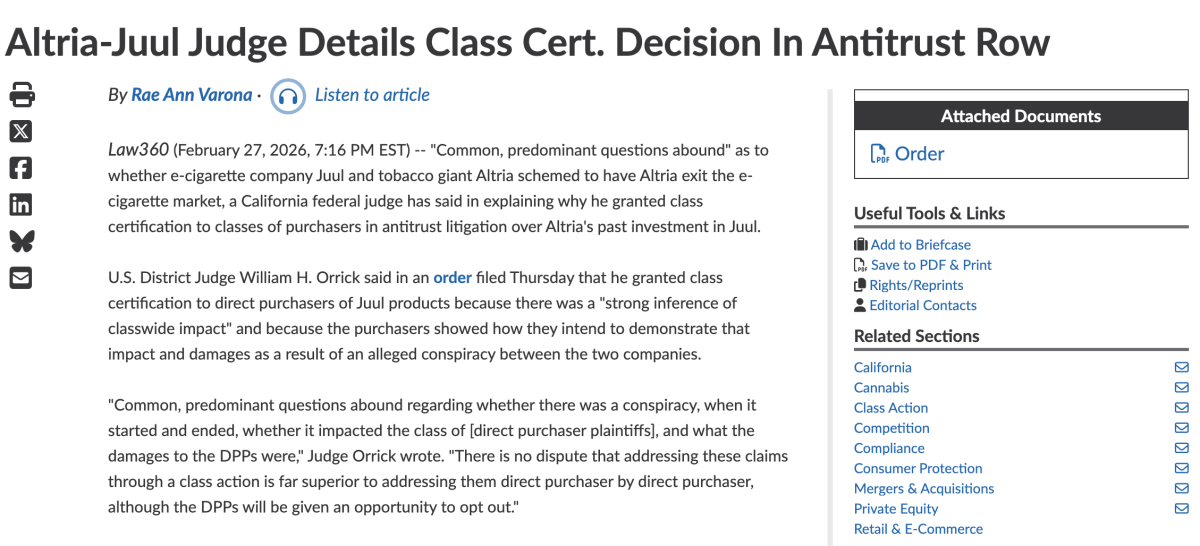
According to Law360, U.S. District Judge William H. Orrick said “common, predominant questions abound” as to whether e-cigarette company Juul and tobacco company Altria schemed to have Altria exit the e-cigarette market. In a Thursday order, he explained he granted class certification to direct purchasers of Juul products, citing a strong inference of classwide impact and the purchasers’ plan for proving impact and damages from the alleged conspiracy.
Judge Orrick wrote that common questions predominate regarding whether a conspiracy existed, when it began and ended, whether it impacted the direct purchaser class, and the resulting damages.
He said resolving the claims through a class action is far superior to doing so purchaser by purchaser, while providing an opportunity to opt out.
The antitrust litigation centers on Altria’s 2018 investment in Juul — a $12.8 billion deal for a 35% stake — which plaintiffs allege induced Altria to exit the e-cigarette market by shuttering its Nu Mark division.
The suit names Altria, Juul and two Juul board members, alleging reduced product variety and higher prices. The Federal Trade Commission also challenged the agreement but dropped its case in 2023 after Altria fully unwound its investment in Juul.
The direct purchaser class covers wholesalers and others who purchased e-cigarette products directly from Juul between Oct. 5, 2018, and the present. Judge Orrick rejected defendants’ arguments that the named purchasers were atypical because class members negotiated separate purchasing contracts involving pricing, rebates and advertising/resale arrangements. He said the named purchasers have claims typical across the class based on alleged overcharges and are adequately incentivized to pursue them.
He also said an imperfect understanding of the class does not undermine adequacy so long as representatives have a basic understanding of the claims and their responsibilities.
The order references prior certification of classes of direct and indirect purchasers and indirect resellers. The indirect purchaser classes cover purchases of Juul pods (excluding devices or kits containing devices) indirectly for personal use between Oct. 25, 2018, and March 29, 2024, while the indirect reseller classes cover those who purchased Juul pods indirectly for resale between Dec. 1, 2018, and March 31, 2025.
Indirect plaintiffs from Arkansas, South Carolina, Tennessee and Virginia were excluded on the basis that those states do not allow class actions for the antitrust claims at issue.
Image source: Law360
We welcome news tips, article submissions, interview requests, or comments on this piece.
Please contact us at info@2firsts.com, or reach out to Alan Zhao, CEO of 2Firsts, on LinkedIn
Notice
1. This article is intended solely for professional research purposes related to industry, technology, and policy. Any references to brands or products are made purely for objective description and do not constitute any form of endorsement, recommendation, or promotion by 2Firsts.
2. The use of nicotine-containing products — including, but not limited to, cigarettes, e-cigarettes, nicotine pouchand heated tobacco products — carries significant health risks. Users are responsible for complying with all applicable laws and regulations in their respective jurisdictions.
3. This article is not intended to serve as the basis for any investment decisions or financial advice. 2Firsts assumes no direct or indirect liability for any inaccuracies or errors in the content.
4. Access to this article is strictly prohibited for individuals below the legal age in their jurisdiction.
Copyright
This article is either an original work created by 2Firsts or a reproduction from third-party sources with proper attribution. All copyrights and usage rights belong to 2Firsts or the original content provider. Unauthorized reproduction, distribution, or any other form of unauthorized use by any individual or organization is strictly prohibited. Violators will be held legally accountable.
For copyright-related inquiries, please contact: info@2firsts.com
AI Assistance Disclaimer
This article may have been enhanced using AI tools to improve translation and editorial efficiency. However, due to technical limitations, inaccuracies may occur. Readers are encouraged to refer to the cited sources for the most accurate information.
We welcome any corrections or feedback. Please contact us at: info@2firsts.com