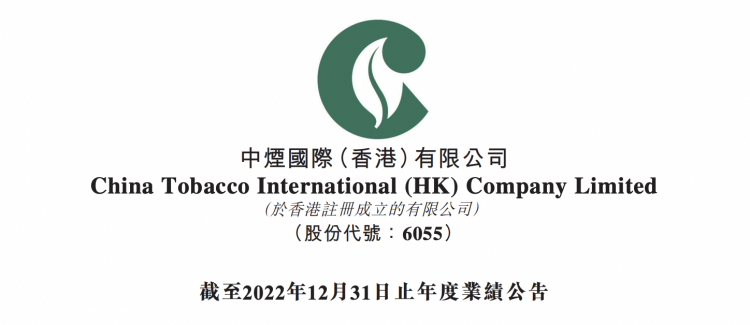
On March 9th, China Tobacco International HK Co. Ltd. released its annual report for the 2022 fiscal year on the Hong Kong stock exchange. According to the report, the company's net profit in 2022 decreased by 46.66% compared to the previous year. However, its new tobacco business saw a 10% increase in sales, and the company's operations in Brazil saw impressive growth.
China Tobacco Hong Kong reported a total operating income of HKD 8.324 billion (approximately RMB 7.3 billion) for the fiscal year 2022, showing a year-on-year growth of 3.23%. However, the net profit attributable to the parent company was HKD 375 million (approximately RMB 330 million), marking a significant decline of 46.66% from the previous year. The basic earnings per share were HKD 0.54.
China Tobacco Hong Kong has explained that the decline in performance is mainly due to weak sales in local cigarette markets in Southeast Asia, caused by increased tobacco taxes and the impact of the pandemic, as well as a weakened demand for tobacco leaves from customers. Additionally, there has been a reduction in suitable tobacco resources available for exportation from China.
Image source: Hong Kong Stock Exchange.
CNTC Hong Kong's new tobacco product exports increased by 47,620 thousand units YoY, accounting for a growth rate of 10%, with total export quantities being 502,390 thousand units. Revenue also increased by HKD 86 million (approximately CNY 75.3 million), resulting in a total revenue of HKD 110 million (approximately CNY 96.33 million), reflecting an 8% increase YoY. However, gross profit decreased by HKD 3.2 million (approximately CNY 2.8 million), representing an 8% decline YoY.
China Tobacco Hong Kong has attributed the growth in sales and revenue of its new tobacco products to its expansion into new markets such as the Middle East, Western Europe, and Eastern Europe. The company has also increased efforts to upgrade its products in response to changing market demands. However, the decrease in profit margin is due to increased investment in marketing resources aimed at gaining more market share.
It is worth mentioning that according to China National Tobacco Corporation Hong Kong's 2022 annual report, its business in Brazil has also grown significantly. Its non-wholly owned subsidiary, CBT, under China National Tobacco Corporation Brazil, exported 29,247 tons of tobacco products to regions outside of China, a year-on-year increase of 33%; revenue was 543 million yuan, a year-on-year increase of 73%; and gross profit was 123 million yuan, a year-on-year increase of 139%.
According to an announcement, China National Tobacco Corporation Hong Kong (CNTC Hong Kong) plans to seize the opportunity presented by the adjustment of China's domestic epidemic prevention policies to continue implementing a dual-wheel development model based on both outward and inward growth. The company will focus on promoting the development of new tobacco product export business and a recovery of cigarette export business.
Reference:
International Chinese cigarette company, limited (Hong Kong) has released their annual report as of December 31, 2022.
Disclaimer
This article is provided solely for professional research, industry discussion, and informational purposes. Any references to brands, companies, products, technologies, or policies are made for factual reporting and analytical purposes only, and do not constitute endorsement, recommendation, promotion, or advertising by 2Firsts.
Nicotine-containing products, including but not limited to cigarettes, e-cigarettes, heated tobacco products, and nicotine pouches, carry significant health risks. Readers are responsible for complying with all applicable laws and regulations in their respective jurisdictions, including age restrictions and access limitations.
The information contained in this article should not be regarded as investment, legal, medical, regulatory, or commercial advice. While 2Firsts strives to ensure the accuracy and reliability of its content, it does not assume liability for any direct or indirect loss arising from errors, omissions, inaccuracies, or reliance on the information contained herein.
This article is not intended for individuals below the legal age for accessing tobacco or nicotine-related information in their jurisdiction.
Copyright Notice
This article is either original content produced by 2Firsts or content reproduced, translated, summarized, or adapted from third-party sources with attribution where applicable. The intellectual property rights of the original content remain with 2Firsts or the respective original rights holders.
No individual or organization may copy, reproduce, distribute, republish, modify, translate, or otherwise use this content without prior authorization. Any unauthorized use may result in legal action.
For copyright-related inquiries, corrections, or removal requests, please contact: info@2firsts.com.
AI-Assisted Translation and Editing Notice
Portions of this article may have been translated, edited, or reviewed with the assistance of artificial intelligence tools to improve efficiency and readability. Due to the limitations of AI-assisted translation and editing, discrepancies, omissions, or inaccuracies may exist when compared with the original source.
Where applicable, readers are advised to refer to the original source for the most complete and accurate information. If you identify any errors or believe that any content infringes upon your rights, please contact us at info@2firsts.com, and we will review and address the matter promptly.